


Finding cheap flights is less about secret tricks than about timing, flexibility and comparing the real price. Fares on the same seat can swing by hundreds of dollars depending on when you book and which day you fly, while the famous “book on a Tuesday at midnight” rule makes almost no difference. This guide uses the latest Google Flights and Expedia data to show when prices tend to bottom out, where to search, which habits really pay off and which myths you can forget.
Book short and domestic flights about 3 to 8 weeks ahead (Google’s data puts the lowest average price around 39 days before departure) and long-haul international flights as soon as your plans are firm, ideally 2 to 4 months out. Fly midweek if you can, compare fares across a whole month, set a price alert, and always compare the total price with bags and seats included. Booking on a particular weekday saves only a few percent.
When is the best time to book flights?
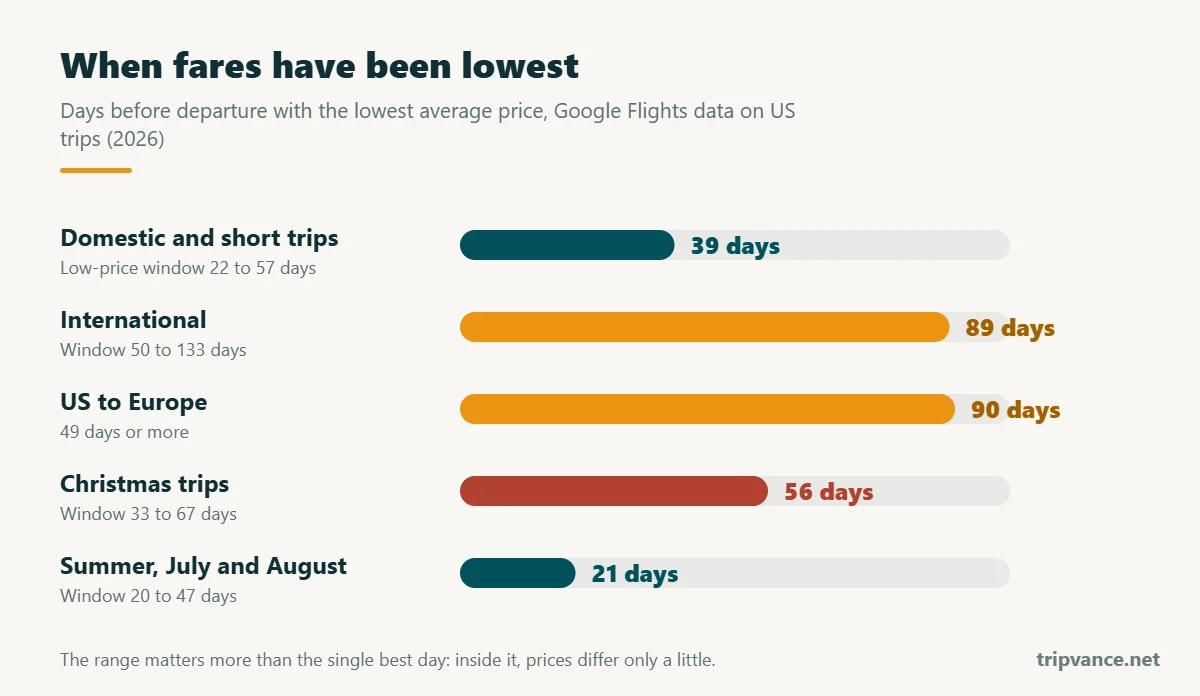
The single most useful number comes from Google, which analyses years of Google Flights prices every autumn. In its October 2026 update, based on five years of data for trips from the United States:
- Domestic flights were cheapest on average 39 days before departure, with a low-price window from 22 to 57 days.
- International flights bottomed out around 89 days before departure, but prices barely moved anywhere between 50 and 133 days out. Google’s advice: for trips abroad, book as soon as you can.
- Christmas trips were cheapest about 56 days out, summer trips in July and August about 21 days out, and trips to Mexico and the Caribbean about 43 days out.
Expedia’s 2026 Air Hacks report, built with the Airlines Reporting Corporation, points the same way with slightly different numbers: domestic economy fares were lowest when booked 15 to 30 days ahead, about $130 below fares bought six months or more in advance. For international trips, booking 31 to 45 days ahead saved an average of $190 compared with booking six months out. Both data sets agree on the two things to avoid: booking very far ahead without a reason, and leaving it to the last two weeks.
Does the day of the week matter?
A little for the day you fly, very little for the day you book. In Expedia’s 2026 data, Friday was the cheapest day to buy, but only about 3% cheaper than Sunday, the most expensive. The day of departure matters more: flying on a Friday instead of a Sunday saved around 8% on average, and on US domestic routes Tuesday departures were about 14% cheaper than Sunday ones. If your dates can move by a day or two, test them; if they cannot, do not wait for a magic weekday to click “buy”.
Where to search for cheap flights
Use a metasearch engine to find the fare, then decide where to buy it.
- Google Flights: the fastest way to see a whole month at once with the date grid and price graph, track a route and, for specific trips, see its “cheapest time to book” insight.
- Skyscanner and Kayak: useful when you are flexible on the destination (“everywhere” or map searches) and for spotting smaller online agencies.
- The airline’s own site: once you know the fare, booking direct usually makes changes, refunds and disruption easier to handle. Some carriers also sell cheaper fares only on their own site or app.
Six habits that really lower the price
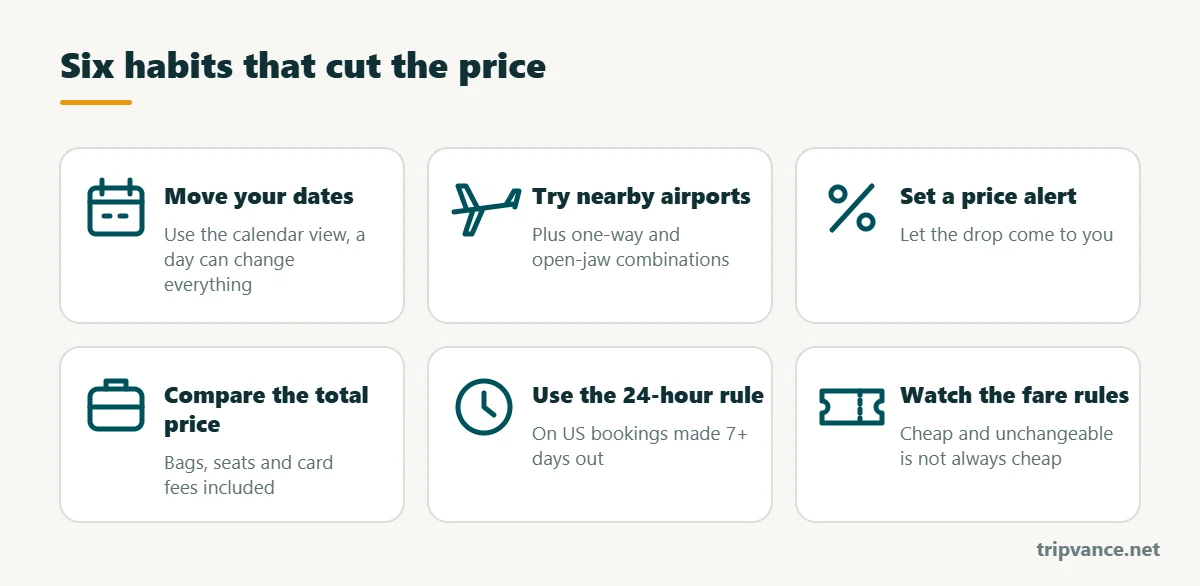
- Move your dates. Look at the whole month before fixing your trip. Shifting by one day, or avoiding the first day of school holidays, often saves more than any booking trick.
- Try nearby airports and different combinations. A second airport within reach, two one-way tickets, or an open-jaw trip (into one city, out of another) can beat a simple return.
- Set a price alert. Fares move several times a week. An alert tells you when a route drops without checking every day.
- Compare the total price. A low-cost fare plus a cabin bag, a checked bag and a seat can cost more than a full-service ticket. Check the bag rules in our guides to personal item sizes and carry-on sizes by airline.
- Use the 24-hour rule. For flights to, from or within the US booked at least a week before departure, airlines must let you hold the fare or cancel without penalty for 24 hours. Book a good fare, then keep looking for a day.
- Watch the fare rules. The cheapest fare is often non-refundable and non-changeable. If your plans are uncertain, a slightly dearer flexible fare can be the cheaper choice in the end.
Budget airlines: cheap fare, expensive extras?
Low-cost carriers can be excellent value on short routes, as long as you travel the way their price assumes. Before booking, check four things: what bag is included (often only a small item under the seat), the cost of a cabin bag or a checked bag added later at the airport, the airport itself (some are far from the city, which adds transport time and money), and check-in rules, since some airlines charge for printing a boarding pass at the desk. Add these up for every traveler before comparing with a traditional airline.
Under EU rules, airlines selling in Europe must show the final price including taxes and unavoidable charges from the start. Optional extras, like bags and seats, can still be added later, so compare at the payment step.
Flight price myths you can ignore
What you hear
- Clear your cookies or search in incognito to see lower prices
- Always book on Tuesday at midnight
- Last-minute flights are the cheapest
- Prices always drop just before departure
What the data says
- Prices change because fares and seats sell out, not because of your browser
- The booking day changes the price by only a few percent
- Fares usually rise sharply in the last two to three weeks
- For international trips, Google sees prices rise within about 50 days of departure
One shortcut to avoid: “hidden city” tickets, where you book a cheaper fare via your real destination and skip the last leg. Airlines forbid it in their conditions, you cannot check a bag, and the airline can cancel the rest of your booking.
After you book
Keep an eye on the fare during the first 24 hours if the US rule applies, and add the booking to your price tracker anyway: some airlines give you a travel credit if the price of the same fare drops. Then protect the trip itself. If your flight is delayed or cancelled, you may be owed money: see our flight delay compensation guide. For expensive non-refundable trips, compare a policy in our guide to travel insurance.
Put your booking date in your travel itinerary the day you decide on a trip, so you buy inside the low-price window instead of when you remember.
Frequently asked questions
What is the cheapest day to book a flight?
In Expedia’s 2026 data, Friday, but only about 3% cheaper than the most expensive day. The day you fly and how far ahead you book matter much more.
How far in advance should I book an international flight?
As soon as your plans are firm. Google’s 2026 data shows the lowest average fares around 89 days before departure and very stable prices between 50 and 133 days out, then rising inside 50 days.
Are flights cheaper at the last minute?
Rarely. Fares usually rise in the final two or three weeks as cheaper fare classes sell out. Last-minute deals exist mostly on routes with lots of empty seats.
Does searching in incognito mode lower prices?
There is no good evidence of it. Prices change often because fare buckets sell out and airlines update them, which can look like your searches pushed the price up.
Is it cheaper to book directly with the airline?
Not always, but it is often easier when something goes wrong. Find the fare on a search engine, then compare the airline’s own price before booking.
What is the 24-hour rule?
A US Department of Transportation rule: for bookings made at least seven days before a flight to, from or within the US, airlines must let you hold the fare without paying or cancel without penalty for 24 hours.
Last updated: November 2026. Fare data comes from studies of past prices and cannot predict a specific route. Always check the price graph for your own dates.