
Fear of flying is one of the most common travel worries, and it says nothing about how brave or rational you are. Some people fear a crash, others the feeling of being shut in, the loss of control or the bumps of turbulence. What helps most is a mix of two things: understanding what is really happening around you, and having a simple way to calm your body when the worry rises. This guide gives you both, with real safety figures, the noises explained and a guided breathing exercise you can use on board.
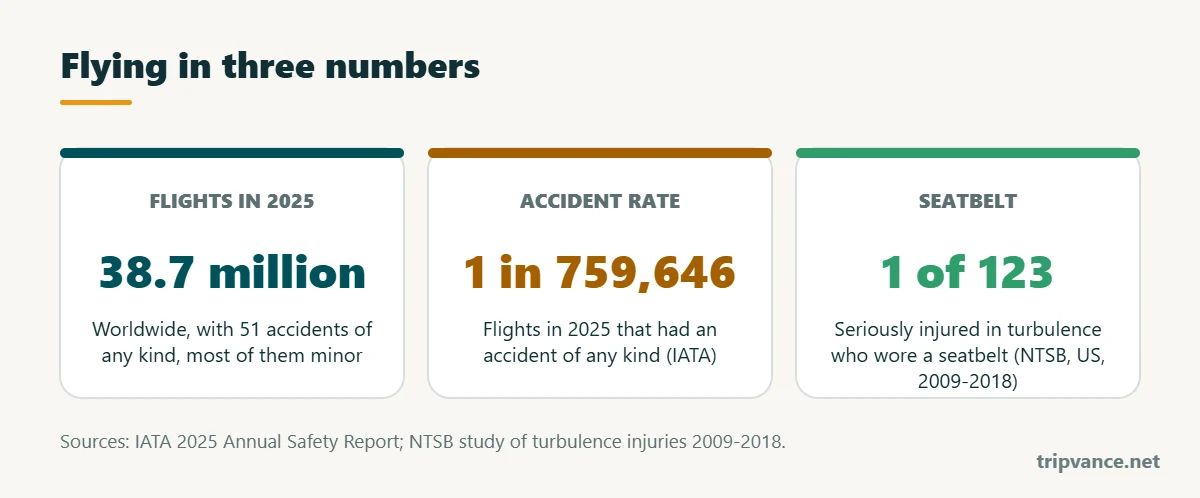
Commercial flying is extremely safe: in 2025 there was one accident of any kind per 759,646 flights, most of them minor, according to IATA. Turbulence is uncomfortable but rarely dangerous for passengers who keep their seatbelt fastened. Learn what the normal sounds mean, practise slow breathing with a longer exhale, and if fear stops you from travelling, a therapist or a fear-of-flying course can help a lot.
How safe is flying, in real numbers?
The International Air Transport Association counted 38.7 million flights worldwide in 2025 and 51 accidents. That figure includes every kind of event, from a wing tip touching a vehicle on the ground to a tail strike on takeoff, and most of them caused no injuries at all. IATA’s Director General summed it up simply: flying is the safest form of long-distance travel.
IATA also measures a “fatality risk”, which averaged 0.12 per million flights over 2021 to 2025. Put another way, someone taking one flight every day would, on average, need more than 20,000 years before being on a flight where everyone on board died. Your brain is not built to feel numbers like that, which is why rare events covered by the news feel so close. Knowing the scale does not make the fear disappear, but it gives your reasoning mind something solid to hold on to.
What turbulence is, and what it is not
Turbulence is simply moving air: currents around clouds, mountains, jet streams or the wake of other aircraft. A plane moving through it behaves like a car on a bumpy road or a boat on small waves. The drops almost always feel much bigger than they really are.
- Planes are built for it. Airliners are certified to withstand forces far greater than turbulence normally produces, and wings are designed to flex.
- Pilots plan around it. They use forecasts, weather radar and reports from other crews to change altitude or route when the ride gets rough.
- The real risk is not being strapped in. A US safety study of serious turbulence injuries from 2009 to 2018 found that of 123 people seriously hurt, only one passenger was documented as wearing a seatbelt. About four in five were flight attendants, who are often standing.
Keep your seatbelt loosely fastened whenever you are seated, even when the sign is off. If the ride gets bumpy, you are already protected, and you can let the plane do its job.
The noises and sensations explained
Much of the fear comes from sounds you do not recognise. Here is what you are most likely to hear or feel, and why it is normal.
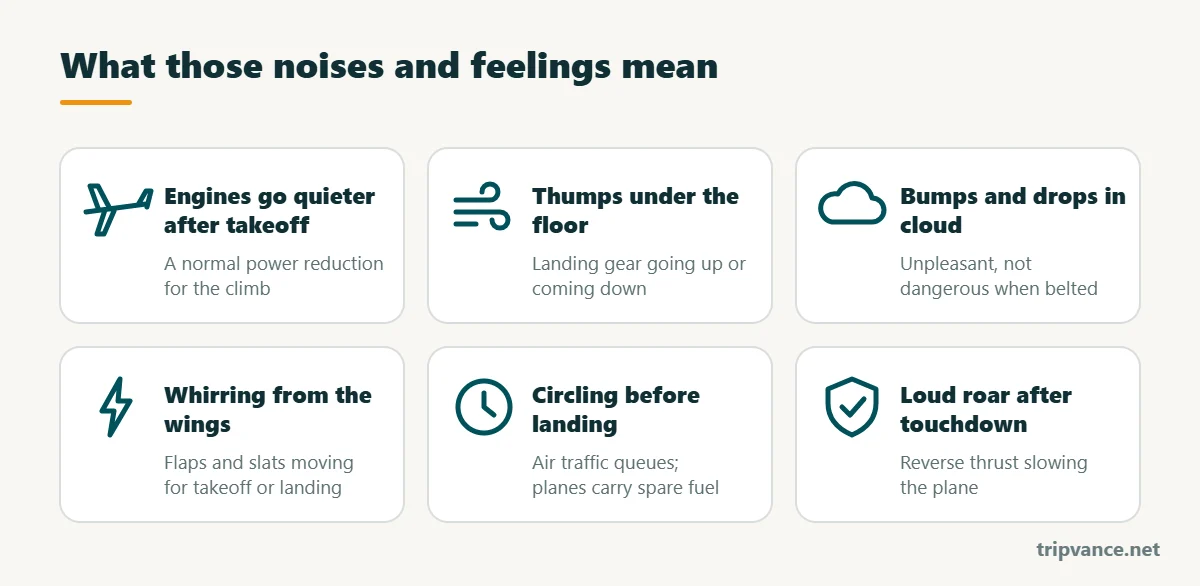
- Engine noise drops after takeoff. Pilots reduce power once the plane has climbed a little. It is planned, not a sign of failure.
- A thump or rumble under your feet. The landing gear retracting after takeoff or coming down before landing.
- Whirring or grinding from the wings. Flaps and slats moving to change the wing shape for slower flight.
- A dinging sound. Usually crew calling each other or a change in the seatbelt sign.
- Circling before landing. Air traffic control is sequencing arrivals. Airliners carry reserve fuel for exactly this.
- A loud roar after touchdown. Reverse thrust and spoilers helping the plane slow down.
A guided breathing exercise for the plane
When anxiety rises, breathing becomes fast and shallow, which feeds the feeling of panic. Slow breathing with a longer exhale is one of the quickest ways to settle your body. Try it at home first, so it feels familiar on board.
Before the flight
- Choose your seat. Seats over the wing usually feel bumps the least. An aisle seat helps if you feel shut in; a window helps if seeing the ground reassures you.
- Pick an easier flight when you can: daytime, direct and on a larger aircraft.
- Arrive with time to spare. Rushing raises stress before you even board. See how early to get to the airport.
- Go easy on coffee and alcohol. Caffeine can mimic anxiety, and alcohol often makes it worse later in the flight.
- Prepare distractions: downloaded films, music, a puzzle book or an audiobook.
- Tell the crew when you board. They meet nervous flyers every day and can explain sounds or check on you.
During the flight
- Keep your seatbelt fastened and follow crew instructions. It is your best protection and one less thing to think about.
- Watch the crew. If flight attendants are calm and working normally, everything is normal.
- Use the breathing rhythm above as soon as you feel tension, not only when it peaks.
- Ground yourself with your senses: name five things you see, four you can touch, three you hear, two you smell and one you taste.
- Think in stages. Takeoff lasts a few minutes, the cruise is usually the smoothest part, and the descent is announced in advance.
When to get extra help
If your fear keeps you from travelling, or you have panic attacks on board, you do not have to manage it alone. Cognitive behavioural therapy and gradual exposure are widely used for fear of flying, and some airlines and pilots run fear-of-flying courses that explain the aircraft and finish with a short flight. Virtual reality programmes exist too.
Some people ask their doctor about medication for a flight. Only take what a doctor has prescribed for you, try it before travel day if your doctor agrees, and never combine it with alcohol.
A long layover can be calmer than a tight connection: see how long a layover you need. If a delay adds stress, know your rights with our guide to flight delay compensation, and recover faster after a long flight with our jet lag guide.
Frequently asked questions
Is turbulence dangerous?
For a passenger with a fastened seatbelt, very rarely. Aircraft are built to handle it, and most serious injuries happen to people who are standing or not strapped in.
Which seat is best if I am afraid of flying?
Seats over the wing usually feel turbulence the least. Choose the aisle if you need space, or the window if seeing outside reassures you.
Is it normal for the wings to move?
Yes. Wings are designed to flex, which helps absorb bumps. A rigid wing would be worse.
What should I do if I panic on a plane?
Tell a flight attendant, breathe slowly with a long exhale, and focus on your senses. Panic peaks and then fades, usually within minutes.
Can pilots see turbulence coming?
Often, yes, thanks to forecasts, weather radar and reports from other aircraft. Clear-air turbulence is harder to predict, which is why the seatbelt advice matters.
Does fear of flying go away?
For many people it eases with information, practice and repeated calm flights. Therapy and dedicated courses help those for whom it stays strong.
Last updated: November 2026. This guide is general information and does not replace advice from a doctor or psychologist.