
How long of a layover do I need? The booking site has already given you an answer of sorts: if it sold you a 45 minute connection on one ticket, the airline considers it possible. Possible is not the same as comfortable. Whether 45 minutes is plenty or a recipe for a night in an airport hotel depends on passport control, checked bags, the size of the hub and, above all, whether your flights are on one booking or two.
On a single ticket, aim for about 1 hour for a domestic connection, 1.5 to 2 hours for an international one, and 2 to 3 hours when you land in the US from abroad and must clear customs. On separate tickets, allow at least 3 hours, and 5 or more if you change airports.
What minimum connection time (MCT) means
Every connection you can buy starts from a number called the minimum connection time, or MCT. IATA, the airline industry body, defines it as the shortest time officially needed at a given airport to transfer a passenger and their luggage from one flight to the next. Airlines at each airport agree the value, IATA publishes it, and booking systems use it to decide which connections they are allowed to show you.
When an airport has no specific value, IATA’s defaults apply. They give a sense of how much the type of connection matters:
Big airports set their own figures, longer or shorter, to reflect terminal changes, immigration, customs and baggage. The key point: a connection shorter than the MCT is not treated as a valid connection, so a single ticket will not be sold with less. If you see a 35 minute connection on one booking, the airlines have agreed it works on a good day.
That is the trap. MCT is a minimum for a flight that lands on time, at a gate near the next one, with no queue at transfer security. It has no buffer for a late inbound flight, a remote stand and a bus, or a 20 minute wait for a jet bridge.
How long of a layover do I need? Recommended buffers
Here is what we recommend, connection by connection. These are our practical numbers, not airline rules, and they assume one ticket unless the row says otherwise.
Add 30 to 60 minutes to any of these in winter, on holiday peaks, when the first flight is your only daily option, or when you are traveling with young children. If the second flight is the last one of the day, give yourself even more, because missing it means a night where you landed.
Connecting into the US: customs, bags and security again
This is the connection that catches most international visitors, and plenty of Americans too. The US has no international transit zone. At your first US airport, everyone goes through the full arrival process, even if the final destination is another country.
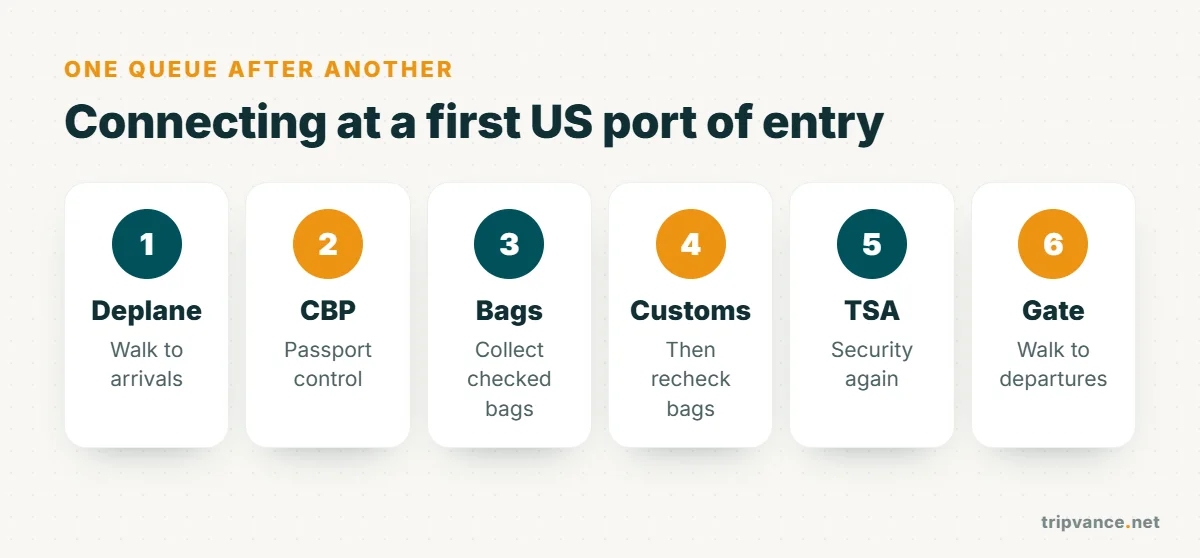
- Passport control with CBP (US Customs and Border Protection).
- Baggage claim. You collect your checked bags, even if they are tagged to your final destination. CBP’s guidance is blunt: bags not collected after your international flight will not get to your final destination.
- Customs and agriculture inspection, with the bags.
- Bag recheck at the connection counters just after customs.
- TSA security screening again, with the usual liquid limits, so duty-free bottles over 100 ml in your carry-on can be a problem.
- A walk or train to your departure gate, sometimes in another terminal.
How long does that take? Seattle-Tacoma’s airport says international arrival processing can take 60 minutes or longer, especially around midday in summer and holidays, and that connections of 60 minutes or less may be rebooked by the airline. Chicago O’Hare says it is rare for processing to take more than two hours. That is why 2 hours is our minimum and 3 hours is our comfortable number for a first US port of entry.
What speeds it up
- Mobile Passport Control (MPC): a free CBP app for US citizens and Canadian visitors, accepted at 27 US international airports. You submit your details after landing and use a dedicated lane.
- Global Entry: CBP’s trusted traveler program for pre-approved, low-risk travelers. The TSA lists the fee at $120, and it includes TSA PreCheck, which helps at the second security check.
- Preclearance: at 15 airports in 6 countries, including Dublin, Shannon, Abu Dhabi and nine Canadian airports, you clear US immigration and customs before you board. You land as a domestic passenger and can connect much faster.
Even with Global Entry, the bag recheck and the TSA queue still apply. Only preclearance removes the whole process on arrival.
Connecting in Europe: Schengen, passport control and EES
Inside Europe, the question is whether you cross a Schengen border during the connection. A flight from New York to Frankfurt and on to Rome means you enter the Schengen area in Frankfurt: you go through passport control there, not in Rome. The reverse applies on the way home. A connection from Paris to Dublin or London means you leave Schengen at the transfer airport.
Those checks got slower in 2026. Europe’s Entry/Exit System (EES) became fully operational on 10 April 2026 and registers non-EU short-stay visitors with fingerprints and a facial image instead of a passport stamp. The temporary rule that let border guards pause the checks during queues ended on 6 September 2026, and early reports put an EES check at about 90 seconds per person, compared with roughly 20 seconds for a stamp. That adds up quickly when two widebodies land at once.
Our advice for non-EU passport holders: treat any connection that includes a Schengen entry or exit as needing at least 2 hours, especially at big hubs in summer. EU citizens can usually manage with the airline’s minimum plus 30 minutes.
Single ticket vs separate tickets
This is the decision that matters most, more than airport size or passport control. When your flights are on one booking, the airline is responsible for getting you to your final destination. If the first flight is late and you miss the second, it rebooks you at no cost, and your bags follow you.
When you book separate tickets, often called a self-transfer, each airline only knows about its own flight. Miss the second one because the first was late, and the second airline treats you as a no-show. You usually have to collect your bags, check in again, and buy a new ticket if you miss it.
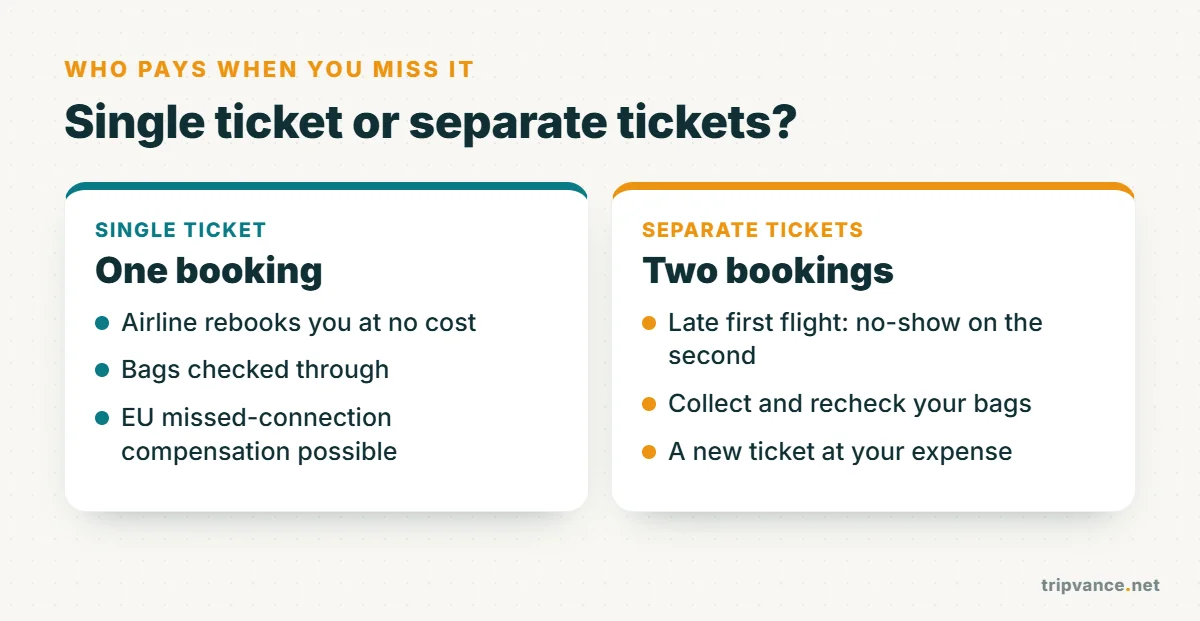
European rules make the difference explicit. Under the EU’s air passenger rights regulation, you can claim compensation for a missed connection only if your flights were booked as part of a single reservation and you reached your final destination 3 hours or more late. The EU Court of Justice confirmed in 2018 (Wegener v Royal Air Maroc) that connecting flights booked together count as one journey, even when part of it is outside the EU. Compensation ranges from €250 to €600 depending on distance. It does not apply if you missed the connection because of security queues or because you did not respect the boarding time at the transfer airport.
| Situation | Rebooked free? | Bags | EU compensation possible? |
|---|---|---|---|
| One ticket, first flight delayed | Yes | Follow you | Yes, if the trip falls under EU rules |
| One ticket, held up at transfer security | Usually, ask at the desk | Follow you | No |
| One ticket, missed the boarding time | At the airline’s discretion | Usually follow you | No |
| Separate tickets, first flight delayed | No, new ticket | Collect and recheck | Not for the missed onward flight |
| Separate tickets with a paid self-transfer guarantee | Per the seller’s terms | Collect and recheck | No |
Separate tickets can still make sense, for example with a low-cost carrier for the last short leg. Just price in the risk: build the itinerary with a long layover, carry-on only if possible (our carry-on size chart by airline helps), and a backup plan for a later flight.
Changing airports: London, Paris and New York
Some cities have several major airports, and a cheap fare can quietly land you at one and depart from the other. Common examples are London Heathrow and Gatwick, Paris Charles de Gaulle and Orly, and New York JFK and Newark. Those pairs are separated by long cross-city transfers by coach, train or taxi, and each transfer means leaving the airport, collecting bags, traveling, then checking in and going through security again.
Treat these as two separate trips joined by ground transport. We recommend 5 hours or more between scheduled landing and departure, more on weekday rush hours. Remember to count the check-in cutoff at the second airport, usually 45 to 60 minutes before departure, not the departure time itself. Our guide to how early to get to the airport lists those cutoffs by airline.
Changing airports in London means entering the UK. Most visitors who do not need a visa now need a UK Electronic Travel Authorisation (ETA), which costs £20, before they can pass border control.
Long layovers: can you leave the airport?
A layover of 6 hours or more opens up options. Before you plan lunch in the city, check three things.
- 30 min: only if the airline sold it
- 2 h: stay near your gate
- 4.5 h: lounge, shower, a proper meal
- 8 h: a short city visit can work
- Entry rules. Leaving the airport means entering the country. You need whatever a visitor needs: a visa, an ESTA for the US, or an ETA for the UK. Even staying airside can require a transit visa for some nationalities.
- Your bags. On one ticket, checked bags normally travel through to your final destination. If they do not, you will have to collect and recheck them, which eats the time you hoped to spend outside.
- The return trip. Plan to be back at the airport as if you were starting a new trip: 2 hours before a domestic flight, 3 before an international one, plus the time to get back from the city.
The UK ETA and transit passengers
The UK requires an ETA if you pass through border control during a transit, for example to change airports or leave Heathrow for the afternoon. In January 2025 the government introduced a temporary exemption for passengers who stay airside and connect at Heathrow or Manchester, and said it would keep it under review. We could not confirm on GOV.UK whether that exemption still applies in October 2026, so check before you fly.
If you would rather stay put, airport lounges sell day passes at many hubs, and several large airports have hotels inside the terminal or a short walk away, useful for an overnight connection. Note it all in your travel itinerary so you have the confirmation at hand.
Is my layover long enough? A quick check
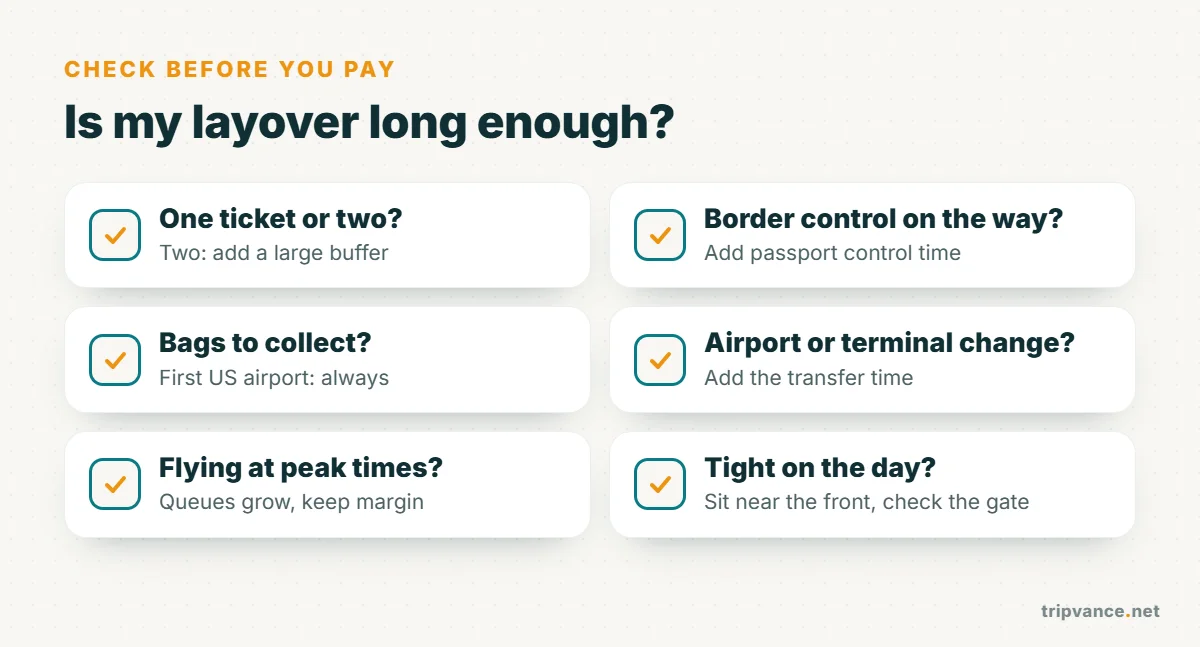
A few habits help on the day too. Sit near the front of the aircraft on the first flight. Use the airline app to see the departure gate before you land. Keep documents together and ready, as listed in our international travel checklist, and pack the carry-on so it clears security quickly; spare batteries must stay in the cabin anyway, as explained in our guide to taking a power bank on a plane.
What to do if you miss your connection
Airlines often rebook missed connections automatically. Your new flight may already be in the app before the doors open.
Look for the transfer or connections desk rather than going back through to check-in. Call the airline at the same time; whichever answers first wins.
On a single ticket departing from the EU, or with an EU airline into the EU, the airline must offer meals and a hotel while you wait. Elsewhere, it depends on the airline’s own policy.
Keep boarding passes and receipts. Under EU rules, a single booking that gets you to your destination 3 hours or more late can mean €250 to €600 per person.
If the missed connection was the airline’s fault and both flights were on one booking, you may also be owed cash: arriving 3 hours or more late at your final destination can trigger up to €600 under EU261. Our flight delay compensation guide shows which flights qualify and how to claim. And if your checked bag did not make the connection, follow the steps in what to do about lost luggage before you leave the arrivals hall.
Layovers: quick answers
Is a 1 hour layover enough?
For a domestic connection on one ticket at the same terminal, usually yes. For an international connection with passport control, or a first US port of entry with bag recheck, it is too tight.
How long of a layover do I need for an international flight?
About 1.5 to 2 hours on a single ticket, 2 to 3 hours when you arrive in the US from abroad, and 3 hours or more on separate tickets.
Do I have to recheck my bags on a connecting flight?
On one ticket, usually not, except at your first US airport when arriving from abroad, where you collect them, clear customs and recheck. On separate tickets, usually yes.
What is the minimum connection time?
The shortest connection airlines agree is possible at an airport. IATA’s defaults are 30 minutes domestic, 60 minutes domestic to international and 90 minutes for international arrivals, but each airport can set its own.
Will the airline wait for me if my first flight is late?
Rarely. Departures are planned around crews, slots and other passengers. On a single ticket, the airline rebooks you instead.
Is a long layover worth it to save money?
Often, if the saving is real and you would enjoy the stop. A 6 hour layover in a city you can visit is a bonus; a 6 hour layover overnight in a closed terminal is not.
- IATA: Station standard minimum connecting time
- OAG: Guide to MCTs explained (PDF)
- CBP: Mobile Passport Control
- CBP: Preclearance locations
- Seattle-Tacoma Airport: International connections
- Your Europe: Air passenger rights
- European Commission: Entry/Exit System
- GOV.UK: Electronic travel authorisation
Last updated: October 2026. Connection rules and border procedures change, so confirm with your airline before you book a tight connection.