
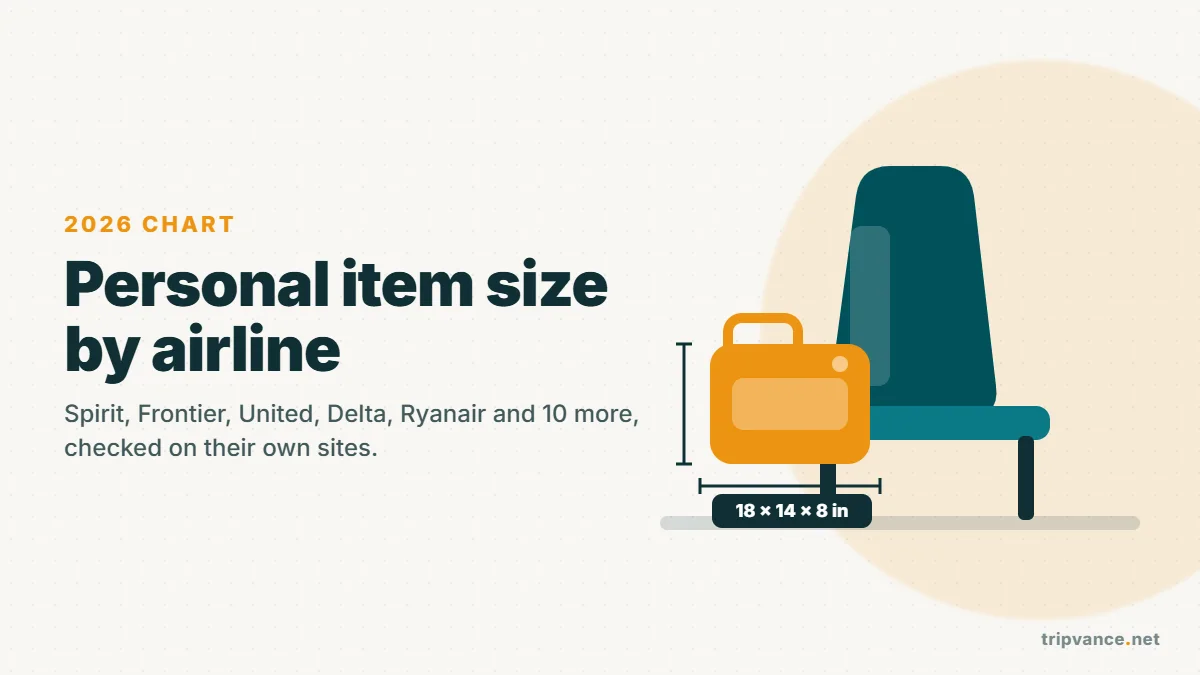
Personal item size is the one baggage rule every ticket shares, from Spirit’s barest fare to a business class seat on Lufthansa, and yet no two airlines draw the box the same way. Spirit, Frontier, American and Allegiant allow 18 x 14 x 8 inches. United cuts the width to 10 inches. Most European carriers stop at 40 x 30 x 15 cm, which is smaller than all of them.
We checked the personal item limit of 15 airlines on their own websites in November 2026. The chart below shows the numbers in inches and centimeters, the volume each one actually gives you, and the single bag size that passes every published limit on the list.
The most common personal item size in the United States is 18 x 14 x 8 inches (45 x 35 x 20 cm), used by Spirit, Frontier, American and Allegiant. United allows 17 x 10 x 9 inches, JetBlue 17 x 13 x 8. In Europe the usual limit is 40 x 30 x 15 cm. A bag no bigger than 40 x 25 x 15 cm (about 15.7 x 9.8 x 5.9 inches) fits all 13 airlines here that publish a size.
Personal item size by airline: the 2026 chart
Every figure below comes from the airline’s own baggage page, terms or contract of carriage. Where an airline publishes only inches, we converted to centimeters and rounded. Volume is simple length times width times height, so you can see how much room each box really holds.
| Airline | Inches | Centimeters | Volume | Worth knowing |
|---|---|---|---|---|
| Spirit | 18 x 14 x 8 | 45 x 35 x 20 | 33 L | Must fit the small sizer bin, handles and wheels included |
| Frontier | 18 x 14 x 8 | 46 x 36 x 20 | 33 L | Up to 35 lb; size is checked during boarding |
| American | 18 x 14 x 8 | 45 x 35 x 20 | 33 L | Diaper bag and breast pump do not count as your item |
| Allegiant | 18 x 14 x 8 | 45 x 35 x 20 | 33 L | Pockets and decorations count in the measurement |
| Avianca | 18 x 14 x 8 | 45 x 35 x 20 | 31.5 L | Free on every fare, checked in airport sizers |
| JetBlue | 17 x 13 x 8 | 43 x 33 x 20 | 29 L | No weight limit on cabin bags |
| United | 17 x 10 x 9 | 43 x 25 x 22 | 25 L | Narrowest width on the list: 10 inches |
| Air Canada | 17 x 13 x 6 | 43 x 33 x 16 | 22.7 L | Some Basic fares allow this item only |
| easyJet | 18 x 14 x 8 | 45 x 36 x 20 | 32.4 L | Up to 15 kg, must go under the seat |
| Ryanair | 16 x 12 x 8 | 40 x 30 x 20 | 24 L | Enlarged in September 2025; sizer measures 42 x 20 x 30 cm |
| British Airways | 16 x 12 x 6 | 40 x 30 x 15 | 18 L | Guaranteed to stay in the cabin |
| Lufthansa | 16 x 12 x 6 | 40 x 30 x 15 | 18 L | The only bag on short-haul Economy Basic |
| Air France | 16 x 12 x 6 | 40 x 30 x 15 | 18 L | 12 kg total with your cabin bag in Economy |
| Delta | Not published | Not published | Varies | Must fit under the seat; space depends on the aircraft |
| Southwest | Not published | Not published | Varies | Goes under the seat in front of you |
Two patterns jump out. North American airlines cluster around 18 x 14 x 8 inches, while the big European network carriers stay with a slim 40 x 30 x 15 cm. Low-cost airlines in Europe sit in the middle: Ryanair added 5 cm of depth in 2025, and easyJet allows the largest under-seat bag on the list.
Which airline gives you the most room?
Dimensions alone can mislead, because a long thin box and a short deep one hold very different amounts. Converting each limit into liters shows the real gap: an easyJet or Spirit bag holds almost twice as much as one that meets the British Airways limit.
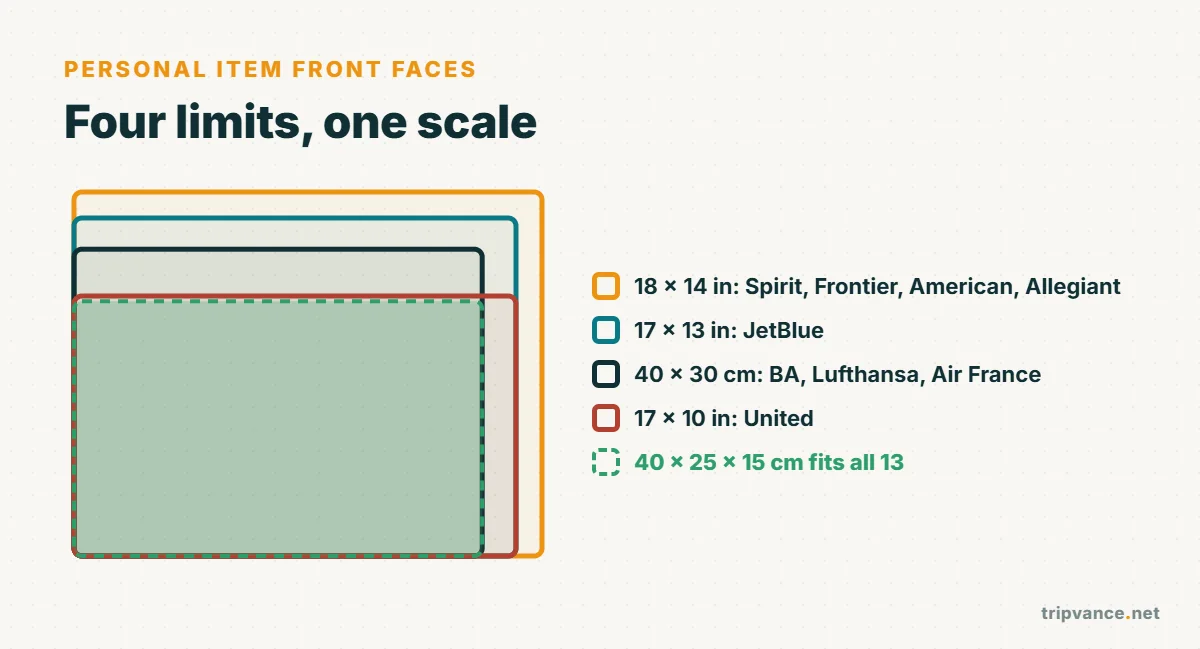
The shape matters as much as the volume. The drawing below puts the front face of each limit on the same grid, with the one size that fits them all in green. United’s box is nearly as long as Spirit’s, but at 10 inches wide it rules out many school backpacks that pass everywhere else.
The one bag size that fits every airline
If you fly several airlines in a year, the useful question is not which limit is biggest but which bag passes all of them. Because you can turn a bag in any direction, the answer comes from taking the smallest long side, the smallest middle side and the smallest short side across the chart.
- Every airline in the chart: 40 x 25 x 15 cm, about 15.7 x 9.8 x 5.9 inches. The 40 cm comes from the European carriers, the 25 cm from United and the 15 cm from BA, Lufthansa and Air France.
- US airlines only: 17 x 10 x 8 inches clears Spirit, Frontier, American, Allegiant, JetBlue and United.
- Europe only: 40 x 30 x 15 cm works on BA, Lufthansa, Air France, Ryanair and easyJet.
In practice that universal size is a slim laptop backpack or a medium tote, not a weekender. If your trip needs more, buy the carry-on allowance for the strict legs instead of squeezing a bigger bag through the sizer.
Soft bags win. A fabric backpack that is a little over on paper usually compresses to fit the sizer once it is not packed to the brim. A hard shell case of the same size will not give an inch.
Delta and Southwest: no fixed size, just the seat
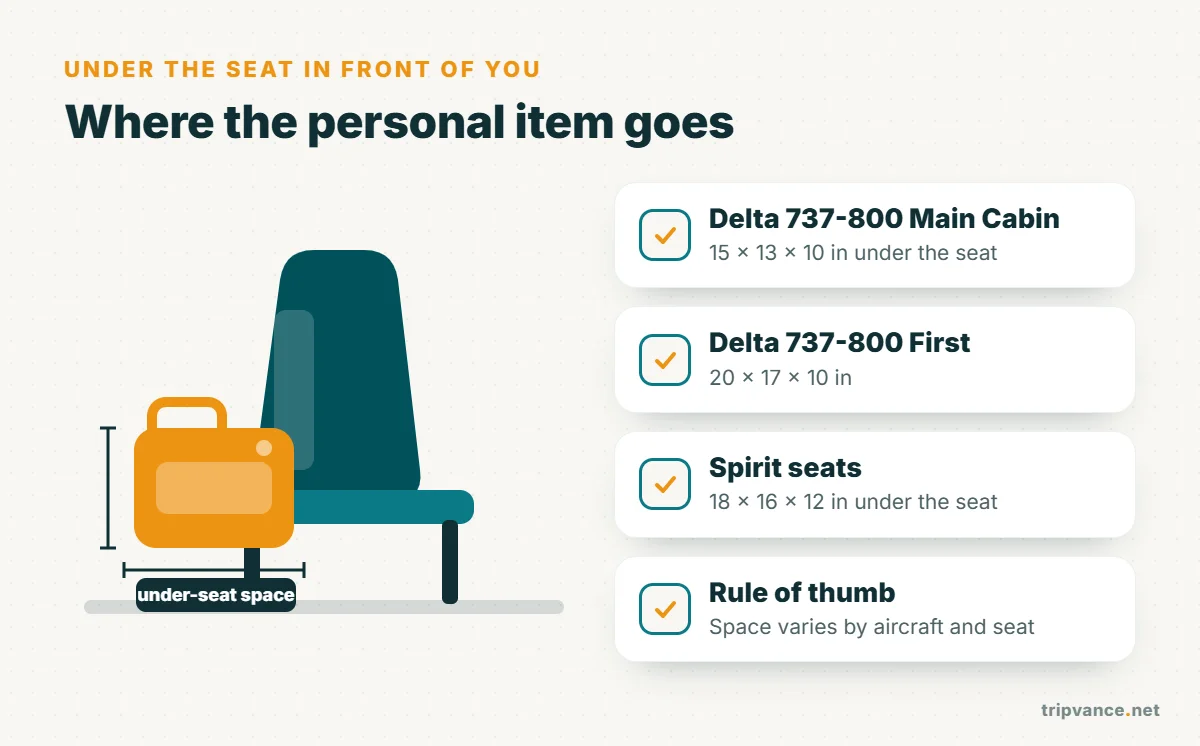
Delta and Southwest do not publish personal item dimensions at all. Delta describes it as a purse, laptop bag or similar item that fits under the seat in front of you, and Southwest uses the same wording. The real limit is therefore the space under the seat, which changes from one aircraft to the next.
Delta does publish that space for each aircraft type. On its Boeing 737-800, for example, the under-seat area in Main Cabin measures 15 x 13 x 10 inches, while First Class seats have 20 x 17 x 10 inches. Spirit, for comparison, lists 18 x 16 x 12 inches under its seats. If you want certainty on Delta, look up your aircraft on its seat map page before packing.
Fares that include only a personal item
On a growing number of basic fares, the under-seat bag is the only free bag. Spirit’s Bare Fare, Frontier and Allegiant include a personal item and charge for anything bigger. Air Canada’s Economy Basic allows only a personal item on flights within Canada, to and from the US, and to Mexico, Central America and the Caribbean. Lufthansa’s Economy Basic on short and medium-haul routes includes a single 40 x 30 x 15 cm item.
That is why the personal item is now the bag people measure most carefully. If you are deciding whether to pay for the overhead bag instead, our carry-on size chart by airline covers overhead bin limits, weights and fees for the same carriers.
From 23 October 2027, Regulation (EU) 2026/2202 will guarantee one free personal item of up to 40 x 30 x 15 cm, or one that fits under the seat in front, on flights covered by EU passenger rights. Airlines can still charge for a larger cabin bag. Until that date, the sizes in the chart above are what counts.
How strictly airlines check, and how to measure
Some airlines rarely look. Others build the check into boarding. Frontier states that the size of your personal item is checked during boarding and that anything larger is charged. Spirit says the bag must fit entirely in the smaller sizer bin. Ryanair warns that oversized cabin bags are refused at the gate or placed in the hold for a fee of 69.99 euros or pounds. Allegiant points out that pockets, wheels, handles and decorations all count.
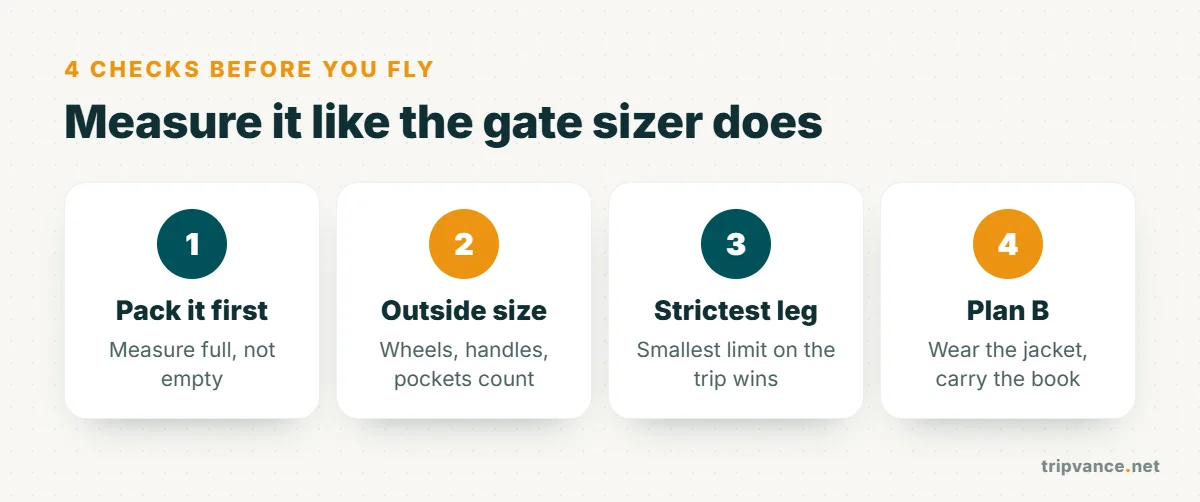
Measure it full, the way it will be at the gate. An empty backpack always looks smaller than it is.
Wheels, handles, side pockets and bottle holders are part of the size at almost every airline.
On a multi-airline trip, the smallest limit on your itinerary is the one that matters.
Wear the bulky jacket, carry the book in your hand, or move items to a travel companion’s allowance before the sizer.
What counts as a personal item, and what does not
Typical personal items are a purse, a laptop bag, a small backpack, a camera bag or a briefcase. Some things travel free on top of it. American Airlines lists diaper bags (one per child), a breast pump, a small cooler of breast milk, child safety seats, strollers and medical or mobility devices. United adds a jacket, an umbrella, reading material and food bought at the airport.
What usually does not get a free pass is a second small purse. United says plainly that small purses are not allowed in addition to the personal item and the carry-on. Put it inside your main bag before boarding. For the liquids you keep in that bag, the TSA 3-1-1 rule still applies, and our packing list helps you decide what earns a place in the small bag.
Frequently asked questions
What is the standard personal item size?
There is no legal standard. In the US the most common limit is 18 x 14 x 8 inches, used by Spirit, Frontier, American and Allegiant. In Europe, 40 x 30 x 15 cm is the norm at British Airways, Lufthansa and Air France.
Is a backpack a personal item?
Yes, if it fits the airline’s limit and goes fully under the seat. A 20 to 25 liter daypack usually works on US airlines. On United, check the width: it cannot exceed 10 inches.
Can my personal item be 18 x 14 x 8 on United?
No. United’s limit is 17 x 10 x 9 inches, so a bag that is 14 inches wide will not meet it even if it is shorter.
Do airlines weigh personal items?
Most do not. Frontier sets 35 lb and easyJet 15 kg, and Air France counts the small bag inside a 12 kg Economy cabin total. JetBlue states it has no weight limit for carry-on bags.
What happens if my personal item is too big?
You will usually be charged the carry-on or checked bag fee at the gate. Ryanair lists 69.99 euros or pounds for oversized cabin bags, and Frontier says larger items are subject to an additional charge.
- Spirit Airlines: What does a personal item consist of?
- Frontier: Bag size and weight limits
- American Airlines: Carry-on bags and size limits
- Allegiant: Carry-on and checked baggage policy
- United Airlines: Carry-on bags
- JetBlue: Carry-on bags
- Delta: Carry-on baggage and Boeing 737-800 specifications
- Southwest: Carry-on and personal item policy
- Air Canada: Carry-on baggage
- Avianca: Everything about baggage
- Ryanair: Bag rules and bigger bag sizers announcement
- easyJet: Cabin bags
- British Airways: Baggage essentials
- Lufthansa: Free baggage rules
- Air France: Authorized baggage
Last checked: November 2026. Airlines change bag rules often, so confirm on your booking before you fly.