
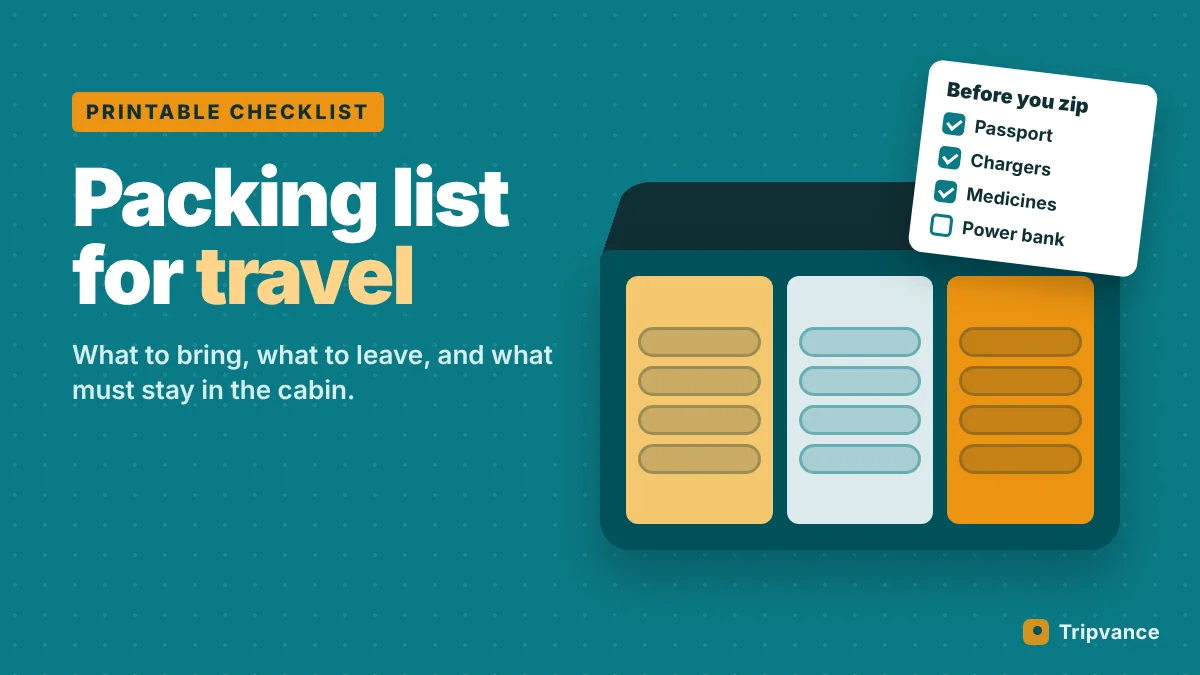
A good packing list for travel is short, boring and reused on every trip. That is the whole secret. People who pack well are not more organized than everyone else, they just stopped starting from a blank page. Below is the list we would hand a friend: the core items by category, a simple clothing formula, variations for beach, city, cold weather, business and family trips, and the airline battery rules that catch people out in 2026.
Packing in five rules
- Start from a fixed list, then remove what this trip does not need. Do not add “just in case” items.
- Clothes for about a week are enough for any trip length: use the 5-4-3-2-1 formula and do laundry.
- Documents, medicine, chargers and one change of clothes always go in your carry-on.
- Power banks and spare lithium batteries go in the cabin only, never in checked bags. Over 100 Wh needs airline approval, and since 27 March 2026 the international rule allows two power banks per person at most, with no recharging during the flight.
- Liquids in your carry-on follow the 100 ml (3.4 oz) rule. Pack them last, on top.
The core packing list for travel
This is the base list for a trip of one to two weeks. Copy it into your phone notes, tick what you need for each trip, and delete what you never use. After three trips it will fit you perfectly.
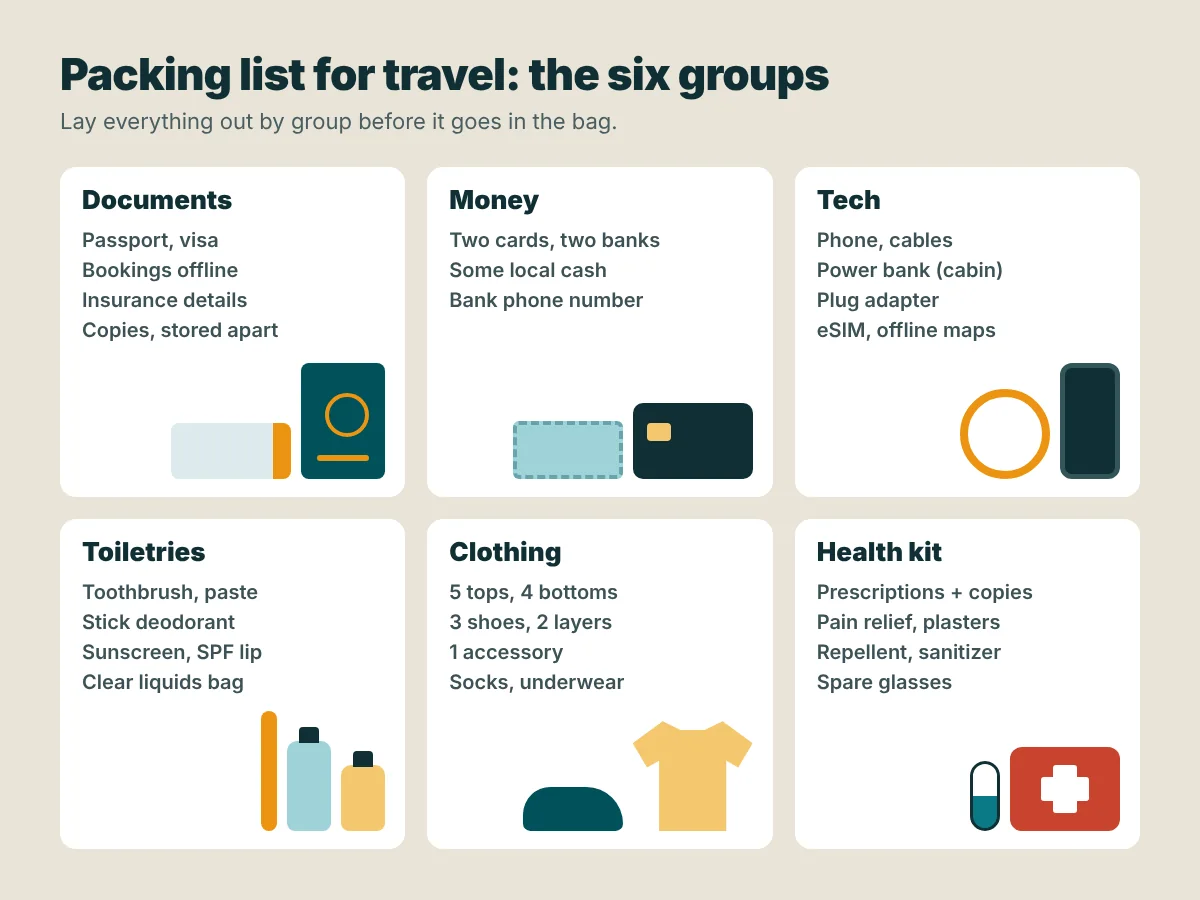
Documents
- Passport or ID card, with enough validity left for your destination
- Visa or travel authorization, printed and saved on your phone
- Boarding passes, hotel and transport confirmations (offline copies)
- Travel insurance policy number and 24-hour assistance phone number
- Driver’s license, plus an International Driving Permit if the country requires one
- Photocopies or photos of all of the above, stored separately from the originals
Money
- Two payment cards from different banks, kept in different places
- A small amount of local cash for taxis, tips and small shops
- Your bank’s phone number for calls from abroad
Tech
- Phone and charger, with a short and a long cable
- Power bank (in your carry-on, see the battery rules below)
- Plug adapter for the destination, ideally one with USB ports
- Headphones
- eSIM or local SIM plan set up before departure, and offline maps downloaded
Toiletries
- Toothbrush, toothpaste, floss
- Deodorant (a stick avoids the liquids bag)
- Sunscreen, lip balm with SPF
- Shampoo bar or small bottles, only if your lodging does not provide them
- Razor, hairbrush, hair ties, contact lenses and solution
- A clear, resealable bag for anything liquid in your carry-on
Health kit
- Prescription medicines for the whole trip plus a few extra days, with copies of the prescriptions
- Pain and fever relief, antihistamine, diarrhea medicine, motion sickness tablets
- Plasters, antiseptic, a few oral rehydration sachets
- Insect repellent and hand sanitizer
- Spare glasses or contact lenses
The US CDC recommends carrying copies of all prescriptions and bringing your own medicines, because quality abroad cannot always be guaranteed. Some common medicines are restricted in other countries, so check the rules of your destination before you pack them.
Carry-on essentials
- Documents, wallet, phone, keys
- Medicines and anything you cannot replace
- Chargers, power bank, headphones
- One full change of clothes and underwear, in case your checked bag is late
- Empty water bottle, a snack, a warm layer for the plane
Clothing: the 5-4-3-2-1 formula
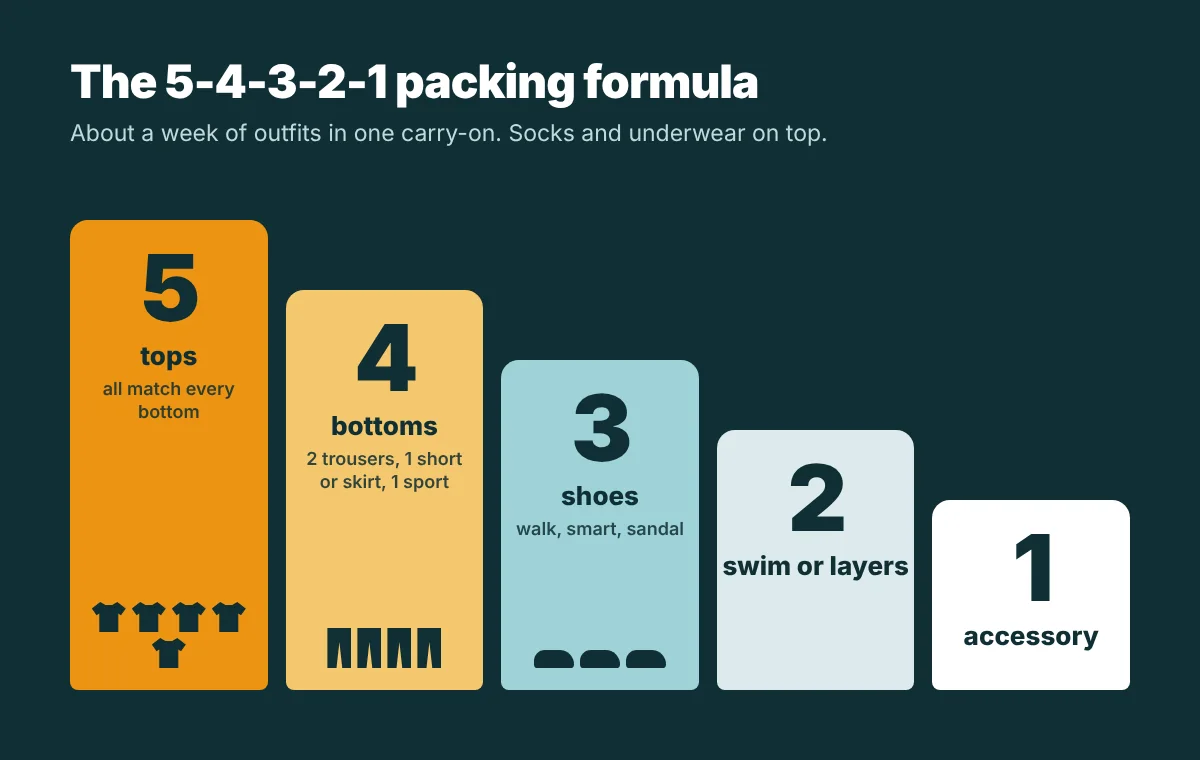
Clothing is where overpacking happens. The 5-4-3-2-1 formula is a simple capsule wardrobe for about a week, and it scales to a month if you do laundry once a week. Socks and underwear come on top.
- 5 tops: T-shirts, shirts or blouses that all go with your bottoms.
- 4 bottoms: for example two pairs of trousers, one pair of shorts or a skirt, and one pair for sport or sleep.
- 3 pairs of shoes: one for walking, one smarter pair, one sandal or flip-flop. Wear the bulkiest pair on the plane.
- 2 swimsuits or 2 layers: swimwear for a beach trip, or a fleece and a light jacket for a city trip.
- 1 accessory set: one hat, one scarf or one bag that changes the look of everything else.
The trick that makes it work is color. Pick two neutral colors (navy and grey, black and beige) and one accent color. Every top then goes with every bottom, and 9 pieces give you more than 20 outfits.
Packing list variations by trip type
Start from the core list, then add or swap these items.
Beach trip
Two swimsuits (one is always wet), a cover-up, sandals, a wide-brimmed hat, a high-SPF sunscreen, after-sun, a dry bag for the phone and a light long-sleeved shirt for the hottest hours. A quick-dry towel is useful if your hotel does not lend beach towels.
City break
Comfortable walking shoes that you have already broken in, a small crossbody bag that closes, a compact umbrella, and one smarter outfit for a dinner out. Leave the large daypack at home: in cities you are rarely more than a few minutes from a shop.
Cold weather
Dress in layers instead of packing one huge coat: a thermal base layer, a fleece or wool mid layer, and a windproof and waterproof shell. Add a warm hat, gloves, wool socks and waterproof boots. Wear the heaviest layers on the plane to save space in your bag.
Business trip
One suit or blazer that works with two trousers or skirts, two or three shirts, one pair of formal shoes, a laptop with its charger, a presentation clicker and adapters for video connectors. Pack the suit jacket inside out, folded once along the shoulders, at the top of your bag.
Traveling with kids
Copies of birth certificates or custody documents if one parent travels alone, a full change of clothes per child in the carry-on, snacks, wipes, a favorite small toy, headphones sized for children, and any baby formula or medicine. Formula and baby food are allowed in larger quantities through US security, but must be declared at the checkpoint.
How to travel with a carry-on only
Traveling with only a carry-on saves time at the airport, money on bag fees and the stress of lost luggage. It works for most trips up to two weeks if you follow three rules.
- Check your airline’s limits first. Size and weight limits vary widely, and low-cost airlines often allow only a small personal item for free. Our guide to carry-on size by airline lists the main carriers.
- Use the 5-4-3-2-1 formula and do laundry. Most hotels and apartments offer a laundry service or a machine. One wash in the middle of the trip halves your clothing.
- Decant liquids. Everything liquid must fit in one clear quart-size or 1 liter bag in containers of 100 ml (3.4 oz) or less. Our guide to TSA liquid rules explains what counts as a liquid and what is exempt.
Weigh your packed carry-on at home with a luggage scale. A bag that fits the size limit can still be over the weight limit, and airlines that weigh cabin bags will charge you at the gate.
Carry-on vs checked bag: what goes where
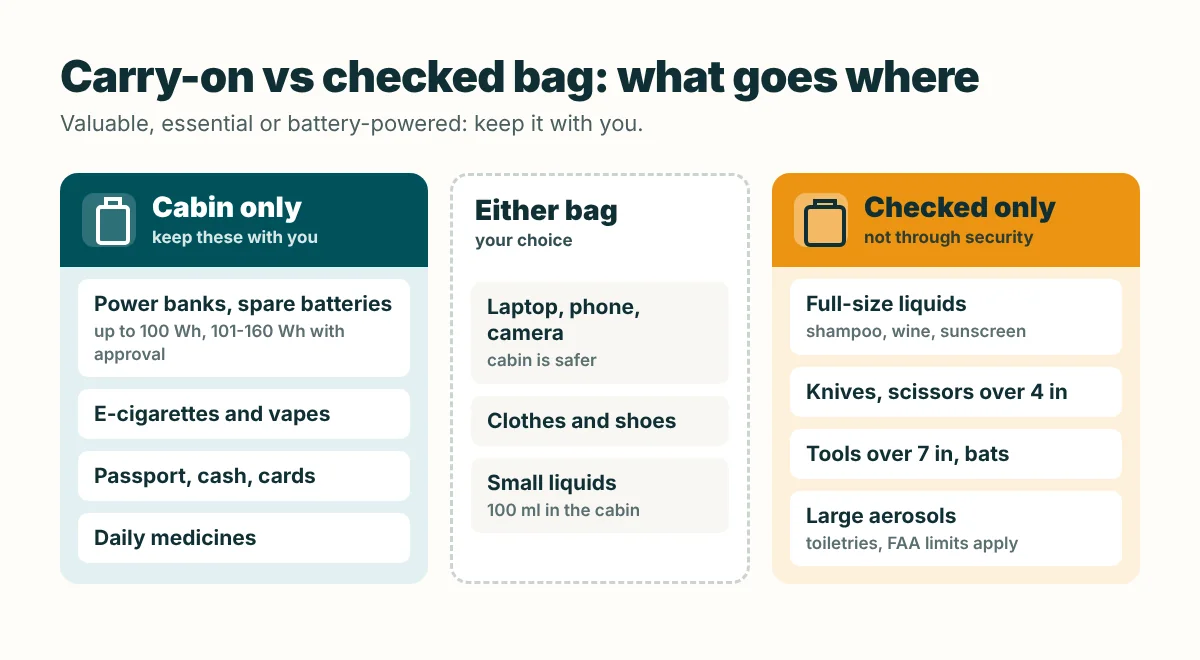
Some items must travel in the cabin, some must go in the hold, and many can go in either. The rule of thumb: anything valuable, fragile, essential or battery-powered stays with you.
Lithium battery and power bank rules
This is the rule people break most often without knowing it. According to the US FAA, which follows the international rules used by most airlines:
- Spare lithium batteries and power banks go in carry-on bags only. If your carry-on is taken at the gate to be checked, take the power bank out and keep it with you.
- Up to 100 Wh per battery is allowed without approval. Most phone power banks are well under this.
- 101 to 160 Wh needs airline approval, with a maximum of two spare batteries per person.
- Above 160 Wh is not allowed as a spare battery in passenger baggage.
- Protect the terminals from short circuits: keep batteries in their original packaging, a case or tape over the contacts.
To find the Wh rating when only mAh is printed, multiply the voltage by the capacity in amp-hours. A 20,000 mAh power bank at 3.7 V is 20 × 3.7 = 74 Wh. Some airlines also limit the number of power banks per passenger or how you can use them on board, so check your airline’s page before you fly.
Damaged, swollen or recalled batteries must not be taken on the aircraft. If a device gets hot or starts to smoke during the flight, tell the crew immediately.
One more reason to keep medication, chargers and a change of clothes in your carry-on: checked bags do go astray, and a delayed bag can take a day or two to reach you. Here is what to do if your luggage is lost or delayed, including the deadlines for claiming.
Packing techniques that save space
Rolling or folding?
Both work, for different items. Roll soft, casual clothes (T-shirts, underwear, leggings): they take less space and wrinkle less. Fold structured items (shirts, blazers, trousers with a crease) flat, in a stack, with the largest piece at the bottom. Mixing the two is what most experienced travelers do.
Packing cubes
Cubes do not create space, but they keep it organized. Use one cube for tops, one for bottoms, one small one for underwear and socks. When you arrive, you lift the cubes into a drawer and the suitcase is unpacked in a minute. Compression cubes do save space, at the cost of more wrinkles.
Weight distribution
In a wheeled suitcase, put the heaviest items (shoes, toiletry bag, books) at the bottom, near the wheels. The bag stays upright and is easier to pull. In a backpack, keep heavy items close to your back and in the middle. Fill shoes with socks and chargers so no space is wasted.
Pack in the right order
Shoes and heavy items first, then folded clothes, then rolled clothes in the gaps, and last the things you need at the airport: the liquids bag, a jacket, the charger. Open your bag at security without digging.
What not to pack
- Full-size toiletries that the hotel already provides.
- “Just in case” outfits. If you cannot name the day you will wear it, leave it.
- Expensive jewelry and anything you would be upset to lose.
- A hair dryer. Almost every hotel has one, and many do not work on a different voltage.
- Too many books. One paperback or an e-reader is enough.
- Items banned by your destination. Some medicines, foods and drones are restricted. Check before you go.
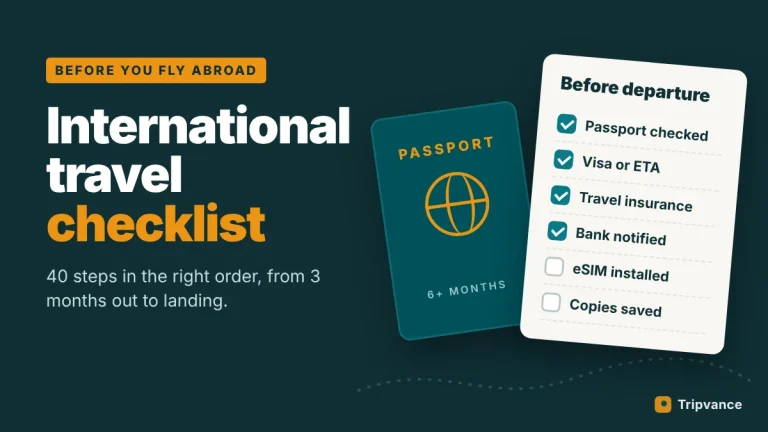
For the paperwork side of a trip abroad, our international travel checklist goes through passports, visas, insurance and money in order. Driving instead of flying? See how to plan a road trip for packing a car.
Packing list for travel: frequently asked questions
What should be on a packing list for travel?
Documents, money, tech, toiletries, a health kit and clothing. Keep documents, medicines, chargers and one change of clothes in your carry-on, and use a clothing formula like 5-4-3-2-1 to avoid overpacking.
What is the 5-4-3-2-1 packing method?
Five tops, four bottoms, three pairs of shoes, two swimsuits or layers, and one accessory, plus socks and underwear. It covers about a week, and longer trips if you do laundry.
Can I put a power bank in checked luggage?
No. Power banks and spare lithium batteries must travel in the cabin. Up to 100 Wh is allowed without approval, 101 to 160 Wh needs airline approval (two spares maximum), and above 160 Wh is not allowed.
Is rolling clothes better than folding?
Rolling is better for soft, casual clothes. Folding is better for shirts, blazers and smart trousers. Most people get the best result by mixing both.
What should I pack for traveling overseas?
The core list plus a passport with enough validity, any visa, a plug adapter, travel insurance details, two payment cards and copies of your prescriptions. Check whether your medicines are allowed in the destination country.
Last updated: October 2026