Morocco customs rules are simple for most visitors, but three points catch people out every year: the 2,000 dirham limit on Moroccan cash, the declaration of foreign currency above 100,000 dirhams, and drones. This guide sums up the Morocco customs allowance for tobacco, alcohol, perfume and gifts, what you must declare, what is prohibited, and what you can take home, with a checker to test your own luggage.
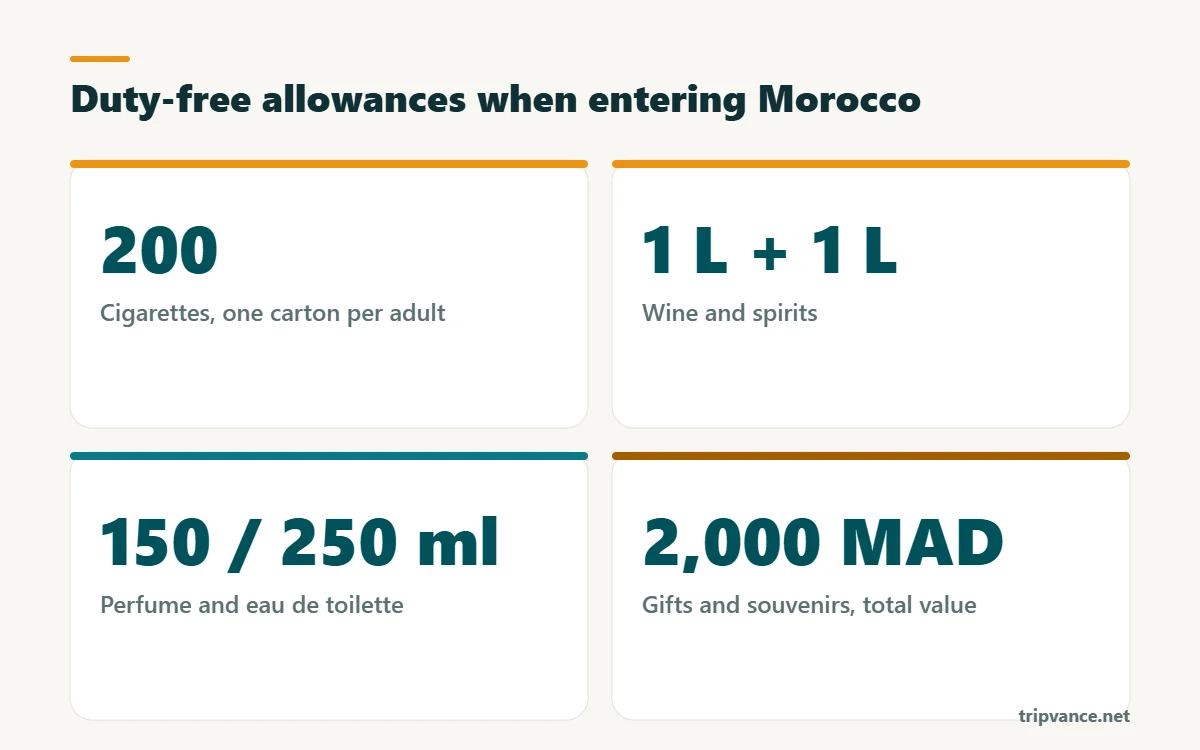
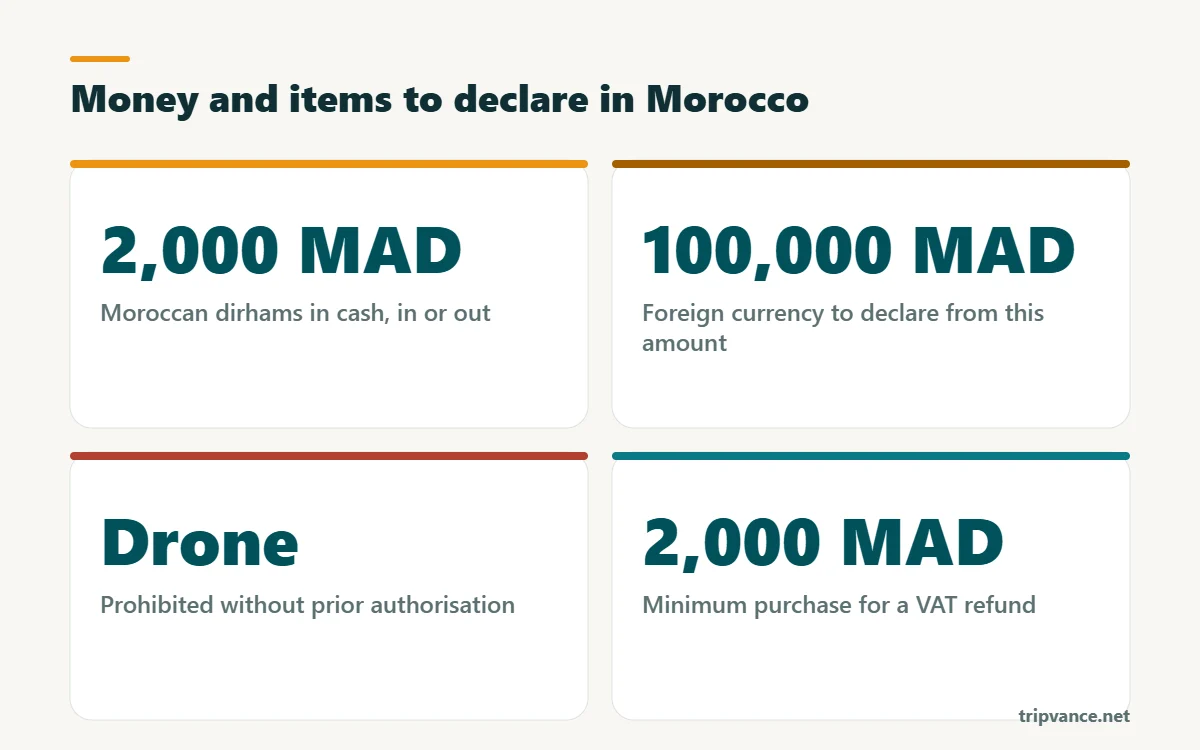
An adult visitor can bring into Morocco, duty free: 200 cigarettes, 1 litre of wine and 1 litre of spirits, 150 ml of perfume and 250 ml of eau de toilette, and gifts worth up to 2,000 MAD. Foreign currency is unlimited but must be declared from 100,000 MAD. Moroccan dirhams in cash are limited to 2,000 MAD in and out. Drones need prior authorisation.
Duty-free allowances when entering Morocco
These allowances apply to travellers’ personal luggage, for their own use or as gifts, with no commercial purpose. They are set by the Customs and Indirect Taxes Administration (ADII) and follow the standards of the World Customs Organization.
Clothes and personal items in use are not counted: your camera, laptop, phone and hair dryer are fine. Keep receipts for expensive new items, because customs can ask for them and charge duties on the part above the allowance. Moroccans living abroad have a separate, larger allowance during the summer holidays.
Check your luggage
Independent tool, not affiliated with Moroccan customs. Nothing you enter is stored or sent.
Money: dirhams and foreign currency
The Moroccan dirham is a closed currency. Its import and export in cash are limited to 2,000 MAD per traveller, under the Office des Changes rules. In practice, arrive with euros, dollars or pounds, or simply a bank card, and change money in Morocco at a bank or an approved exchange office. Keep the exchange receipts: they let you change your remaining dirhams back before you leave.
Foreign currency is not limited. From an amount equal to 100,000 MAD, roughly 9,000 to 10,000 euros, you must fill in a written declaration at the border customs office on arrival. Keep it: it justifies the origin of the money if you take it out again. Failing to declare can lead to a fine equal to part of the undeclared amount.
With your exchange receipts, banks can change unused dirhams back into foreign currency. At ports and airports, exchange counters can reconvert up to 2,000 MAD per passport on presentation of a ticket. Better to change small amounts as you go than to end the trip with a wad of notes. For card payments, see how to avoid bad rates in our guide to using a credit card abroad.
Drones, medicines and prohibited goods
The most common problem at Moroccan airports is the drone. Import and use are prohibited without prior authorisation. If you arrive with one, declare it: customs usually hold it and give you a receipt so you can collect it when you leave. An undeclared drone found in your bag is seized.
- Medicines: bring them in their original packaging with the prescription, in quantities matching your stay.
- Weapons, ammunition and narcotics: prohibited.
- Goods in commercial quantities: they must go through a full customs declaration, even if you say they are gifts.
- Professional equipment: photographers and film crews with large kits should ask about temporary admission before the trip.
Drones, binoculars with night vision and transmission equipment are checked at the scanner. A short declaration on arrival takes five minutes; a seizure can take days to resolve.
Leaving Morocco: what you can take home
Carpets, leather, ceramics, argan oil and spices leave the country without trouble. Two Moroccan rules apply on departure: the 2,000 MAD cash limit, and the need for an authorisation to export antiques and items of cultural heritage. Non-residents can also claim back VAT on purchases of at least 2,000 MAD including tax in the same shop, if the seller fills in an export sales form that you show at customs when leaving.
Then come the rules of the country you return to. Morocco is outside the EU, so standard third-country limits apply when you get home.
| Destination | Tobacco | Alcohol | Other goods |
|---|---|---|---|
| European Union | 200 cigarettes | 1 L spirits, 4 L wine, 16 L beer | 430 EUR by air or sea |
| United Kingdom | 200 cigarettes | 4 L spirits, 18 L still wine, 42 L beer | 390 GBP |
| United States | 200 cigarettes | 1 L | 800 USD exemption |
The EU and the UK do not allow meat or dairy products in passengers’ luggage from Morocco. Dates, olive oil in sealed containers, spices and argan oil are fine in reasonable quantities. In the cabin, liquids still follow the 100 ml rule: our guide to liquid rules explains the details.
Frequently asked questions
How much cash can I take to Morocco?
Foreign currency is unlimited, but you must declare it in writing from 100,000 MAD. Moroccan dirhams are limited to 2,000 MAD in cash.
Can I bring alcohol into Morocco?
Yes, 1 litre of wine and 1 litre of spirits per adult, duty free. Above that, declare it and pay the duties.
Can I bring a drone to Morocco?
Not without prior authorisation. Declare it on arrival: customs usually hold it and return it when you leave.
Do I need to fill in a customs form when arriving in Morocco?
Only if you have something to declare, such as currency above 100,000 MAD, goods above the allowances or a drone. Otherwise, take the green channel.
Can I get a VAT refund in Morocco?
Yes for non-residents, on purchases of at least 2,000 MAD including tax in one shop, with an export sales form validated by customs on departure. Food, tobacco and medicines are excluded.
Do I need a visa for Morocco?
Many nationalities do not need one for short tourist stays. Check your case in our Morocco visa guide.
Passport validity, plug adapters, mobile data: check everything in a few clicks.
Open the travel tools- Customs and Indirect Taxes Administration (ADII), Kingdom of Morocco: travellers’ guide
- Office des Changes: foreign non-residents
- Your Europe (EU): alcohol, tobacco and cash when entering the EU
- GOV.UK: bringing goods into the UK for personal use
- U.S. Customs and Border Protection: Know before you go
Updated November 2026. Allowances apply to adults; tobacco and alcohol allowances are not granted to minors.