

Travel insurance is one of those purchases that feels optional right up to the moment you need it. A broken ankle on a hiking trail, a cancelled flight two days before a wedding, a hospital bill in a country where nobody takes your health card: these are the situations it exists for. It is also easy to overpay for cover you already have or will never use. This guide explains when you really need a policy, what a good one covers, what it costs, and how to check one against the Schengen visa rules in under a minute.
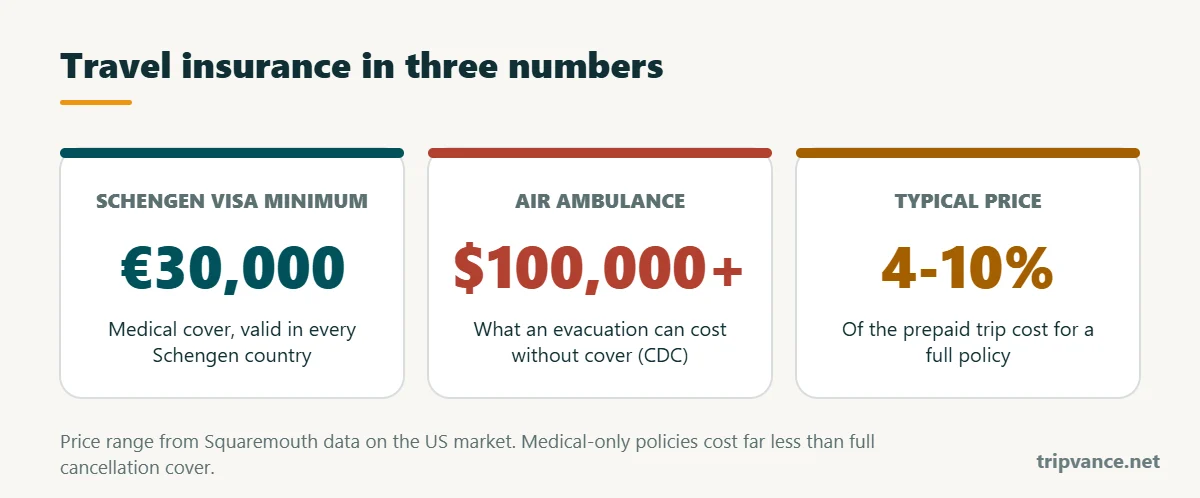
You need travel insurance whenever a medical emergency abroad would not be covered by your own health system, when you have paid a lot of money upfront that you cannot get back, and when the destination requires it, as the Schengen area does for visa applicants (at least €30,000 of medical cover). A full policy usually costs 4 to 10% of the prepaid trip; a medical-only plan costs much less. The cover that matters most is emergency medical care and evacuation, which can exceed $100,000.
Do you need travel insurance?
Insurance is about the risks you cannot afford to carry yourself. For most trips abroad, those risks are medical: your health insurance or public health system usually stops at the border, or pays only a fraction of foreign prices. US travelers should note that Medicare generally does not pay for care outside the United States, and many private plans pay little abroad.
A policy is strongly recommended, or simply necessary, in these cases:
- You are going somewhere with expensive private healthcare, such as the United States, or to remote areas where an injury means an evacuation.
- You have prepaid a lot: tour packages, cruises, non-refundable hotels, family events booked months ahead.
- You need a visa that requires it. Schengen visa applicants must show travel medical insurance; Cuba asks for proof at the border; Saudi Arabia includes compulsory medical cover in the price of its tourist e-visa.
- You are older, pregnant or have a medical condition, where both the risk and the cost of treatment are higher.
- You plan activities with a higher risk: skiing, diving, trekking at altitude, renting a scooter.
Where it matters less: a short trip inside your own country, or a trip within Europe for an EU resident with a European Health Insurance Card and only refundable bookings. Even then, cover for repatriation is not included in public healthcare, which is why many Europeans still buy a cheap annual policy.
What travel insurance covers
Policies are sold as bundles of separate “benefits”, each with its own limit. Reading the limits, not the brand name, is how you compare them.
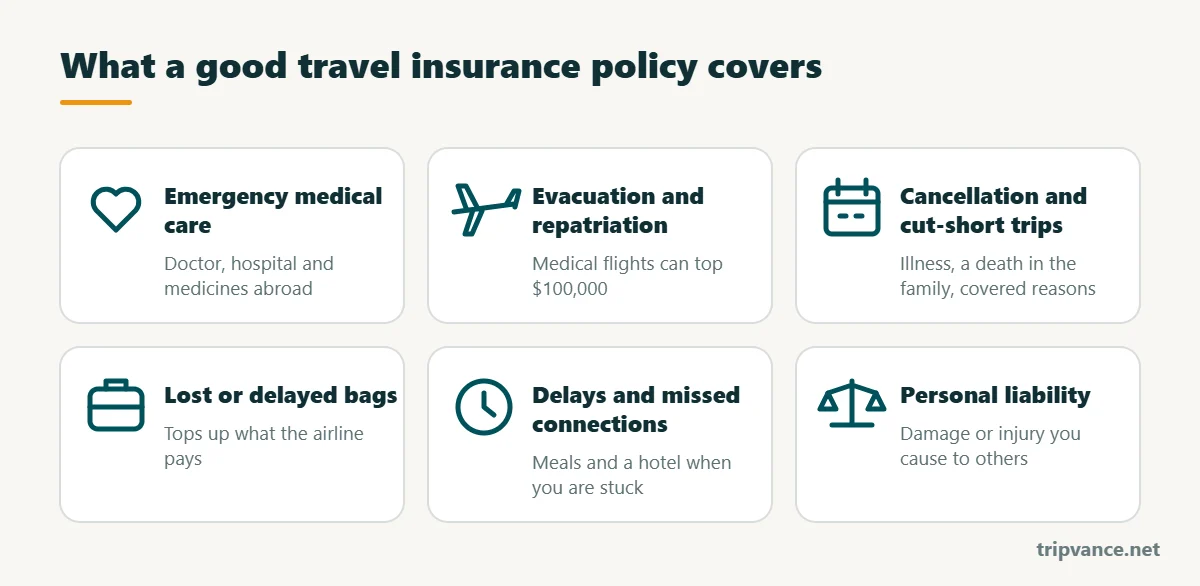
- Emergency medical expenses: doctor visits, hospital stays, surgery and prescribed medicines for an illness or accident that starts during the trip.
- Medical evacuation and repatriation: transport to a hospital that can treat you, or home, often by air ambulance. The CDC notes that a medical evacuation can cost more than $100,000. This is the benefit that protects you from a life-changing bill.
- Trip cancellation and interruption: your non-refundable costs if you cannot leave, or must come home early, for a reason listed in the policy, such as serious illness or a death in the family.
- Baggage: lost, stolen or delayed luggage, usually with low limits per item. It tops up what the airline owes you; see our guide to lost luggage claims for the airline side.
- Travel delay and missed connections: meals, a hotel and new tickets when a covered delay strands you. If your flight was in Europe, the airline may also owe you cash under EU261, explained in our flight delay compensation guide.
- Personal liability: damage or injury you cause to someone else, such as knocking over a cyclist or damaging a rental flat.
What it usually does not cover
Most refused claims come from the exclusions, not from the insurer being difficult. The common ones are worth knowing before you buy:
Medical conditions you already had and did not declare; anything that happens while drunk or on drugs; risky sports that were not added to the policy; travel to a country your government advises against; events that were already known when you bought the policy, such as a named storm or an announced strike; items left unattended; and simply changing your mind, unless you pay for a Cancel For Any Reason option.
The rule about known events is the one that catches people: buy the policy as soon as you book, not the week before you leave. Cancellation cover only protects you from things that had not happened yet when you bought it.
How much does travel insurance cost?
The price depends mostly on what you insure. For a policy with cancellation cover, the insurer prices a share of your prepaid, non-refundable trip cost; age, trip length and destination push it up or down. Squaremouth, a large US comparison site, gives a typical range of 4 to 10% of the trip cost. In the month to 29 October 2026, comprehensive policies sold on its platform cost an average of $482, about 6.6% of the insured trip.
Two practical consequences. First, insure only what you would lose: refundable hotel bookings and points tickets that can be redeposited do not need cancellation cover. Second, if your trip is cheap but far away, a medical-only plan may give you the protection that matters for a fraction of the price.
Medical-only, comprehensive or annual?
| Type | Covers | Best for |
|---|---|---|
| Travel medical | Emergency care, evacuation, repatriation | Cheap or flexible trips, visa applications, backpackers |
| Comprehensive | Medical plus cancellation, interruption, bags, delays | Expensive prepaid trips, cruises, family events |
| Annual multi-trip | Usually medical plus some trip benefits, every trip in the year | Three or more trips a year, each under a set length |
| Evacuation membership | Transport home or to a better hospital, not treatment | Remote travel, as a top-up to medical cover |
Do you already have cover?
Before buying, check what you already pay for. You may only need to fill a gap.
- Credit cards: premium cards often include trip delay, cancellation and baggage benefits, sometimes medical cover. Conditions matter: the trip usually has to be paid with the card, limits can be modest and medical benefits may only apply after your other insurance. Ask for the benefits document, not the marketing page. The CDC goes further and advises travelers not to treat card benefits as a substitute for a real travel health or evacuation policy.
- European Health Insurance Card (EHIC) and UK GHIC: they give access to state healthcare in EU countries, Iceland, Liechtenstein, Norway and Switzerland on the same terms as locals. They do not cover private clinics, repatriation or anything outside those countries.
- Your health insurer: some plans include worldwide emergency cover. Check the ceiling and whether they pay the hospital directly or reimburse you later.
- Home or renters insurance: may already cover belongings stolen abroad.
Travel insurance for a Schengen visa
If you need a visa for France, Spain, Italy or any other Schengen country, your application must include travel medical insurance that meets the EU Visa Code. Consulates check four points: medical cover of at least €30,000, validity in every Schengen country, cover for the whole stay, and cover for repatriation, including in case of death. Non-medical benefits such as baggage do not count toward the €30,000. Visa-exempt travelers do not have to show insurance, but the reasons to have it are the same. Visa-free visitors should also keep an eye on ETIAS, the future travel authorization.
Independent tool by Tripvance, not an official service of any consulate or government. The result is indicative: the consulate decides, and the wording of your own policy is what counts.
A tip from consulates: buy cover that starts a day before you fly and ends a day after you return. Flights get delayed, and a policy that ends at midnight on your planned return date leaves you uncovered if you are stuck.
How to choose a policy in 10 minutes
Prepaid, non-refundable costs only. That figure is the cancellation cover you need.
At least $100,000 or €100,000 for long-haul trips, more for the US. Evacuation should be separate and generous.
Skiing, diving, motorbikes: make sure they are listed or add them.
An undeclared condition is the classic reason for a refused medical claim.
A low deductible and an assistance line that pays the hospital directly are worth more than extras.
Save the policy number and the assistance phone number in your phone and on paper, next to the other items on our international travel checklist.
How to make a claim
For a medical emergency, call the insurer’s assistance line as soon as it is safe to do so: many policies require approval before a hospital admission or an evacuation, and the insurer can often pay the hospital directly. For everything else, collect proof on the spot: medical reports, receipts, the airline’s written confirmation of a delay or cancellation, a police report for theft, and the airline’s file reference for a missing bag. Claim within the deadline in your policy, often 30 to 90 days after you return, and keep copies of everything you send.
Take a photo of every receipt the day you pay it. Missing paperwork, not exclusions, is behind many delayed claims.
Frequently asked questions
Is travel insurance worth it?
For trips abroad, the medical and evacuation part almost always is, because the cost of a serious accident can run into six figures. Cancellation cover is worth it when you have large non-refundable costs.
When should I buy travel insurance?
As soon as you pay for the trip. Cancellation benefits only cover events that were not known when you bought the policy, and some time-sensitive benefits must be bought within days of the first payment.
How much travel insurance do I need for a Schengen visa?
At least €30,000 of medical cover, valid in all Schengen countries for your whole stay, including repatriation. Use the checker above to test your policy.
Does travel insurance cover pre-existing conditions?
Only if you declare them and the insurer accepts them, sometimes for an extra premium. Some US plans waive the exclusion if you buy within a short window after your first trip payment.
Does travel insurance cover flight delays?
Most comprehensive policies pay reasonable expenses after a delay of a set number of hours. They do not replace what the airline owes you under passenger rights rules, which you can claim separately.
Is credit card travel insurance enough?
Sometimes for delays and baggage, rarely for medical care and evacuation. Check the medical limit, whether the trip must be paid with the card, and who is covered.
- CDC: Travel insurance for travelers
- CDC Yellow Book 2026: Travel insurance, travel health insurance and medical evacuation insurance
- Czech Ministry of Foreign Affairs: Schengen travel medical insurance requirements
- Your Europe: European Health Insurance Card
- Squaremouth: How much does travel insurance cost in 2026
Last updated: November 2026. This guide is general information, not insurance or financial advice. Policy terms vary: the wording of your own policy is what counts.