
Ramadan in Morocco changes the rhythm of the whole country, and Ramadan 2027 is expected to begin on Monday 8 February 2027. Days are slower, evenings turn into the best part of the trip, and a few practical details shift: opening hours, transport around sunset, alcohol sales. None of this should stop you from travelling. It simply helps to know what to expect, and this guide covers the dates, the daily schedule, the rules that apply to visitors and the etiquette that locals appreciate.
Ramadan 2027 should start in Morocco on Monday 8 February 2027, or Tuesday 9 February depending on the moon sighting, and last 29 or 30 days. Eid al-Fitr, a two-day public holiday, is expected between 9 and 11 March 2027. Tourists can travel normally: hotels and many restaurants in tourist areas serve food during the day, and the evenings are lively.
When is Ramadan 2027 in Morocco?
Ramadan is the ninth month of the Islamic lunar calendar, so it starts about 11 days earlier every year. In Morocco, the start is not fixed in advance by a calendar: the Ministry of Habous and Islamic Affairs announces it on the evening of the 29th of Sha’ban, after committees across the country try to sight the new crescent. Morocco often starts a day after Saudi Arabia, so do not rely on dates announced for other countries.
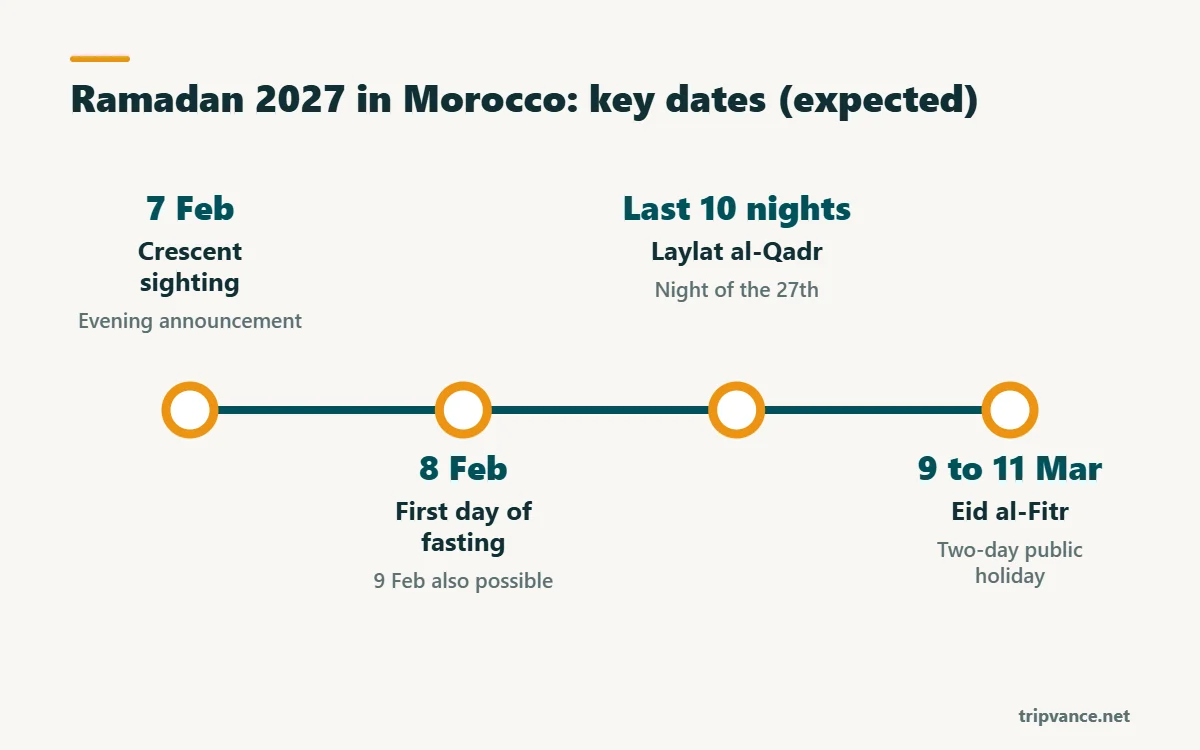
Astronomical data supports the 8 February estimate: the new moon is born on 6 February 2027 and should be visible from the Morocco region on the evening of 7 February. Treat it as a planning date, and keep one day of flexibility at both ends of your trip if your plans depend on it.
Fasting hours in your city
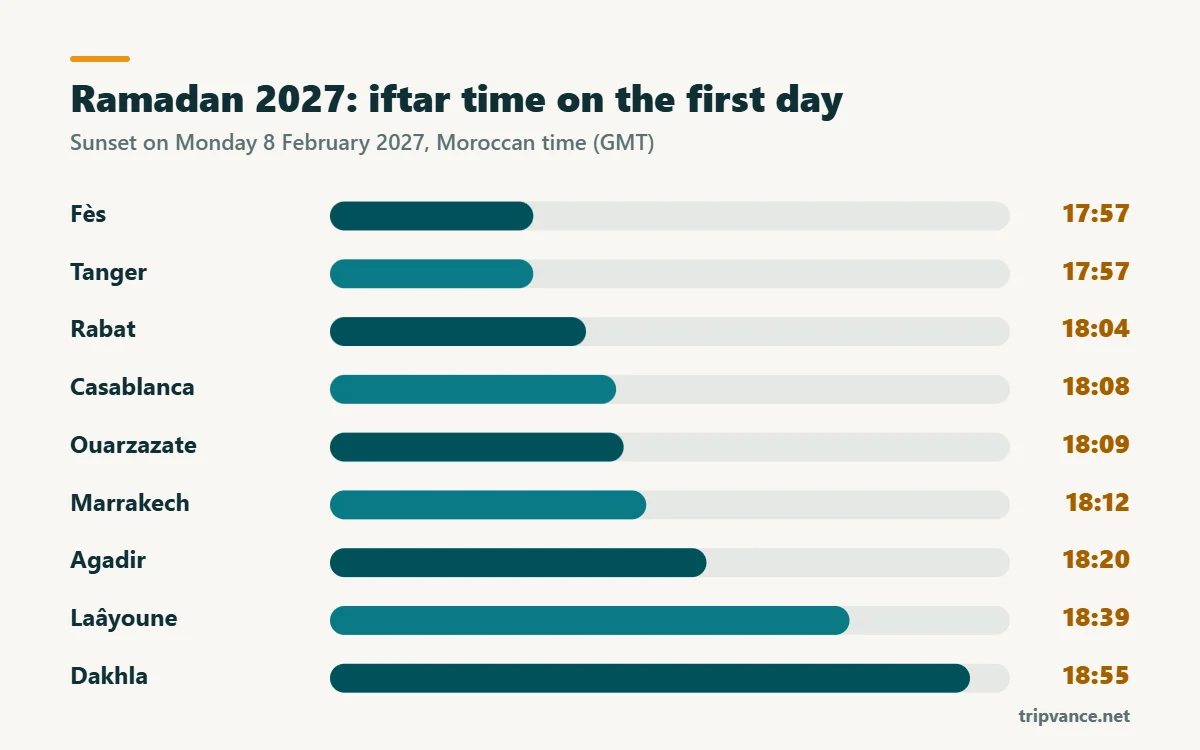
Fasting runs from dawn to sunset, so its length depends on where you are. In February and early March it is one of the shortest Ramadans of the decade, around 12 to 13 hours. Morocco now stays on GMT all year, so unlike previous years there is no clock change at the start or end of the month.
Independent tool. Ramadan dates are set in Morocco by the Ministry of Habous and Islamic Affairs after the crescent moon is sighted.
What a day looks like during Ramadan
The day follows the fast. Mornings start later, many shops in the medinas open around 10 am, and activity peaks in the late afternoon as people buy bread, dates and pastries for the evening meal. Shortly before sunset the streets empty fast: taxis are hard to find, drivers are in a hurry and traffic can be tense in the last 30 minutes. Then the call to prayer marks the end of the fast and the country sits down to eat.
A light meal before the fast begins. Some neighbourhoods still have a nafar, a man who walks the streets with a horn or drum to wake people up.
Fewer people outside, slower service, shorter opening hours in public offices. A good time for museums, gardens and long walks.
Markets are crowded, especially around bakeries and stalls selling chebakia, the honey and sesame pastry of Ramadan.
The fast is broken with dates, milk, harira soup, boiled eggs and pastries. Cities fall silent for about half an hour.
Cafés fill up, families walk, mosques hold the tarawih prayers. Squares such as Jemaa el-Fna stay busy late.
Rules and etiquette for visitors
Moroccan law does not require visitors to fast. Article 222 of the Penal Code punishes a person publicly known to be Muslim who openly breaks the fast in a public place during the day, without a reason accepted by the religion. It is aimed at Moroccan Muslims, not at foreign tourists, and it is a debated provision inside Morocco. In practice, what matters for you is courtesy.
- Eat, drink and smoke discreetly during the day: in your hotel, in a restaurant, not while walking through a souk.
- Carry water, and drink it out of sight if you can. In hot weather nobody expects you to go without.
- Dress a little more conservatively than usual, especially in mosques’ neighbourhoods and smaller towns.
- Avoid public displays of affection and loud music near mosques in the evening.
- If you are invited to an iftar, accept: it is the warmest experience of the month. Bring pastries or dates.
- Be patient with people who are fasting: a driver or a guide at 4 pm has not eaten since dawn.
Religious rules allow travellers to postpone the fast. Article 222 still concerns public places, so if you are not fasting while in Morocco, eat away from public view.
Restaurants, alcohol and opening hours
Most local cafés and snack bars close during the day and reopen at iftar. In Marrakech, Fès, Casablanca, Agadir, Essaouira and other tourist areas, hotel restaurants, many tourist restaurants and international chains keep serving lunch. In small towns and rural areas, plan a picnic or eat at your accommodation.
The sale of alcohol to Moroccan Muslims is prohibited all year. During Ramadan, many supermarkets stop selling alcohol entirely, and some bars close for the month. Licensed hotels usually continue to serve non-Muslim guests. If wine with dinner matters to you, ask your hotel before booking.
Public offices switch to a continuous 9 am to 3 pm schedule, Monday to Friday. Monuments and museums generally stay open but can close earlier than usual. Banks, pharmacies and shops in modern districts keep working, with shorter hours.
Is Ramadan a good time to visit Morocco?
The good side
- Quieter monuments and gardens during the day
- Mild weather in February and early March
- Unique evening atmosphere and iftar invitations
- Often lower hotel prices outside Eid
The trade-offs
- Fewer places to eat at lunchtime outside tourist areas
- Slower service and shorter opening hours
- Hard to find a taxi just before sunset
- Busy roads, trains and buses around Eid al-Fitr
For a city break or a desert trip, Ramadan works well. For a road trip through small villages, build in more time for meals. The busiest moment is the end: trains, buses and flights fill up as families travel for Eid al-Fitr, so book transport early if you are in Morocco around 9 to 11 March 2027.
Check your passport validity and entry rules in our Morocco visa guide, and add the trip dates to your international travel checklist. Mobile data is easy to sort with an eSIM for travel.
Frequently asked questions
Can tourists eat in public during Ramadan in Morocco?
The law targets Muslims, not foreign visitors, but eating openly in the street is seen as disrespectful. Eat in restaurants, hotels or private spaces during the day.
Are restaurants open during Ramadan in Morocco?
Yes in tourist areas: hotels, many tourist restaurants and international chains serve food during the day. Local cafés usually open only at sunset.
Can you buy alcohol in Morocco during Ramadan?
It is harder. Many supermarkets stop selling it and some bars close. Licensed hotels generally keep serving non-Muslim guests.
Does Morocco change its clocks for Ramadan 2027?
No. Since 20 September 2026, Morocco stays on GMT all year, so there is no clock change at the start or end of Ramadan.
When is Eid al-Fitr 2027 in Morocco?
It falls on 1 Shawwal, expected between 9 and 11 March 2027 depending on the moon. It is a two-day public holiday.
Do I need to fast if I visit Morocco during Ramadan?
No. Non-Muslim visitors are not expected to fast. Respecting those who do is enough.
Check your passport validity, find the right plug adapter or estimate your mobile data in a few clicks.
Open the travel tools- Ministry of Habous and Islamic Affairs, Kingdom of Morocco (official announcements and prayer times)
- GOV.UK: Morocco travel advice (local laws and customs)
- General Secretariat of the Government: Official Bulletin no. 7521 (decree no. 2.26.530 on legal time)
- Moonsighting.org.uk: crescent visibility predictions for Ramadan 1448
Updated November 2026. Dates are astronomical estimates until the official announcement in Morocco.