
Whether you need a visa for Morocco depends first on the passport you travel on, but not only on it. The official Accès Maroc checker also asks for your passport type, your country of usual residence, any other valid visa you hold, the purpose of your trip and whether you are taking part in an event in Morocco. Depending on the answers, a traveler may enter visa-free, need an electronic travel authorization (AEVM), qualify for an e-visa, or have to apply at a Moroccan embassy or consulate.
This is an independent guide written by Tripvance from public official information: the Accès Maroc portal of Morocco’s Ministry of Foreign Affairs, its published eVisa terms of use, Moroccan embassy pages and the travel advice of the British, French and Spanish governments. It explains the four entry routes, the e-visa fees and steps, and the documents border officers can ask for. It does not give a personal eligibility decision.
This Tripvance guide is independent information. It is not an official government service and is not affiliated with, authorized by, or endorsed by the Government of Morocco, the Moroccan Ministry of Foreign Affairs, or the Accès Maroc platform.
It is based on publicly available official sources and is intended for general guidance only. It is preliminary and does not constitute an official visa decision or a guarantee of eligibility.
Visa requirements and entry conditions may change without notice. Your passport type, country of residence, other visas you hold, the purpose of your trip and other individual circumstances may affect your eligibility.
Always verify your personal situation on the official Accès Maroc platform or with the relevant Moroccan embassy or consulate before booking travel or submitting an application. Only the competent Moroccan authorities can determine visa eligibility and authorize entry into Morocco.
With an ordinary passport and for tourism, many nationalities can visit Morocco without a visa; the British, French and Spanish governments, for example, say so for their own citizens. Other nationalities apply online for an e-visa (770 MAD standard), some need an AEVM, and others an embassy visa. A residence permit or a multiple-entry visa from certain countries can open the e-visa route. For your own case, only the official checker on acces-maroc.ma gives a reliable answer. Indian passport holders can read our Morocco visa for Indians guide.
Do you need a visa for Morocco? How to check your situation
Tripvance does not run a visa checker. The answer depends on several personal details, so only the official checker on the Accès Maroc portal can tell you which route applies to you. On its home page it asks six questions: your nationality, your country of usual residence, your document (passport) type, whether you are taking part in an event in Morocco, the purpose of your trip and whether you hold another valid visa.
The Accès Maroc portal is run by Morocco’s Ministry of Foreign Affairs. Tripvance is independent and not affiliated with it. Only the competent Moroccan authorities can decide on your visa and your entry.
Open the official Accès Maroc checkerPassport type matters. The official eVisa terms accept ordinary passports only: holders of diplomatic, service or special passports, refugee or stateless travel documents and other travel documents who are subject to a visa must apply at a Moroccan embassy or consulate.
The four ways to enter Morocco
Every passport falls into one of four routes. Knowing yours tells you how long the paperwork takes and where to do it.
| Route | Who | Where | Cost |
|---|---|---|---|
| Visa-free | Nationalities exempt from the visa requirement, such as British, French and Spanish citizens for tourism | Nothing to apply for | Free |
| AEVM | Some visa-exempt nationalities that must still register online before they travel | acces-maroc.ma | Online request |
| e-Visa | Category A nationalities, and visa-required travelers who meet the residence (B) or visa (C) condition | acces-maroc.ma | 770 or 1,100 MAD |
| Embassy visa | Visa-required travelers who do not qualify for the e-visa, and holders of non-ordinary passports | Moroccan embassy or consulate | Set by the consulate |
Visa-free countries: what you still need
Visa-free does not mean document-free. The British government says you can visit Morocco without a visa for up to 90 days for tourism and that your passport must expire at least 3 months after the day you arrive. Spain asks its citizens for a passport valid more than 6 months and reminds them that the Spanish ID card is not accepted. France states that the passport must cover the whole stay and that the national ID card alone no longer gets you in, even on an organized group tour.
- Passport, not ID card. France and Spain both state that their national ID cards are not accepted. Six months of validity keeps you safe whatever your airline checks.
- An entry stamp. Both London and Paris warn that travelers without a stamp have had trouble leaving. Check your passport before you walk away from the booth.
- A return ticket and funds. France notes that every non-resident visitor, visa or not, must carry a return ticket and proof of enough money for the stay.
- 90 days maximum. To stay longer you ask the Moroccan police or immigration service for an extension before day 90.
The land border between Morocco and Algeria is closed, according to French travel advice. Plan to arrive by air or by sea.
The Morocco e-visa: who can apply, fees and limits
The e-visa is issued only through acces-maroc.ma. The official eVisa terms of use define three groups of applicants, all holding an ordinary passport valid at least 90 days from the application date:
- Category A, by nationality. Citizens of countries listed by the Moroccan authorities. The version of the eVisa terms available on 11 November 2026 lists Azerbaijan, Benin, Brunei Darussalam, Cambodia, Guatemala, India, Jordan, Laos, Israel, Thailand and Vietnam. The list can change, so confirm with the official checker.
- Category B, by residence. Visa-required nationals who live in the European Union, the United States, Australia, Canada, the United Kingdom, Japan, Norway, New Zealand, the United Arab Emirates or Switzerland, with a residence card or permit valid at least 180 days on the application date.
- Category C, by visa. Visa-required nationals who hold a multiple-entry, non-electronic visa from the Schengen area, the United States, Australia, the United Kingdom, Ireland, Japan, Canada, Norway or New Zealand, valid at least 90 days from the application date.
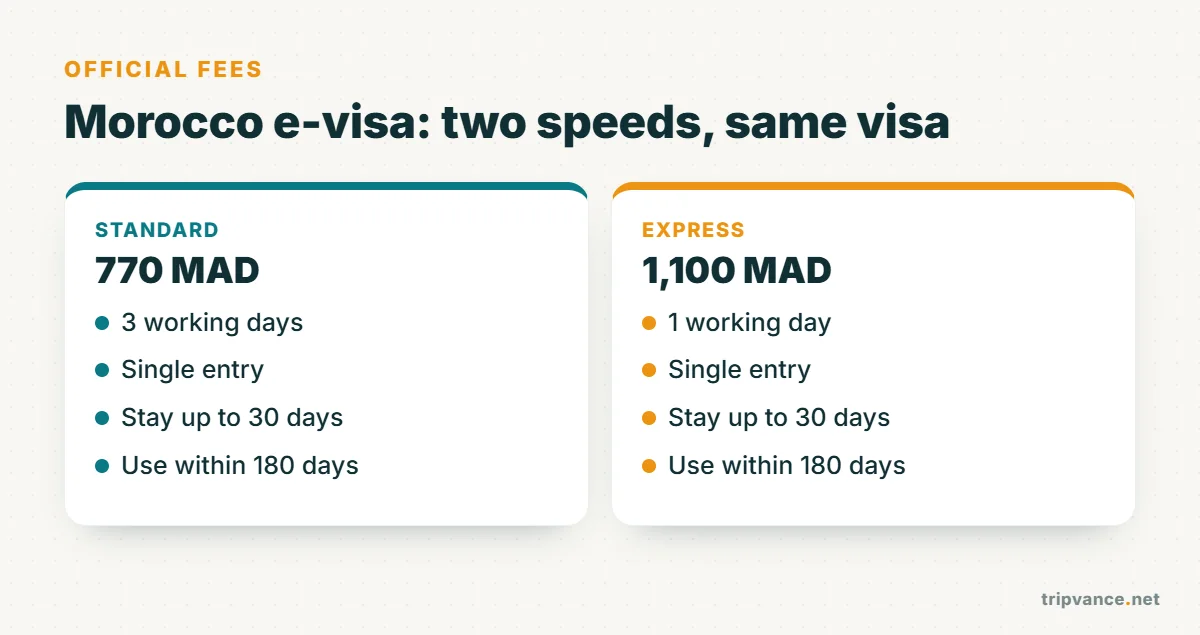
The portal sells two speeds. The standard e-visa costs 770 MAD and is processed in 3 working days, the express e-visa costs 1,100 MAD and takes 1 working day. The conditions put it in hours: 72 Moroccan working hours for standard, 24 for express, and the clock does not run on incomplete files. Both give a single entry, a stay of up to 30 days, and must be used within 180 days of issue.
Once an application is validated and paid, it cannot be cancelled or refunded. Two e-visas cannot be stacked to stay longer than 30 days in a row, and an e-visa never leads to residency in Morocco.
How to apply for the e-visa, step by step
The government guide describes the same sequence every applicant goes through. Allow 30 to 45 minutes if your scans are ready.
On the acces-maroc.ma home page, answer the six eligibility questions: nationality, country of residence, passport type, event participation, purpose of trip and any other valid visa.
The portal sends a secure link that opens your application form.
Copy names, dates and document numbers exactly as printed in your passport, residence card or visa.
JPG, JPEG or PDF files of 1 MB or less. A family or group can put its applications in one file.
Payment by bank card on the site of the Moroccan Treasury (Trésorerie Générale du Royaume), then follow the status in your account.
The documents asked for are short: a recent color photo of 35 x 45 mm taken within the last 6 months to ICAO standards, and a color copy of your passport identity and validity pages. Category B applicants add both sides of their residence card, Category C applicants add a copy of their visa. Receipts for a residence card renewal are not accepted. Business travelers attach an invitation or a recommendation that justifies the trip.
A status of “waiting to be completed” means the officer needs something more. Answer quickly, because the processing clock stops until you do.
The AEVM: an authorization, not a visa
The AEVM (Autorisation Electronique de Voyage au Maroc) is required for nationals of certain countries that are exempt from the entry visa. The official AEVM page does not publish the list of countries: the official checker tells you whether your passport needs one. You create an account on acces-maroc.ma, fill in the request form and attach an ID photo, your identity or residence card and the identity page of your passport.
The portal lists three exceptions: holders of a valid Moroccan residence permit, travelers in transit who stay inside the airport or port, and spouses of Moroccan citizens who carry the supporting documents.
Embassy visas: documents and timing
If the official checker sends you to a consulate and you do not qualify for Category B or C, apply at the Moroccan embassy or consulate that covers your place of residence. Moroccan embassy pages list the same core file for a tourist visa: the visa application form, two color photos of 4 x 3 cm on a white background, a passport valid longer than the stay with a copy of its identity pages, proof of address, a bank statement, a confirmed return ticket, travel insurance and a hotel booking or a travel agency voucher. A family visit replaces the hotel with a legalized invitation.
Consulates set their own fees and delays. Apply at least a month ahead, longer around Eid holidays and the summer peak.
What to carry at the Moroccan border
The eVisa conditions list what an officer can ask to see on arrival, on top of your passport and the printed e-visa. Visa-free travelers should carry the same file, since France reminds its citizens that a return ticket and proof of means apply to everyone.
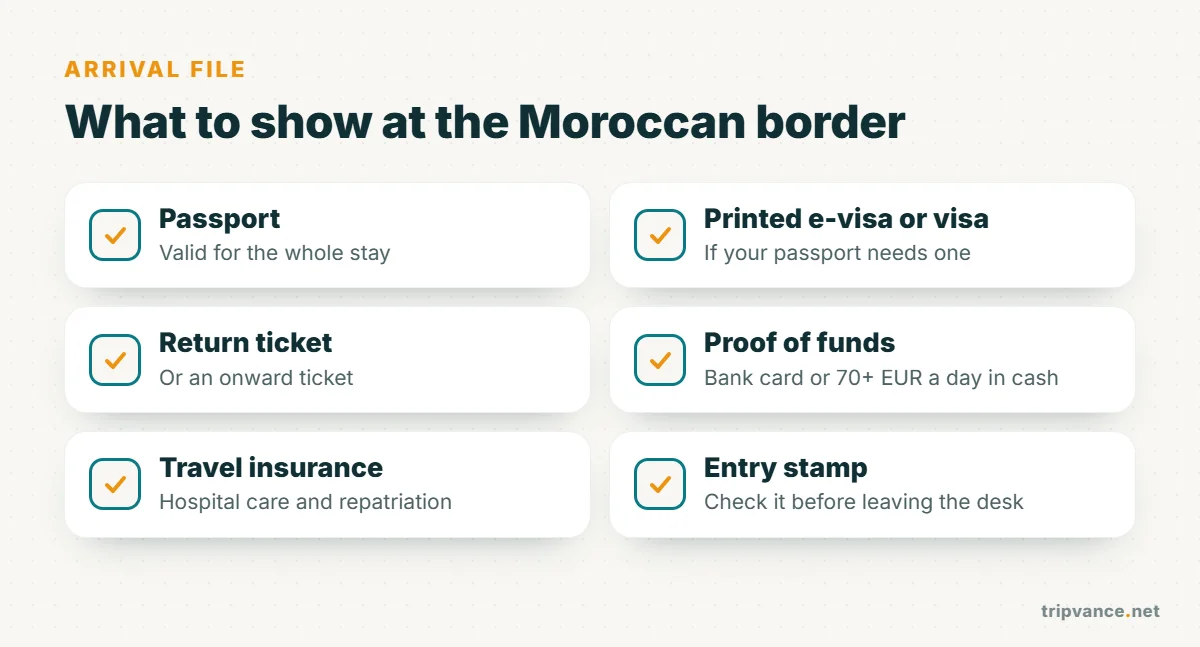
- The residence card or visa you used for a Category B or C application.
- A return or onward ticket.
- Proof of funds: an international bank card, or more than 70 euros in cash per person per day of stay.
- Insurance covering hospital care and medical repatriation for the whole trip.
- For children: a minor holding an e-visa may enter only with a parent or legal guardian. France also advises carrying proof of filiation and a letter from the absent parent.
Once the entry question is settled, our international travel checklist covers insurance, money and copies of your documents, and the packing list helps you fit it all in.
Morocco visa FAQ
Does Morocco offer a visa on arrival?
The official portal lists no visa on arrival. Visa-free travelers simply show their passport, and everyone else must hold an e-visa, an AEVM or an embassy visa before boarding.
How long does the Morocco e-visa take?
Three working days for the standard e-visa at 770 MAD and one working day for the express option at 1,100 MAD, counted in Moroccan working hours. Incomplete files take longer.
Can I enter Morocco with a Schengen visa?
A Schengen visa does not replace a Moroccan visa. Under Category C of the official eVisa terms, a traveler who needs a visa and holds a multiple-entry, non-electronic Schengen visa valid at least 90 days can apply for the e-visa. The official checker confirms whether your nationality qualifies.
How long can I stay in Morocco without a visa?
Generally up to 90 days for tourism. Beyond that you must request an extension from the Moroccan police or immigration service before the 90 days end.
Is the e-visa a multiple-entry visa?
No. The portal sells single-entry e-visas only, valid up to 180 days from issue, for a stay of up to 30 days.
- Accès Maroc, eligibility checker and e-visa page (Ministry of Foreign Affairs of Morocco)
- eVisa terms of use (PDF, Accès Maroc)
- Accès Maroc, AEVM page
- Embassy of Morocco, documents required for a visa
- GOV.UK, Morocco entry requirements
- France Diplomatie, Maroc entrée et séjour
- Spanish Ministry of Foreign Affairs, travel advice for Morocco
Tripvance presents this information independently and in its own words. This page has no technical connection with the Accès Maroc portal and is not updated in real time: it is a manually maintained summary.
Last verified: Accès Maroc pages and eVisa terms on 11 November 2026; British, French and Spanish travel advice on 8 November 2026. Rules can change without notice: confirm on acces-maroc.ma before you book.