
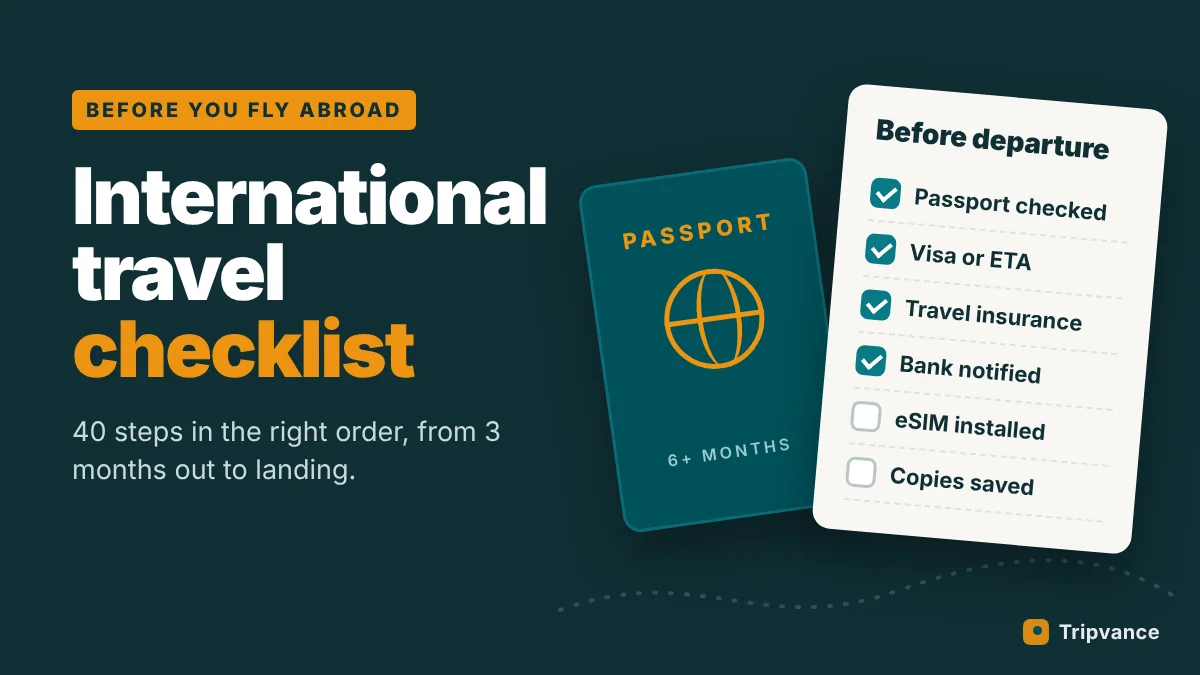
This international travel checklist puts 40 tasks in the order you should do them, because most trips abroad go wrong on timing, not on packing. A passport that expires in four months, an entry permit you did not know existed, a bank card frozen on the first evening: each one is easy to fix three months out and very hard to fix at the airport. Work through the lists below from the top and tick as you go.
The short answer
- Check your passport first. Many countries and airlines want it valid for 6 months after you leave. The US State Department has listed routine processing at 4 to 6 weeks in 2026, plus up to 2 weeks of mailing each way. Check the live figure before you book.
- Look up entry rules on official sites only. The UK now requires an ETA (£20) from US travelers. The EU’s ETIAS is still not running.
- See a doctor about a month before if your destination needs vaccines or malaria tablets.
- Sort money and phone a week out: a card without foreign transaction fees, a second backup card, an eSIM or roaming plan.
- Keep copies of your passport, insurance and bookings offline on your phone and in the cloud.
The international travel checklist timeline
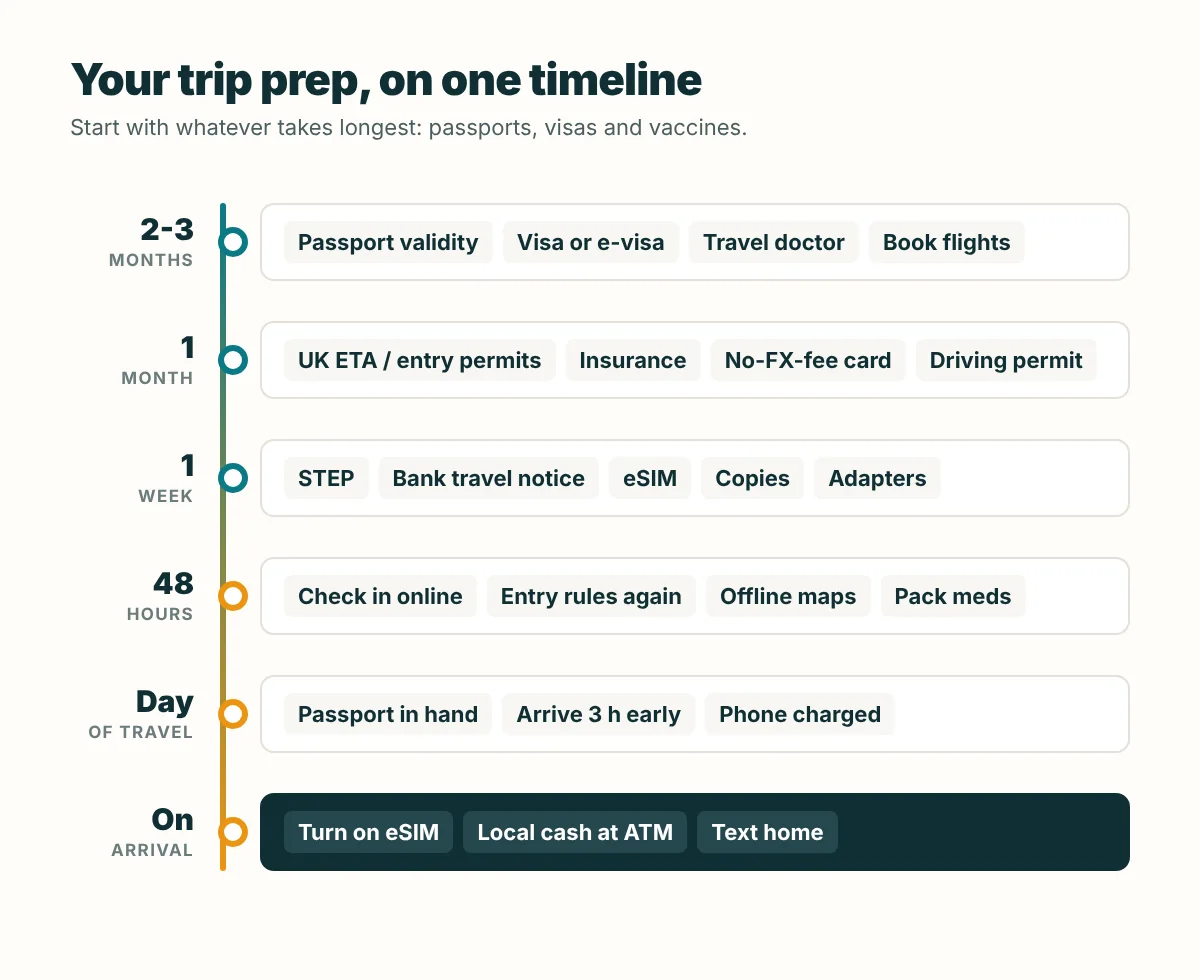
The order matters more than the list. Anything that depends on a government office (passports, visas, driving permits) or on your body (vaccines that need two doses) goes first. Anything that depends on your phone or your bag can wait until the last week.
If you are booking a last-minute trip, do not skip steps: compress them. Do the passport and entry permit checks the same day you book, before you pay for anything non-refundable.
2 to 3 months before: passport, visas, health
- 1. Check your passport expiry date against the 6-month rule explained below.
- 2. Count the blank pages. Some countries ask for one or two fully blank visa pages. Amendment and endorsement pages do not count.
- 3. Renew now if you are close. In 2026 the US State Department has listed routine processing at 4 to 6 weeks and expedited at 2 to 3 weeks (60 dollars extra), not counting up to 2 weeks of mailing each way. The figure moves with demand, so check travel.state.gov on the day you apply.
- 4. Check entry requirements for every country, including the ones you only transit, on the destination’s official government site or the US State Department country page.
- 5. Apply for any visa or e-visa. Embassy visas can take weeks. Use only the official government portal; look-alike sites charge extra fees for the same form.
- 6. Book a travel health appointment. Check the CDC Travelers’ Health page for your destination, then see your doctor or a travel clinic at least a month before you leave.
- 7. Check the travel advisory level for your destination on travel.state.gov.
- 8. Book flights and the first nights of accommodation, ideally with free cancellation until your documents are confirmed.
- 9. Check that names match exactly between your ticket and your passport, including middle names if the airline asks.
- 10. Start a simple trip plan with dates, cities and booking numbers. Our travel itinerary template gives you a ready layout.
The 6-month passport rule
Many countries refuse entry if your passport expires within six months of your travel dates, and airlines check this before you board because they pay to fly you back if you are refused. The safe reading is six months counted from the day you leave the destination, not the day you arrive.
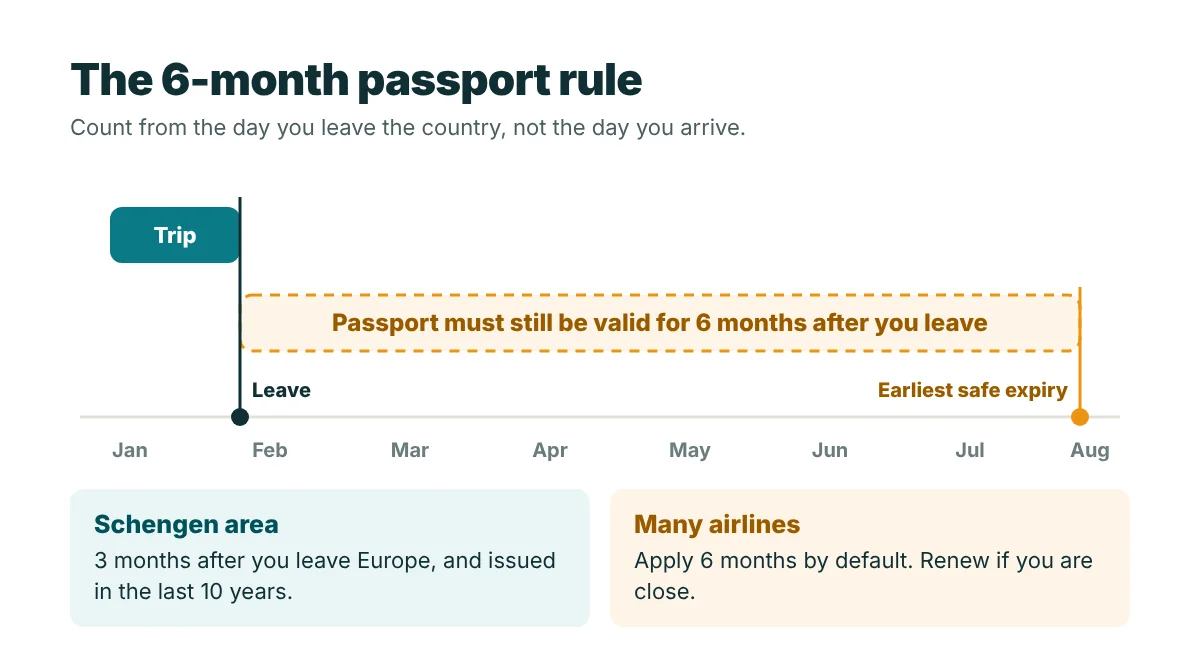
The rule is not the same everywhere. The 29 Schengen countries require a passport valid at least three months after you leave the Schengen area and issued within the previous 10 years. Some countries only need it valid for your stay. Because airline staff often apply six months as a blanket check, our advice is to renew whenever you are under seven months on the departure date.
Visas, e-visas and travel authorizations in 2026
A growing number of visa-free countries now ask visitors to register online before they travel. These permits are cheap and fast, but airlines will deny boarding without them.
UK ETA
US citizens and most other visa-free visitors need an Electronic Travel Authorisation (ETA) to visit the United Kingdom. As of October 2026 it costs £20 per person, babies and children included. It is valid for two years or until your passport expires, whichever comes first, and covers visits of up to six months each. Most decisions arrive within a day, but allow at least three working days. You also need one if you change planes in the UK and pass through UK border control. Apply on GOV.UK or the official UK ETA app, not on third-party sites.
ETIAS for Europe
ETIAS, the European travel authorization for visa-free visitors, is still not in operation as of October 2026. The fee has been set at EUR 20, and the EU says it will announce the start date several months before launch. Until then, nobody can apply, so any site asking you to pay for ETIAS today is not official. Our ETIAS 2026 guide tracks the launch status and the EUR 20 fee.
What did start is the EU Entry/Exit System (EES), fully operational at Schengen external borders since April 10, 2026. On your first entry, border officers record your fingerprints and a facial image instead of stamping your passport. Expect a slightly longer queue the first time.
Entry rules change with little notice. Always confirm on the destination government’s own website or the State Department’s country page in the week before you fly, not on a blog, including this one.
1 month before: insurance, money, driving
- 11. Apply for your ETA or e-authorization if you have not already.
- 12. Buy travel insurance that covers medical care abroad and emergency evacuation. Many US health plans, and Medicare, offer little or no cover outside the US.
- 13. Get your vaccines and prescriptions, including any malaria tablets that must be started before departure.
- 14. Get a credit card with no foreign transaction fee if you do not have one. Fees on each purchase add up fast on a two-week trip, and our guide to using a credit card abroad shows how to avoid the others.
- 15. Order a backup card on a different network (Visa and Mastercard, for example).
- 16. Get an International Driving Permit if you will drive. In the US only AAA and AATA are authorized to issue it; it costs $20, is valid for one year and must be carried with your US license.
- 17. Book anything with limited capacity: trains, museum time slots, popular tours, airport transfers.
- 18. Check your phone plan and decide between international roaming, a travel eSIM or a local SIM.
- 19. Check medication rules at your destination. Some countries restrict common drugs, including some ADHD and pain medications, so check the embassy website and carry a doctor’s letter.
1 week before: phone, copies and the small stuff
- 20. Enroll in STEP. The State Department’s free Smart Traveler Enrollment Program sends you safety alerts and lets the embassy contact you in an emergency.
- 21. Tell your bank you are traveling, or check in your banking app that travel notices are no longer needed.
- 22. Install and test your eSIM before you leave, while you still have home Wi-Fi.
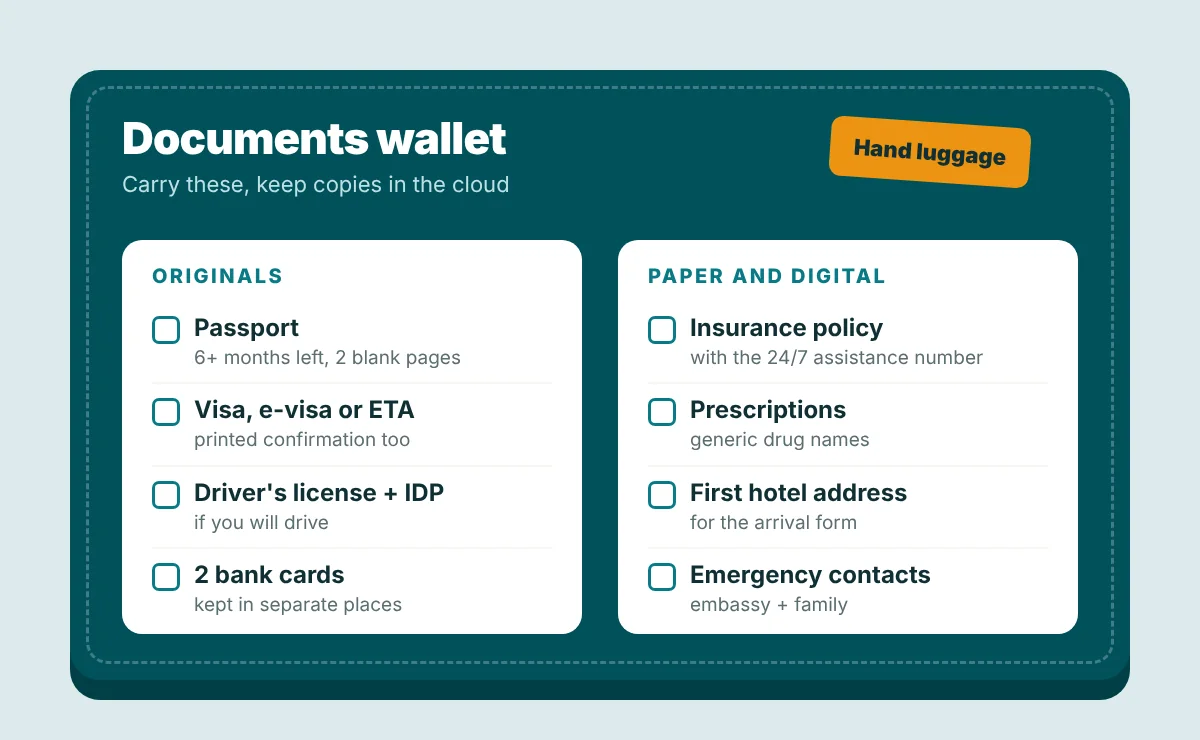
- 23. Save copies of your documents: passport photo page, visa or ETA, insurance policy, bookings. Keep them offline on your phone and in a cloud folder someone at home can access.
- 24. Buy the right plug adapters. Europe mostly uses type C and F plugs, the UK type G. Check that chargers say 100-240V before you plug in.
- 25. Write down emergency contacts: the nearest US embassy, your insurer’s 24/7 number, your bank’s international number and a family contact.
- 26. Arrange home basics: mail hold, pet care, plants, bills that fall due while you are away.
- 27. Check your airline’s bag rules. Use our guide to carry-on size by airline, especially if one leg is on a budget carrier.
- 28. Start packing from a list. Our packing list for travel covers clothes, toiletries and tech.
48 hours before departure
- 29. Check in online and download boarding passes to your phone.
- 30. Recheck entry rules and any arrival forms that must be filled in online before landing.
- 31. Download offline maps and the transit app for your first city.
- 32. Pack medication in your carry-on in original labeled containers, with enough for a few extra days.
- 33. Pack liquids to the 100 ml rule. See our TSA liquid rules guide.
- 34. Get a little local cash if you land late at night, or plan to use an airport ATM.
Day of departure
- 35. Passport in your hand, not in the checked bag. Touch it before you lock the door.
- 36. Arrive early. Three hours before an international flight is the usual advice from US airlines.
- 37. Charge your phone and a power bank. Power banks go in carry-on bags only.
- 38. Keep the first night’s address handy for the immigration form.
On arrival
- 39. Switch on your eSIM or roaming and send a short message home.
- 40. Withdraw local currency from a bank ATM and always choose to be charged in the local currency, not dollars, when a card machine offers the choice.
That last tip saves real money. The “pay in your home currency” option, called dynamic currency conversion, uses the merchant’s exchange rate, which is almost always worse than your card’s.
Crossing several time zones? Start shifting your sleep a few days before departure and use daylight on arrival: our jet lag plan gives a day-by-day schedule for flights east and west. Keep your boarding passes and baggage tags until you are home, too. You will need them if you claim flight delay compensation or report a lost bag.
International travel checklist: frequently asked questions
What documents do I need to travel internationally?
A valid passport, any visa or electronic travel authorization your destination requires, proof of onward travel if asked, and your travel insurance details. Drivers also need their license and often an International Driving Permit.
Can I travel with a passport that expires in less than 6 months?
Sometimes. Some countries only require validity for your stay, and Schengen countries ask for three months after departure. But many countries and airlines apply six months, so renewing is the safe choice.
Do US citizens need ETIAS to visit Europe in 2026?
No. As of October 2026 ETIAS is not operating and no one can apply. The EU will announce the start date several months in advance. The UK is different: US citizens do need a UK ETA.
How early should I start preparing for an international trip?
Two to three months ahead is comfortable. That covers a routine passport renewal, a visa if needed and a vaccine course. For a short-notice trip, check your passport and entry rules before booking.
Is travel insurance required?
Some countries require proof of medical insurance, for example for certain visas. Even where it is optional, it is worth it: a hospital stay or medical evacuation abroad can cost tens of thousands of dollars.
- US State Department: Passport processing times
- US State Department: Smart Traveler Enrollment Program (STEP)
- US State Department: Driving and road safety abroad
- GOV.UK: Get an electronic travel authorisation (ETA)
- European Commission: ETIAS
- EU official ETIAS website
- eucrim: Entry/Exit System fully operational since 10 April 2026
- CDC Travelers’ Health
- AAA: How to get an International Driving Permit
Last updated: October 2026