If you are wondering how to start a travel agency in 2026, the honest answer is that the hard part is no longer the paperwork. You can register a business in a week and join a host agency in a day. The hard part is choosing a model that fits your money and time, picking a niche narrow enough to be found, and getting your first twenty clients. This guide walks through each step in the order that saves you money, with the legal checks, typical commissions and a 90-day plan.
The short answer
- Pick a model first: home-based advisor with a host agency, independent agency, online niche agency, or tour operator / DMC.
- Choose one niche (a destination, a traveler type or a trip style) before you build anything.
- Register the business, then check seller of travel rules. California, Florida, Washington and Hawaii all require registration or a license.
- Get E&O insurance and decide how you will hold client money (trust account or bond where required).
- Budget example: a home-based start with a host agency can stay in the low thousands of dollars. A licensed tour operator costs far more.
- Plan for 90 days of setup and marketing before steady bookings arrive.
Step 1: choose your travel agency business model
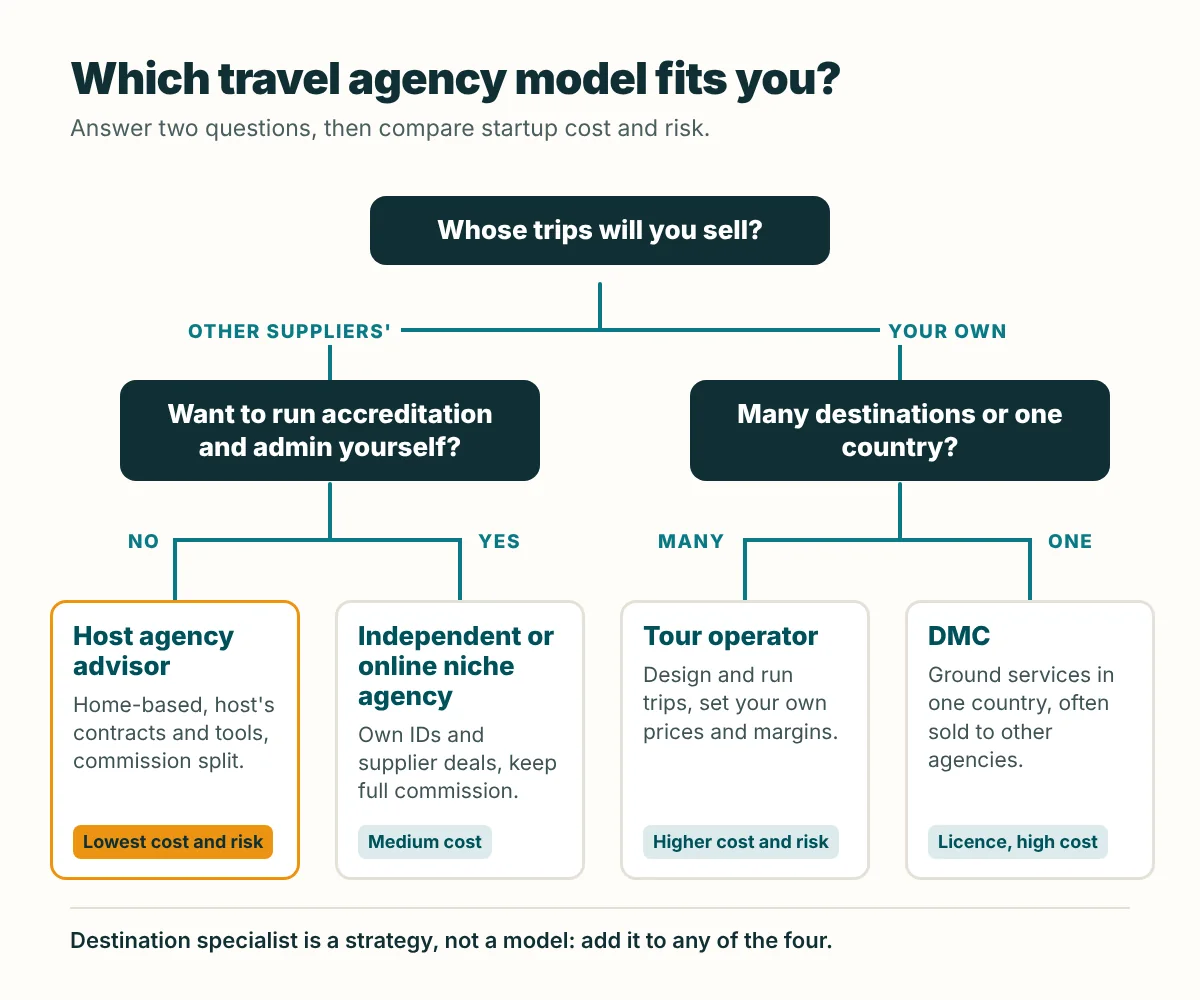
Every other decision depends on this one. The model decides your startup cost, whether you need accreditation, how you get paid and how much risk you carry when a supplier fails.
Home-based advisor with a host agency
This is how most new advisors start a travel agency from home. A host agency lends you its accreditation, supplier contracts, booking tools and training. You sell, the host collects the commission, and you keep a share. A 70/30 split in your favor is a common starting point, and some hosts go to 80% or 90% in exchange for higher membership fees. It is the cheapest route and the one we would suggest if you have never sold travel before. If you would rather start as an agent before running your own agency, our guide on how to become a travel agent compares the three paths.
Independent agency
You hold your own industry identifiers, sign your own supplier agreements and keep 100% of the commission. In return you handle accreditation, compliance and back office yourself. It makes sense once you have a book of clients and know which suppliers you sell most.
Online niche agency
A small online agency wins on focus, not on price: honeymoons in the Indian Ocean, accessible travel, scuba trips, family ski weeks. You cannot outspend large OTAs on ads, so your website content and reputation do the selling.
Tour operator or DMC
Here you create and run the trips: guides, vehicles, hotels, activities. Margins are higher (you set the price) but so is the risk, because you pay suppliers and carry the liability. A destination management company (DMC) does the same thing in one country and often sells to other agencies.
Destination specialist
This is less a separate model than a strategy you can add to any of the above. Selling one destination deeply is the fastest way to become the name people recommend.
Step 2: pick a niche you can explain in one sentence
“Full-service travel” is not a niche. “Small-group food trips to Morocco and Portugal for travelers over 50” is. A niche helps you choose suppliers, write useful content and appear in search results that big brands ignore.
- Destination: one country or region you know well and can visit regularly.
- Traveler type: families with young kids, solo women, retirees, LGBTQ+ travelers, travelers with reduced mobility.
- Trip style: cruises, safaris, pilgrimages, adventure, weddings and honeymoons, corporate groups.
Test it before you commit. Can you name ten suppliers in that niche? Are there people already asking questions about it in forums and social groups? Would you happily talk about it every day for three years? If the answer to all three is yes, keep it.
Step 3: register the business and check seller of travel laws
Start with a business entity. In the US, many solo advisors begin as a sole proprietor or form an LLC to separate personal and business assets. Ask an accountant which structure fits your state and tax situation, then open a separate business bank account from day one.
US seller of travel registration
Several states regulate businesses that sell travel. These are the four most often cited, with requirements as we found them on official state sites in October 2026:
| State | What is required | Fee (official source) |
|---|---|---|
| California | Registration with the Attorney General before operating; trust account or bond in some cases; Travel Consumer Restitution Fund for California-based sellers | $100 per business location per year |
| Florida | Annual registration with FDACS plus a surety bond ($25,000 standard, $10,000 possible for new businesses) | $300 per year |
| Washington | Seller of travel license through the Business Licensing Service; trust account or bond ($10,000 to $50,000) if you hold client funds over 5 business days | $222 (fee schedule under review in 2026) |
| Hawaii | Travel agency registration with DCCA and a client trust account at a Hawaii bank | $146 or $215 depending on the year you apply |
Rules can reach you even when you live elsewhere, if you actively sell to residents of these states. If you join a host agency, ask whether its registration covers you and confirm the answer with the state, because the host’s word is not a legal opinion.
Industry identifiers: IATA, ARC and CLIA
Suppliers want to know who you are before paying commission. The cheapest entry is the IATA TIDS code, a non-ticketing identifier that IATA now provides free of charge. ARC accreditation lets a US agency issue airline tickets, but it involves an application fee and a bond, so most new agencies skip it and book air through a consolidator or host. CLIA membership matters if cruises are a big part of your plan. Confirm current fees directly with each body, as they change.
Outside the United States
Most countries license travel agencies. In France, travel operators must register with Atout France (the official guide lists a fee of 100 euros, renewed every 3 years) and prove a financial guarantee and professional liability insurance. In Morocco, Law 11-16 requires a licence from the competent administration, a permanent financial guarantee and civil liability insurance, and the licence number must appear on your website. Check the official texts in your own country before you take a deposit.
The most common legal mistake is accepting client deposits into a personal account. Set up the business account, and the trust account or bond if your state requires one, before your first sale.
This guide is general information, not legal or tax advice. Licensing rules differ by state and country and change over time, so confirm them with the regulator, an accountant or a lawyer before you register the business or take client money.
Step 4: insurance and protecting client money
Errors and omissions (E&O) insurance covers you when a client claims you made a mistake: a wrong date, a missed visa requirement, a booking that was never confirmed. Insureon reports a median of about $451 a year for travel agent E&O, and about $350 a year for general liability, based on its customers’ policies. Your price depends on revenue, location and claims history. Many host agencies include E&O or require you to buy it, so read the contract.
Also offer travel insurance to every client and record their answer. If someone declines cover and later cancels, a signed “declined” note protects you more than any policy.
Step 5: suppliers, commissions and how you get paid
Travel agencies earn money in three ways: commission from suppliers, service fees charged to clients, and markup on packages you build yourself. Typical commission ranges reported by Fora Travel in 2026:
| Supplier type | Typical commission |
|---|---|
| Hotels | 5% to 10%, higher with preferred programs |
| Cruises | 10% to 20% of the commissionable fare |
| Tours and packages | 10% to 20% |
| Domestic airfare | 0% to 5% |
| International airfare | 5% to 15%, depending on airline and cabin |
Commissions are paid after travel, often weeks later. A trip you sell in March may pay you in September. That cash gap is why a service fee (for planning, for complex itineraries, for air-only bookings) is worth charging from the start. Clients who value your time will pay it, and it filters out people collecting free quotes.
Build supplier relationships slowly. Register with the tour operators, hotel groups and cruise lines that serve your niche, do their online training, and ask local partners (guides, drivers, small hotels) for net rates if you plan to build your own packages.
How much does it cost to start a travel agency?
Costs vary enormously by model. The example below is for a home-based advisor in the US joining a host agency, using fees verified above where possible. It is an example budget, not a quote.
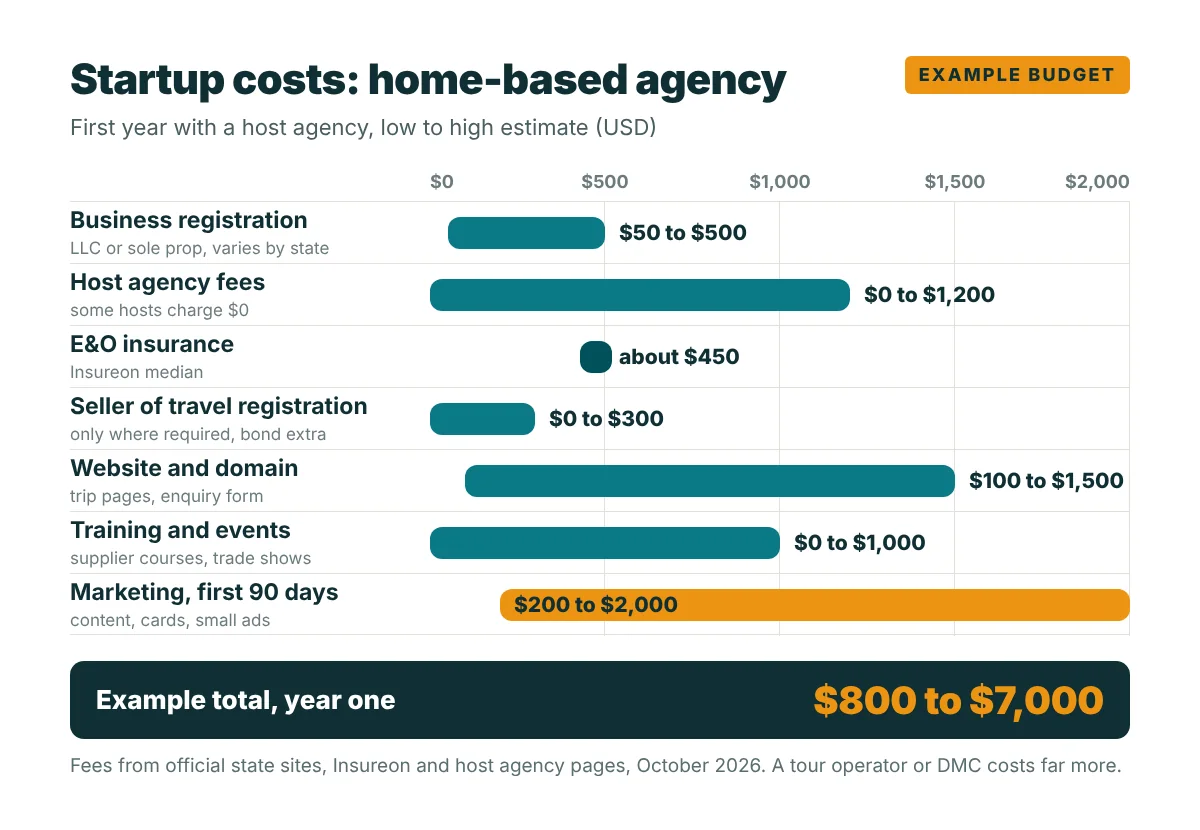
Can you start a travel agency with no money? Almost. Some host agencies have low or no joining fees, and a basic website can cost very little. But “no money” usually means paying with your time, and you still need E&O cover and any state registration. A tour operator or DMC is a different scale: vehicles, deposits to hotels, a licence and a financial guarantee can run into tens of thousands.
Step 6: the tech stack a small agency needs
- CRM: a place to store clients, trip history, passport expiry dates and preferences. Many hosts provide one.
- Itinerary and booking tools: supplier portals, a GDS or consolidator for air, and an itinerary builder that produces a clean document for the client.
- Website with real trip pages: one page per trip or service, with price “from”, what is included, day-by-day plan and an enquiry form. This is what people find on Google.
- Payments: card payments through the supplier where possible, so client money goes straight to the operator. Use your own payment links only for your service fees or your own packages.
If you run your own tours, you will need software that handles availability, itineraries and bookings. We cover the options in our guide to tour operator software. For agencies on WordPress, Tripvance is the free plugin we build to publish tours, activities and transfers with day-by-day itineraries, booking requests and invoices; you can see what it covers on the features page.
Step 7: marketing that works for a new agency
SEO content
Write the pages your future clients search for: “10 days in Japan with kids”, “best time to visit Patagonia”, “is a Nile cruise worth it”. Each useful article brings visitors for years. Two strong articles a month beat ten thin ones.
Google Business Profile
If clients can meet you, create a Google Business Profile. Home-based advisors who visit clients should set it up as a service-area business and hide the home address. Google does not accept virtual offices, so do not list a rented mailbox.
Social media and partnerships
Choose one platform where your niche spends time and post consistently. Partnerships often work faster than ads: wedding planners for honeymoons, dive schools for scuba trips, churches and community groups for pilgrimages, employers for incentive travel.
Need a website that sells trips? We design travel agency websites with real tour pages, booking requests and multilingual content, built on WordPress.
See our website design serviceYour first 90 days: a launch plan
Ninety days is enough to set up properly and make your first sales, if you work on legal, suppliers, website and marketing in parallel rather than one after another.
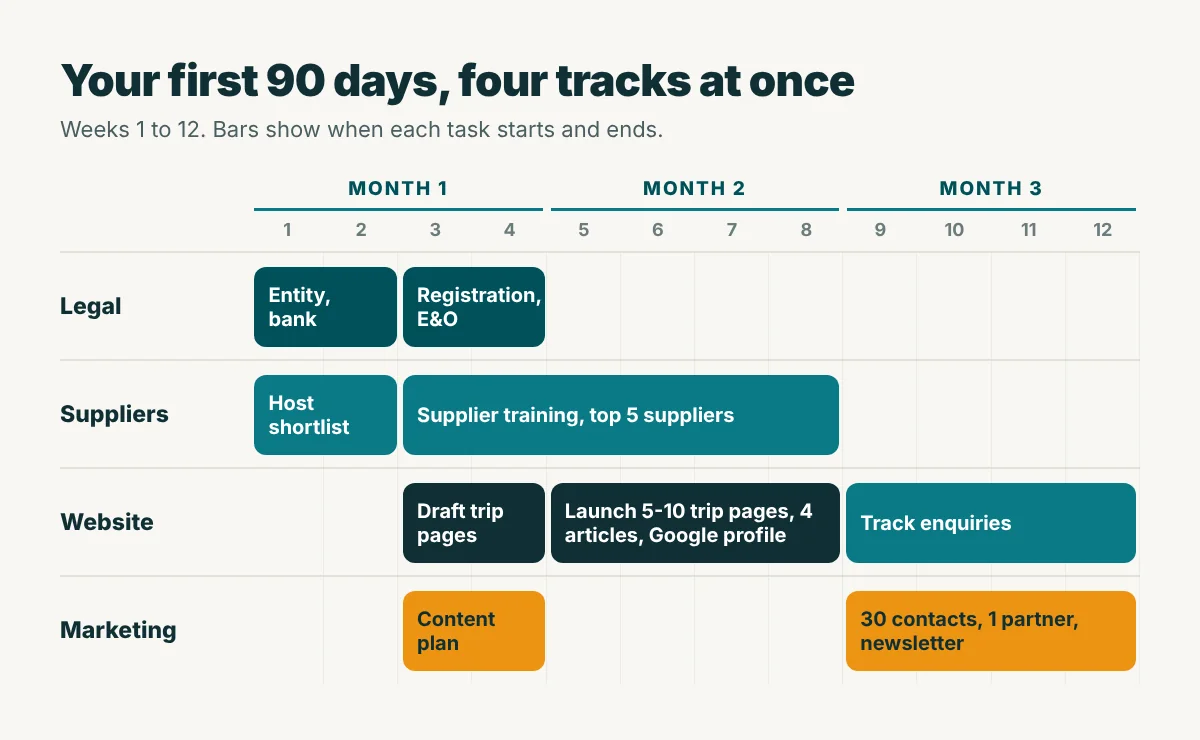
- Weeks 1 to 2: choose your model and niche, form the business, open the bank account, compare three host agencies.
- Weeks 3 to 4: state registration if needed, E&O insurance, supplier training for your top 5 suppliers.
- Weeks 5 to 8: launch the website with 5 to 10 trip pages, set up your Google Business Profile, publish your first 4 articles.
- Weeks 9 to 12: contact 30 people in your network personally, run one partnership, send your first newsletter, review which pages bring enquiries.
Common mistakes to avoid
- Selling everything to everyone instead of choosing a niche.
- Taking deposits before registration, insurance and a business account are in place.
- Paying for expensive “franchise” packages before comparing ordinary host agencies.
- Waiting for a perfect website instead of publishing a few good trip pages.
- Working for free: no service fee, unlimited quotes, no deposit to start planning.
- Ignoring cash flow: commissions arrive after travel, bills arrive now.
Once you are ready to grow, compare the free and paid options on our pricing page before you commit to monthly software bills.
How to start a travel agency: FAQ
Do I need a license to start a travel agency?
It depends on where you sell. In the US there is no federal travel agent license, but states such as California, Florida, Washington and Hawaii require registration or a license. Many other countries, including France and Morocco, license all travel agencies.
Can I start a travel agency from home?
Yes. Most new advisors work from home with a host agency that provides accreditation, supplier contracts and tools. Check your local zoning rules if clients will visit your home.
How do travel agents make money?
Through supplier commissions (often 10% to 20% on tours and cruises, less on hotels and air), service fees paid by clients, and markup on packages they build themselves.
What is a host agency?
A host agency is an established agency that lets independent advisors book under its accreditation and supplier agreements. In exchange it keeps part of the commission and may charge a membership fee.
How long before a new travel agency makes money?
Plan for several months. Even if you sell in your first month, commissions are usually paid after the client travels, so cash can arrive 3 to 9 months after the sale.
- California Attorney General: Seller of Travel registrant FAQ
- Florida FDACS: Seller of Travel registration package guide
- Washington DOL: Get your sellers of travel license
- Washington DOL: WAC 308-129-110 seller of travel fees
- Hawaii DCCA: travel agency registration instructions
- IATA: Travel Industry Designator Service (TIDS)
- French administration guide: registering a travel agency with Atout France
- Morocco: Law 11-16 regulating the travel agent profession (Adala)
- Insureon: travel agent insurance costs
- Fora Travel: travel agent commission rates
- Google: Business Profile guidelines
Last updated: October 2026