

Learning how to plan a road trip comes down to one honest question: how many hours a day do you actually want to sit behind the wheel? Get that number right and everything else falls into place, from where you sleep to how much fuel you buy. Get it wrong and a dream drive turns into a week of motel parking lots. This step-by-step planner walks you through the route, the stops, the budget (with a real fuel cost formula), the car, and the apps worth using in 2026.
The plan in 30 seconds
- Choose the shape first: one-way, loop, or hub and spoke. It decides your costs and your pace.
- Cap driving at 4 to 6 hours a day, and add 25% to whatever the map app says.
- Pick overnight stops before sights. Book the first night, the last night and any busy weekend.
- Fuel budget = distance ÷ fuel economy × price per gallon, plus 10% for detours.
- Break every 2 hours or 100 miles, as AAA recommends, and never drive through the night.
Step 1: pick the shape of your trip
Before you open a map, decide what kind of road trip you are taking. There are three shapes, and each one changes the budget and the rhythm of the days.
- The loop. You start and finish at home or at the same rental desk. It is the cheapest option for rental cars because there is no one-way drop fee, and you can turn back early if plans change.
- The one-way line. Fly in to one city, drive, fly home from another. You see more and backtrack less, but rental companies often charge a drop fee for returning the car somewhere else. Ask for the total price before you book.
- Hub and spoke. You stay two or three nights in one place and take day drives from it. Packing and unpacking drops to almost zero. It suits families with small children and anyone who hates checking out at 10 a.m. every day.
Our advice for a first long road trip: a loop of 5 to 8 days with one or two hub stays in the middle. It gives you the feeling of being on the move without the fatigue of a new bed every night.
Step 2: set a realistic daily driving limit
This is where most road trip plans fail. Map apps give you pure driving time with no fuel stops, no lunch, no traffic jam in the next town, no stop for the view that made you take the trip. In practice, add 25% to the app’s estimate for a day with normal breaks, and more with children or pets.
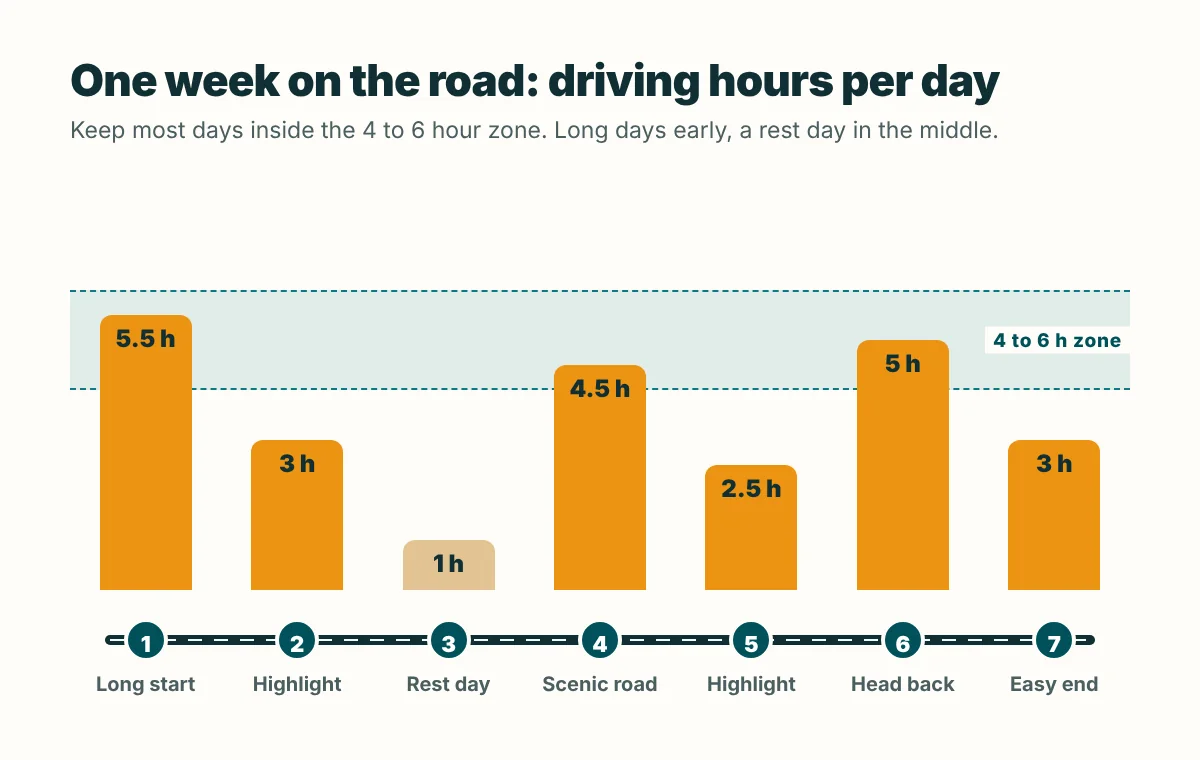
A good rule of thumb is 4 to 6 hours of driving per day. Four hours leaves a full afternoon to explore. Six hours is a travel day with a short visit at the end. Anything above 7 hours should be the exception, placed early in the trip when everyone is fresh, and never two days in a row.
Plan breaks into the schedule
AAA recommends stopping every two hours or every 100 miles, and earlier if you notice signs of sleepiness. Build those stops into the plan as named places: a viewpoint, a bakery, a town square. Breaks that have a purpose actually happen. Breaks that are “we’ll see” usually get skipped.
Step 3: plot your route and stops
Work from big to small. First the overnight towns, then the sights between them, then the small stuff like fuel and food. This order keeps the daily driving under control.
- Mark the non-negotiables. The 3 to 5 places that are the reason for the trip. Everything else is optional.
- Place the overnight stops. Divide the route so each day lands within your driving limit. Prefer towns with several places to stay and somewhere to eat after 8 p.m.
- Add day stops. One or two per driving day is plenty. A day with five stops means you will rush all five.
- Check opening days. Museums, national park visitor centers and small restaurants often close one or two days a week. Shift the route, not the dream.
- Leave one empty half day. Every week of driving needs a slot for bad weather, a flat tire or a place you want to stay longer in.
Write the result in a simple day-by-day table. Our free travel itinerary template has the columns ready (date, start, end, drive time, overnight, confirmation number) so you can copy it into Google Sheets in a minute.
Step 4: decide what to book and what to leave open
Booking everything kills the freedom of a road trip. Booking nothing can leave you driving at 10 p.m. looking for a bed. The middle path works best:
- Always book: the first night (you will be tired), the last night (you have a flight or work the next day), and any night on a Friday, a Saturday or a holiday weekend.
- Book early: lodging inside or next to popular national parks, and any timed-entry tickets or permits. These sell out weeks or months ahead in high season.
- Keep flexible: weekday nights in towns with plenty of hotels. Choose free cancellation rates so you can move a night if the plan changes.
Save every confirmation as a screenshot as well as an email. Mountain roads and desert stretches often have no signal, which is exactly when you need the hotel’s address and check-in code.
Step 5: build the budget (with a fuel cost formula)
A road trip budget has five lines: fuel, lodging, food, activities and the car itself (rental, insurance, tolls, parking). Lodging is usually the biggest. Fuel is the one people underestimate, so calculate it instead of guessing.
How to calculate fuel cost for a road trip
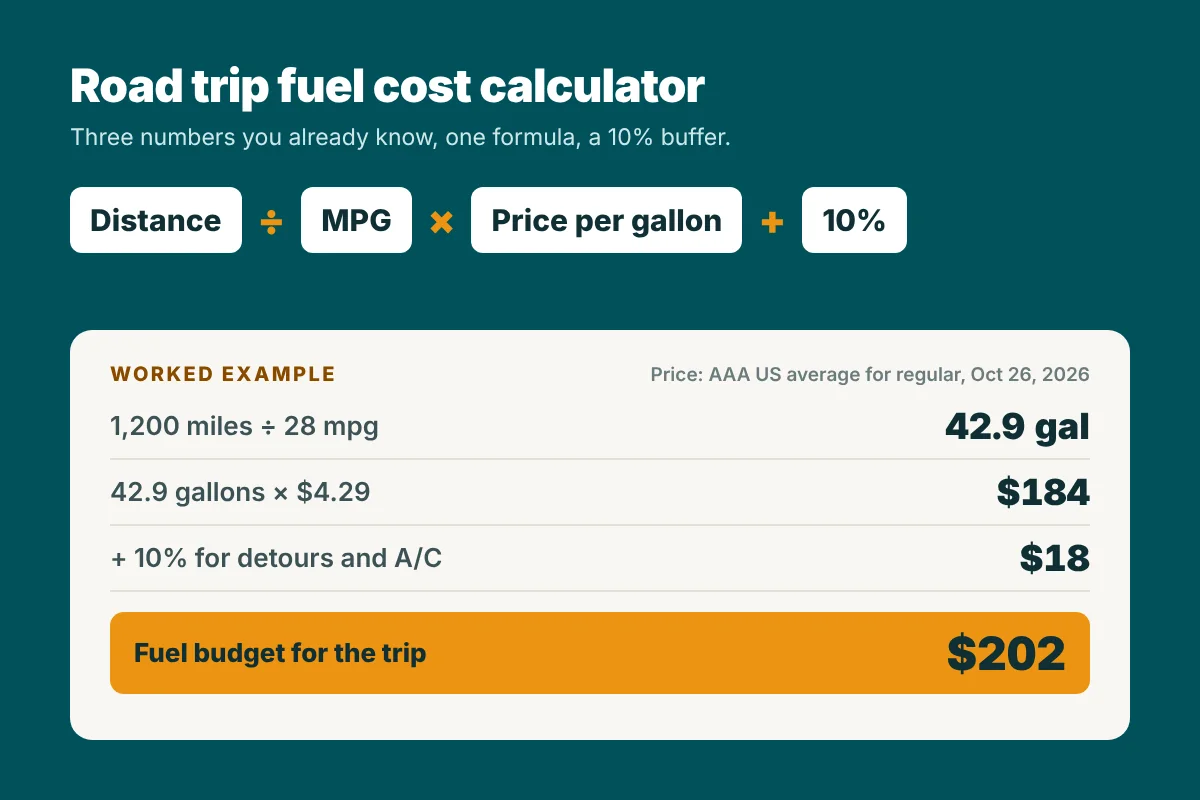
The formula is short: total distance ÷ fuel economy = gallons needed, then gallons × price per gallon = fuel cost. Add 10% for detours, getting lost and air conditioning.
Worked example: a 1,200 mile loop in a car that averages 28 miles per gallon needs about 42.9 gallons. At $4.29 a gallon (close to the AAA US national average for regular on October 26, 2026), that is about $184. With the 10% buffer, budget around $202 for fuel. Prices vary a lot by state and change weekly, so check the price along your route a few days before you leave.
Metric version: distance in km ÷ 100 × litres per 100 km × price per litre. A 1,900 km trip at 7.5 L/100 km uses about 143 litres, so at 1.75 per litre you spend about 250 in local currency before the buffer.
The other budget lines
Multiply the nights by a realistic room rate for your route, not the cheapest one you saw once. A cooler with water, fruit and sandwiches cuts the food line a lot. Then check tolls (many map apps show them) and parking fees at city hotels.
Step 6: get the car ready
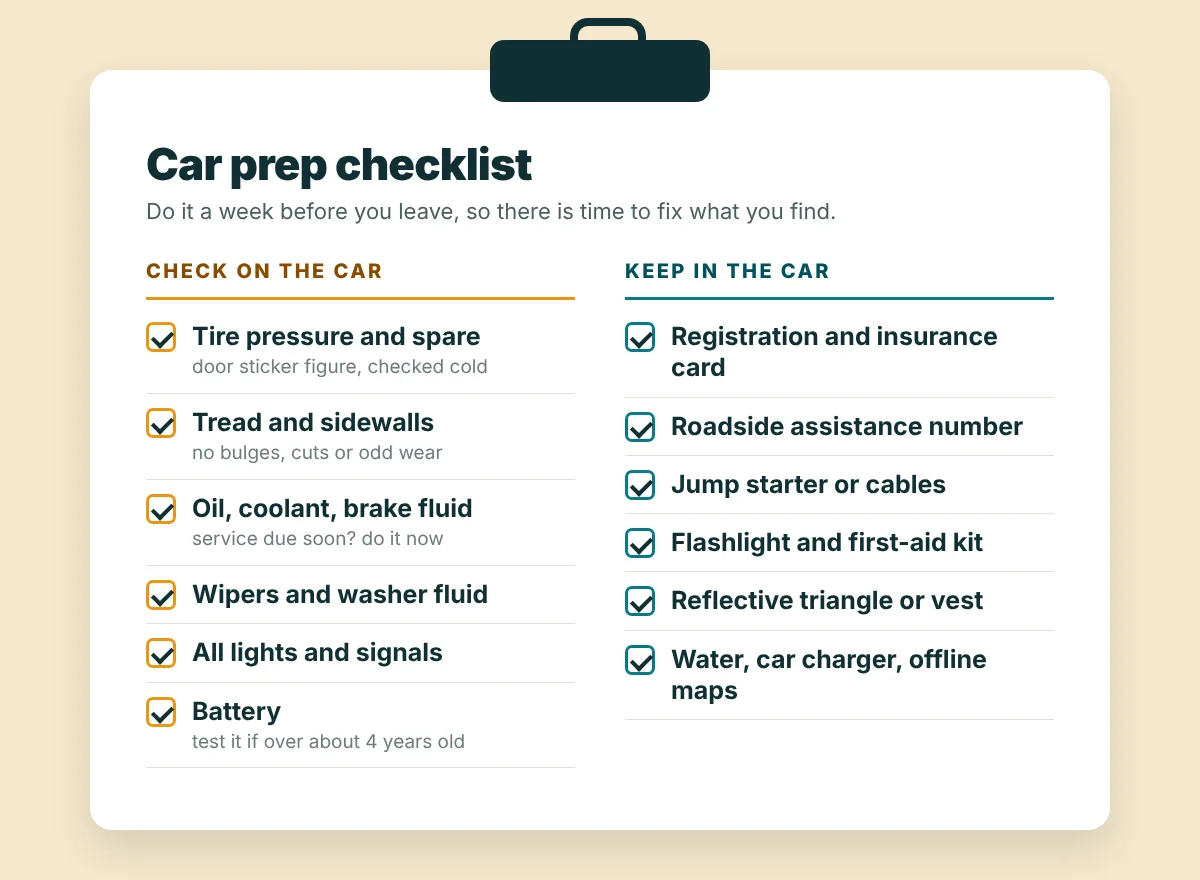
A breakdown on day two costs more time than any bad booking. Do this check a week before departure, so there is time to fix what you find.
- Tire pressure set to the figure on the driver’s door sticker, checked cold, spare tire included
- Tread depth and sidewalls: no bulges, cuts or uneven wear
- Oil level and service date: if a change is due during the trip, do it before
- Coolant, brake fluid and windshield washer fluid topped up
- Wipers that clear the glass without streaks
- All lights working: headlights, brake lights, turn signals
- Battery terminals clean, and a battery older than about 4 years tested at a shop
- Registration, insurance card and roadside assistance number in the glovebox
Renting? Film every scratch before you leave the lot, roof and wheels included, and check that the spare tire and jack are actually there.
The emergency kit that lives in the trunk
Jumper cables or a portable jump starter, a flashlight, a basic first-aid kit, a reflective triangle or vest, a phone charger for the car, water, and a paper list of key phone numbers. In winter add a scraper, a blanket and warm gloves.
Step 7: if you drive an electric car
An EV road trip is very doable in 2026, but the plan is built around chargers rather than gas stations. According to the US Department of Energy, DC fast chargers add roughly 100 to 200 or more miles of range in 30 minutes depending on the car, while Level 2 chargers add about 25 miles per hour, which makes them ideal overnight.
- Plan charging stops, not just driving stops. Use the car’s own route planner or the free Alternative Fueling Station Locator to find fast chargers along the route.
- Arrive with a margin. Aim to reach each charger with 15 to 20% battery left, in case one is out of order or busy.
- Charge to about 80% on the road. Fast charging slows down sharply near full, so two short stops are often quicker than one long one.
- Book hotels with chargers. Waking up with a full battery saves the first stop of the day.
- Expect lower range in heat, cold and at high speed. Plan legs shorter than the official range figure.
For the EV budget, swap the fuel formula for: miles × kWh used per mile × price per kWh. Fast-charging prices vary a lot between networks, so check them in the network’s app before you go.
Step 8: pack the car and plan for safety
Packing a car is different from packing a suitcase. You can bring more, which is exactly why cars end up overloaded. Keep heavy items low and centered, keep the rear window clear, and put one small “tonight bag” on top so you never unpack the whole car at a motel. For the full list by category, see our packing list for travel.
Safety habits on the road
- Get a full night’s sleep before a long driving day and drive during your normal waking hours.
- Swap drivers before anyone feels tired, not after. Yawning, drifting and missing exits are signs to stop now.
- Share the day’s route and your overnight address with someone at home.
- Refuel at half a tank on empty stretches. The next station is often further than the sign suggests.
- Check road and weather conditions each morning, especially for mountain passes.
Crossing a border by car? Rental contracts often limit which countries you can drive into, and you may need extra documents. Our international travel checklist covers passports, insurance and permits.
The best road trip planner apps, compared honestly
You can plan a great trip with a free map app and a spreadsheet. Dedicated road trip planner apps help when the route has many stops or you want to discover places along the way. Here is what each tool actually does, based on what the companies list in October 2026.
| Tool | Best for | Free version | Paid option |
|---|---|---|---|
| Google Maps | Turn-by-turn driving and quick multi-stop routes | Up to 9 stops including the destination; offline areas can be downloaded | None |
| Roadtrippers | Finding attractions, campgrounds and oddities along a route | 1 saved trip, 3 stops | Basic $35.99/yr (20 stops), Pro $49.99/yr (50), Premium $59.99/yr (150) |
| Wanderlog | Day-by-day plans shared with friends, with a map per day | Unlimited stops, collaboration, budget tracking | Pro adds route optimization, offline maps, Google Maps export (about $40/yr in the US) |
| GasBuddy | Finding cheaper fuel and estimating fuel cost | Crowdsourced station prices, trip cost calculator | Paid membership with fuel discounts |
| AFDC Station Locator | EV charging stations along a US route | Free government tool | None |
Our honest take: use one planner for the big picture (Wanderlog or Roadtrippers), and Google Maps or your car’s navigation for the actual driving each day. The 9-stop limit in Google Maps is rarely a problem if you build one route per day instead of one route for the whole week. Prices and plan limits change often, so confirm them in the app before paying.
A sample 7-day road trip itinerary format
This is a template, not a specific route. Replace the places with your own and keep the rhythm: a longer first day, short days around the highlights, a rest day in the middle, and an easy last day.
| Day | Driving | Plan | Overnight |
|---|---|---|---|
| 1 | 5.5 h | Early start, lunch stop at the halfway town, arrive by 5 p.m. | Booked |
| 2 | 3 h | First highlight in the afternoon, sunset viewpoint | Booked (hub, 2 nights) |
| 3 | 1 h | Rest day: hike, museum or lake, no long drive | Same hub |
| 4 | 4.5 h | Scenic road, two short stops | Flexible |
| 5 | 2.5 h | Second highlight, full afternoon there | Book if weekend |
| 6 | 5 h | Drive back toward home, one stop for a long lunch | Flexible |
| 7 | 3 h | Easy morning, home or car return by early afternoon | Home |
Total: about 24.5 hours of driving over a week, never more than 6 hours in a day. That is a comfortable pace for most families and couples.
Road trip planning: frequently asked questions
How many hours a day should you drive on a road trip?
Between 4 and 6 hours of actual driving is comfortable for most people. Add about 25% to the map app’s estimate for breaks, and keep days over 7 hours rare and never back to back.
How far in advance should I plan a road trip?
For a summer trip with national parks, start 3 to 6 months ahead, because park lodging and timed-entry permits sell out. A weekday trip off season can be planned in a week or two.
How many stops can you add on Google Maps?
Google Maps lets you add up to 9 stops, including the final destination, for driving, walking and cycling routes. Multiple stops are not available for public transit. For longer trips, make one route per day.
How do I calculate gas cost for a road trip?
Divide the total miles by your car’s miles per gallon, then multiply by the price per gallon. Add 10% for detours. For example, 1,200 miles ÷ 28 mpg × $4.29 is about $184, or about $202 with the buffer.
Last updated: October 2026