
Checking the plug type by country takes one minute before you pack and saves you from a dead phone on your first night abroad. Two questions matter: does your plug physically fit the wall socket, and is the voltage the same as at home? The first is solved with a cheap adapter. The second decides whether a device can be plugged in at all. This guide covers both, with a table of plug types, a quick checker for your trip and the devices that most often cause trouble.
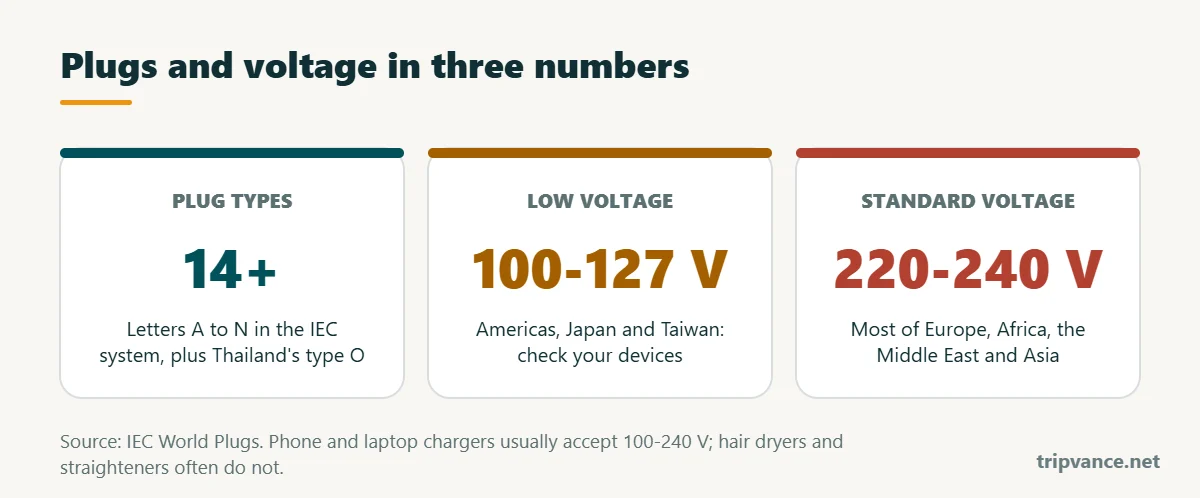
There are more than 14 plug types, named by letters from A to N, plus Thailand’s type O. A plug adapter only changes the shape of the plug. A voltage converter changes the electricity itself, and you need one only for devices that are not marked 100-240 V. Phone, tablet, camera and laptop chargers almost always are; hair dryers, straighteners and travel kettles often are not.
Adapter or converter: what is the difference?
Most of the world uses 220 to 240 volts, while the Americas, Japan and Taiwan use 100 to 127 volts. Plug shapes vary even more. That gives you two separate problems, and two different tools.
Plug adapter
- Lets your plug fit a foreign socket
- Small, light and cheap
- Enough for any device marked 100-240 V
Voltage converter
- Steps 230 V down to 120 V, or the reverse
- Heavier, and limited in power
- Needed only for single-voltage devices
In practice, most travelers only need an adapter. The voltage question matters when you travel between a 120 V country and a 230 V country with a device that has no “100-240 V” marking.
Check your trip: plug and voltage checker
Plug types around the world
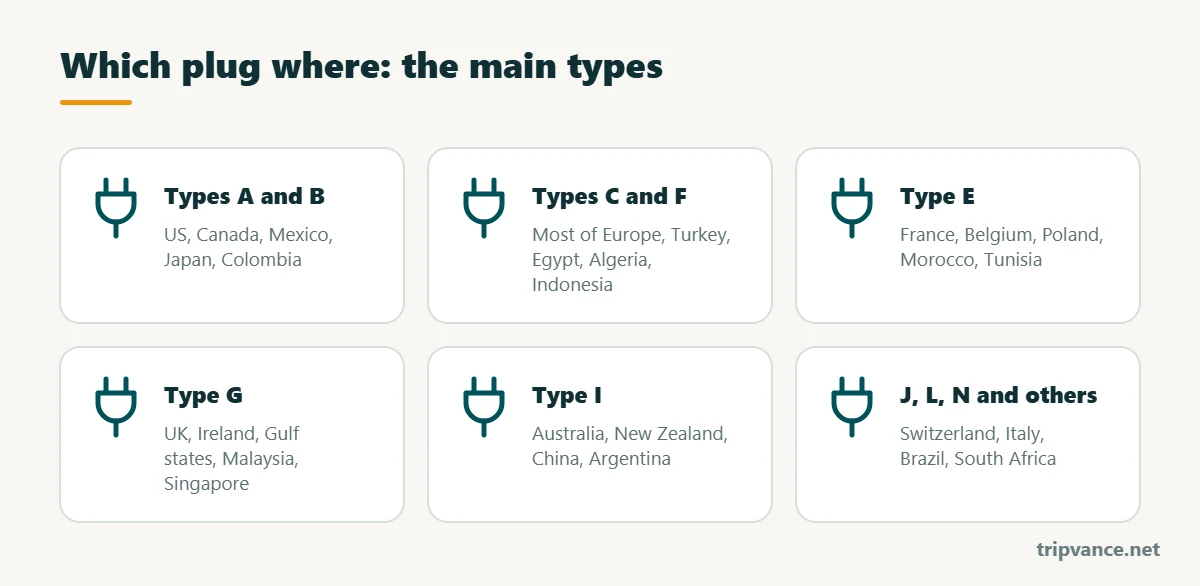
The letter system comes from the International Electrotechnical Commission (IEC). Some types are compatible: the flat two-pin Europlug (type C) fits most sockets in Europe, North Africa, South America and much of Asia.
| Type | What it looks like | Main countries |
|---|---|---|
| A and B | Two flat parallel pins, B adds a round earth pin | US, Canada, Mexico, Japan, Colombia |
| C | Two round pins, no earth (Europlug) | Most of Europe, Africa, the Middle East, South America |
| E and F | Two round pins with earth: a pin in the socket (E) or side clips (F) | E: France, Belgium, Poland, Morocco, Tunisia. F: Germany, Spain, Turkey, Egypt |
| G | Three rectangular pins | UK, Ireland, Gulf states, Malaysia, Singapore, Hong Kong |
| I | Two flat pins in a V, often with earth | Australia, New Zealand, China, Argentina |
| D and M | Three large round pins in a triangle | India, Sri Lanka, Pakistan, South Africa (M) |
| H, J, K, L, N, O | National designs, most also accept type C | Israel (H), Switzerland (J), Denmark (K), Italy and Chile (L), Brazil and South Africa (N), Thailand (O) |
Voltage: which devices can you plug in anywhere?
Look at the small print on the charger or the device, usually next to “INPUT”. If it says 100-240 V, 50/60 Hz, it works everywhere with just an adapter. If it shows a single value such as 120 V or 230 V, check the destination before plugging it in.
- Usually fine everywhere: phone, tablet, laptop, camera and e-reader chargers, most USB chargers and power banks.
- Check before use: hair dryers, straighteners, curling irons, travel kettles, some electric toothbrush and shaver chargers. Some have a dual-voltage switch that you must set by hand.
- The risk: a 120 V device on 230 V can overheat or burn out in seconds. A 230 V device on 120 V usually just runs weakly or not at all.
- Frequency, 50 or 60 Hz, rarely matters for chargers. It can affect clocks and some motors. Japan uses 50 Hz in the east and 60 Hz in the west.
These are the devices that fail most often abroad, because they draw a lot of power. Small travel converters often cannot handle them. A dual-voltage model, or the hotel’s own hair dryer, is usually the safer choice.
Choosing a travel adapter
- One universal adapter covering types A, C, G and I works in most countries. Check that it also fits recessed sockets, common in France, Germany and Italy.
- Built-in USB-C ports with fast charging let you charge a phone and a laptop from one socket.
- Earth pin support matters for laptops and devices with a three-pin plug.
- Read the power limit printed on the adapter and do not connect heaters or hair dryers through a small one.
- Buy a certified model from a known brand. Very cheap adapters can overheat.
- Bring a small multi-port charger instead of several adapters: hotel rooms rarely have many free sockets near the bed.
Quick reference by region
| Region | Plug types | Voltage |
|---|---|---|
| Most of Europe, Turkey | C, F (E in France and Belgium) | 230 V |
| UK and Ireland | G | 230 V |
| North Africa | C with E (Morocco, Tunisia) or F (Algeria, Egypt) | 220 to 230 V |
| Gulf states | Mostly G | 230 to 240 V, 60 Hz in Saudi Arabia |
| US, Canada, Mexico | A, B | 120 to 127 V, 60 Hz |
| Japan | A, B | 100 V |
| China | A, C, I | 220 V |
| Australia, New Zealand | I | 230 V |
| Brazil | N, C | 127 or 220 V depending on the city |
Put the adapter on your packing list and keep it in your carry-on, with your phone charger. If you travel with a power bank, check the rules in our guide to power banks on planes, and see how to stay online abroad with an eSIM for travel.
Frequently asked questions
What plug type is used in Europe?
Mainly types C and F, with type E in France, Belgium, Poland and Czechia. The UK and Ireland use type G, Switzerland J, Italy L and Denmark K. A flat two-pin Europlug fits almost all of them.
Do I need an adapter or a converter?
An adapter if the plug shape is different. A converter only if the voltage is different and your device is not marked 100-240 V.
Can I use a US hair dryer in Europe?
Only if it is dual voltage or has a voltage switch set to 230 V. Otherwise it can burn out, even with an adapter.
Is a universal travel adapter enough?
For chargers and other dual-voltage devices, yes. It does not change the voltage, so it does not solve the problem for single-voltage appliances.
Does Morocco use the same plug as France?
Yes. Morocco uses types C and E at 220 V, so French plugs fit without an adapter.
What plug is used in Saudi Arabia and the UAE?
Mostly type G, the same three-pin plug as in the UK, at 230 V. Saudi Arabia uses 60 Hz.
Last updated: November 2026. Some countries are changing their standard sockets, and hotels often add international ones: check with your accommodation if in doubt.