
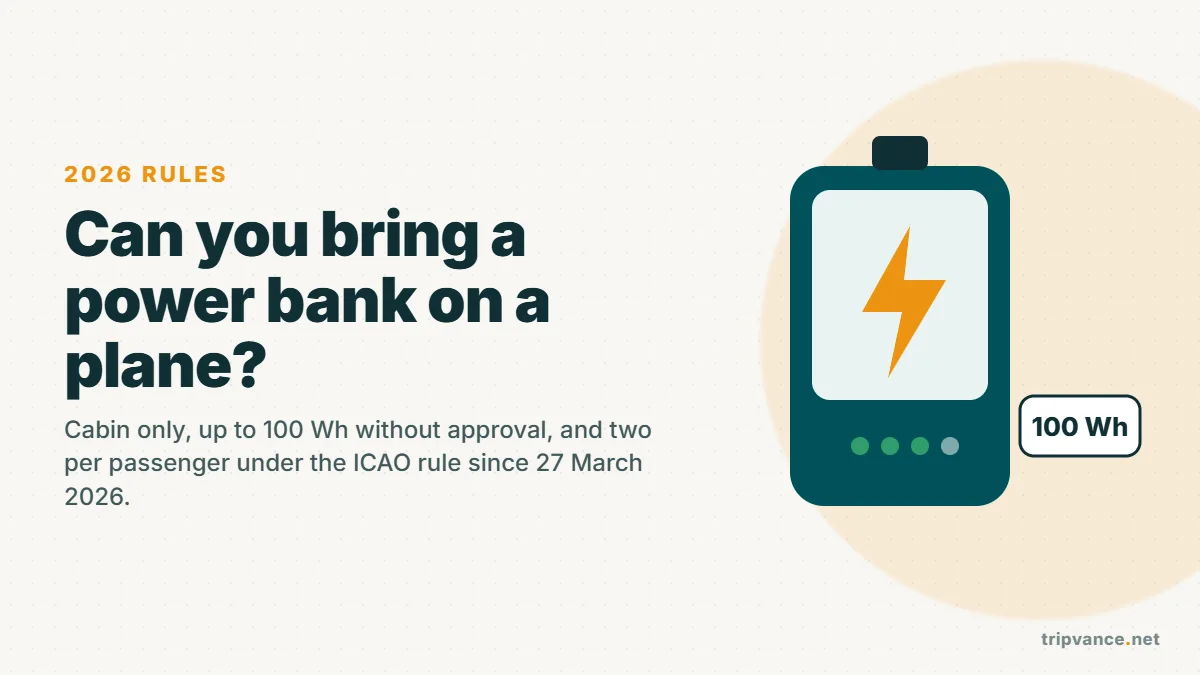
Yes, you can bring a power bank on a plane, but only in the cabin, and the rules got stricter in 2026. Since 27 March 2026 the international standard caps you at two power banks per person and forbids recharging them during the flight. Several airlines go further and won’t let you use one at all once the doors close. Here is what that means for the charger sitting in your backpack right now.
Pack your power bank in your carry-on or personal item, never in a checked suitcase. Keep it at or under 100 Wh (about 27,000 mAh), bring two at most, don’t plug it into the seat to recharge it, and check your airline’s page before you fly, because some carriers ban in-flight use completely.
What changed for power banks on a plane in 2026
For years the rule was simple: power banks in the cabin, never in the hold, and anything above 100 Wh needs the airline’s blessing. That part has not changed. What changed is the behaviour expected once you are on board, after a run of cabin fires traced back to cheap or damaged batteries, including the Air Busan aircraft that burned on the ground in Busan in January 2025.
The International Civil Aviation Organization (ICAO) published an addendum to its dangerous goods instructions that applies from 27 March 2026. It does two things for passengers:
- It limits each traveller to two power banks.
- It bans recharging a power bank on board, whether from a seat socket or a USB port.
IATA’s guidance to airlines adds a recommendation that power banks should not be used to charge phones or tablets during the flight. It is a recommendation, not a ban, which is why rules now differ so much from one airline to the next. IATA will write the two-per-person limit and the recharging ban into its 68th edition Dangerous Goods Regulations, which take effect on 1 January 2027.
Each country still adopts ICAO changes through its own process, so the exact date can vary by airport. In practice, most large airlines already apply the 2026 limits.
Carry-on only: why a power bank can never go in a checked bag
A lithium battery that overheats in the cabin is a problem the crew can see, smell and deal with. Flight attendants carry fire bags and are trained to cool a burning battery. The same battery inside a suitcase in the cargo hold is out of reach, and a hold fire is one of the worst things that can happen to an aircraft. That is the whole logic behind the rule, and it is why the FAA, EASA and every airline we checked say the same thing: spare lithium batteries and power banks travel in the cabin only.
The trap most people fall into is the gate-checked bag. On a full flight, staff often take roller bags at the door and send them to the hold. If your power bank is inside, you are now carrying a banned item in the hold without knowing it. The FAA is explicit: when a carry-on is checked at the gate or planeside, every spare battery and power bank must come out and stay with you in the cabin.
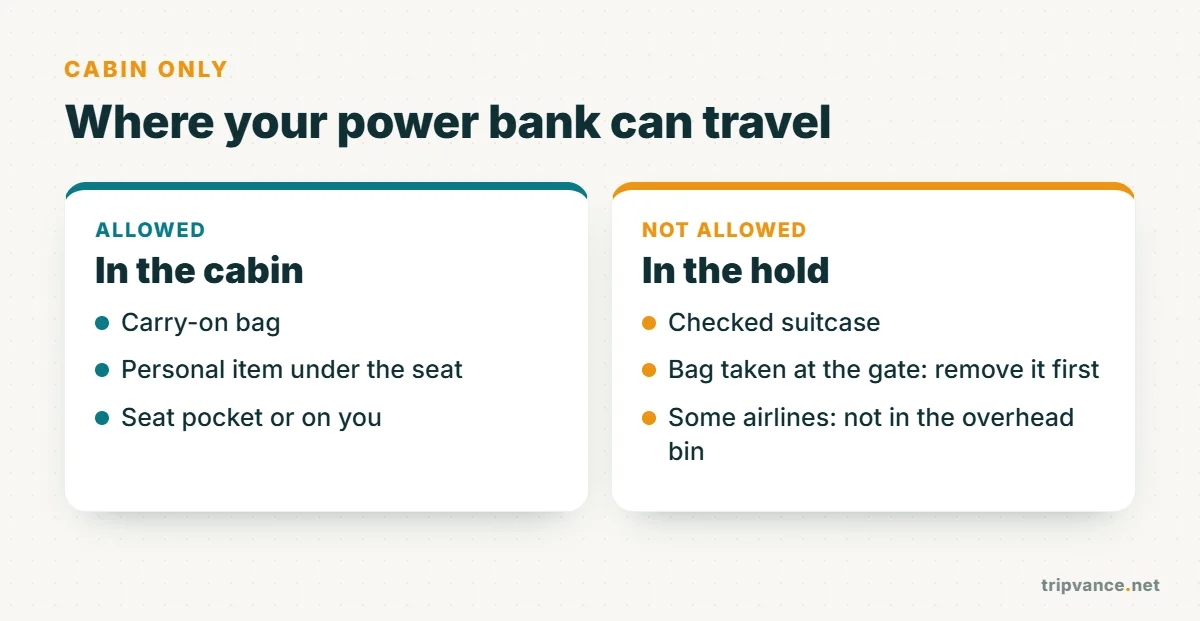
A few airlines also keep power banks out of the overhead bins. American Airlines has required them to stay in the seat pocket or in a bag under the seat in front of you since May 2026, and Emirates has had the same rule since October 2025. The reason is the same: a battery in a closed bin can smoulder for minutes before anyone notices.
How big a power bank can you bring on a plane?
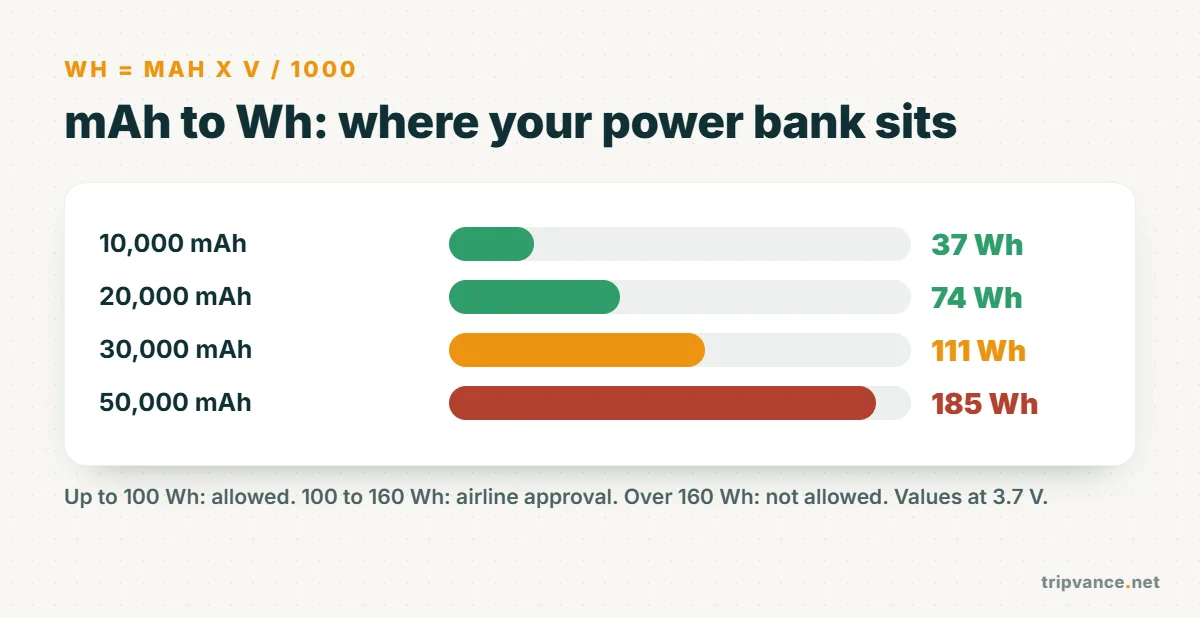
Airlines measure batteries in watt-hours (Wh), not in the milliamp-hours (mAh) printed in big letters on the box. Watt-hours tell security how much energy is stored, which is what matters in a fire. The limits work in three bands:
- 10,000 mAh = 37 Wh
- 20,000 mAh = 74 Wh
- 30,000 mAh = 111 Wh
- 50,000 mAh = 185 Wh
The middle band is shrinking. Under IATA’s guidance for 2026, a 100 to 160 Wh power bank still needs the operator’s approval, and that approval route for power banks disappears from the 2027 regulations. In the US, the FAA still lets passengers carry larger spare batteries up to 160 Wh with airline approval, limited to two. If you own a 30,000 mAh brick, call the airline before you leave or leave it at home.
How to convert mAh to Wh
Most power banks print the Wh rating on the case. If yours only shows mAh, use this formula with the battery voltage, which is almost always 3.6 or 3.7 V for the cells inside:
Wh = mAh × V ÷ 1000. A 20,000 mAh pack at 3.7 V gives 20,000 × 3.7 ÷ 1000 = 74 Wh, comfortably under the limit.
How many power banks can you take?
Under the ICAO rule, two. That is now the number most airlines print on their dangerous goods pages, including American Airlines and the Lufthansa Group (Lufthansa, SWISS, Austrian, Brussels Airlines and Eurowings). Emirates is stricter and allows one power bank under 100 Wh, with the capacity clearly marked on it.
US rules are a little looser on paper. The FAA sets no fixed number for spare batteries under 100 Wh as long as they are for personal use, but your airline’s limit applies on top of that, and the airline limit is what the gate agent will enforce. Two is the safe number to plan around anywhere in the world.
Spare camera batteries and the battery that sits inside your laptop or phone are counted separately from power banks. The two-per-person limit is about standalone chargers.
Can you use a power bank during the flight?
This is where airlines disagree the most. Recharging the power bank itself from the aircraft is banned everywhere under the 2026 rule. Using it to top up your phone depends on who you fly with. The table below shows the policies we could confirm in October 2026.
| Airline | How many | Charge your phone in flight? | Where it must be |
|---|---|---|---|
| Emirates | 1 (under 100 Wh) | No, since 1 Oct 2025 | Seat pocket or under the seat |
| Lufthansa Group | 2 | No, since 15 Jan 2026 | Cabin baggage |
| Qantas, Singapore Airlines, Cathay Pacific | Airline limit | No | Cabin baggage |
| American Airlines | 2 (each 100 Wh max) | Allowed, but no recharging the bank | Seat pocket or bag under the seat, not the overhead bin |
| Southwest Airlines | Airline limit | Allowed only if it stays in plain sight | Out of your bag while in use |
If your airline is not listed, search its name with “dangerous goods” or “lithium batteries”. The policy page is usually short and more reliable than any summary, including this one. And charge everything before you leave home: most long-haul aircraft have USB or mains sockets at the seat, and plugging your phone straight into the seat is always allowed.
US flights: what the TSA and FAA say
At a US checkpoint, the TSA allows power banks in carry-on bags and refuses them in checked bags. The screening officer has the final word, and a pack with an unreadable or missing label is the one most likely to be pulled aside.
The FAA’s PackSafe rules add the details that matter on board:
- Lithium-ion batteries are limited to 100 Wh each; 101 to 160 Wh needs airline approval and you can carry two of those at most.
- Battery terminals must be protected from short circuits: keep each pack in its original packaging, a pouch or a small plastic bag, or tape over exposed contacts.
- Damaged, swollen or recalled batteries are not allowed on board at all.
Liquids follow a different rulebook at the same checkpoint. If you are packing both, our guide to TSA liquid rules explains the 3-1-1 bag, and the carry-on size chart by airline helps you pick a bag that will not be gate-checked in the first place.
How to pack a power bank so security waves it through
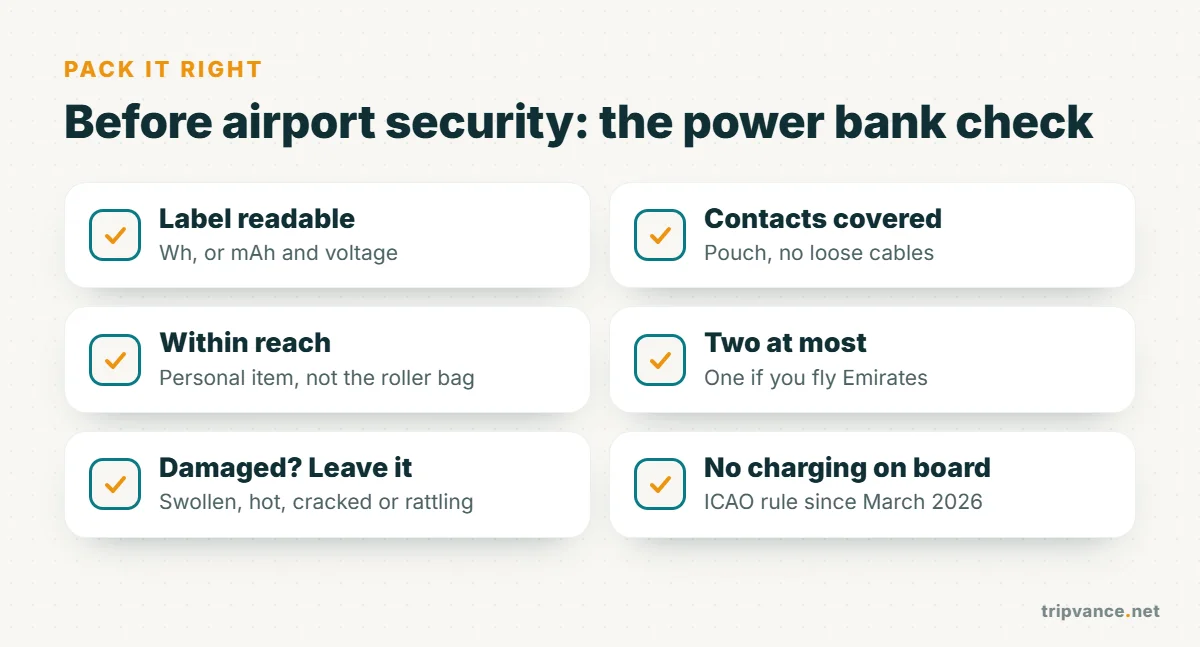
- Check the label. Make sure the Wh rating, or the mAh and voltage, is printed and readable. A worn or scratched label is the most common reason a pack is confiscated.
- Cover the contacts. Keep cables unplugged and the power bank in a pouch so keys or coins cannot touch the ports.
- Pack it where you can reach it. Put it in your personal item, not deep in a roller bag that might be taken at the gate.
- Bring the right number. Two at most, one if you fly Emirates.
- Leave damaged packs at home. If it is swollen, hot when idle, cracked or rattles, recycle it. It will not fly, and it should not.
Running through a full list before a long trip helps too. Our packing list for travel and the international travel checklist both include the charging kit, and if you are flying through a busy hub, read how early to get to the airport before you leave.
What happens if your power bank breaks the rules
Most of the time, nothing dramatic. A power bank over 160 Wh, one with no readable rating or a third one over the limit is usually confiscated at security or at the gate, and you lose it. If the issue is found at check-in in a suitcase, staff will ask you to take it out, which is easy at the desk and much harder once the bag has gone down the belt.
Using a power bank on an airline that bans it in flight is a different matter. You are breaking a crew instruction, and that can escalate quickly. If a power bank ever gets hot, starts to swell, smokes or smells odd during the flight, do not hide it in a bag: call a flight attendant straight away. They are trained for exactly that.
Power bank on a plane: quick answers
Can I bring a 20,000 mAh power bank on a plane?
Yes. At 3.7 V it is about 74 Wh, under the 100 Wh limit, so it goes in your carry-on with no approval needed. Count it toward your two-power-bank limit.
Can I bring a 30,000 mAh power bank on a plane?
Only with the airline’s approval in most cases, because it works out at about 111 Wh. Some 30,000 mAh models use a lower rating and stay under 100 Wh, so read the Wh figure on the label rather than guessing.
Is a 50,000 mAh power bank allowed?
No. At around 185 Wh it is above the 160 Wh ceiling for passengers, in the cabin and in the hold.
Can I put a power bank in my checked luggage?
No, never. That applies on every airline and in every country. If your carry-on gets gate-checked, take the power bank out first.
Can I charge my phone with a power bank on the plane?
It depends on the airline. Emirates, the Lufthansa Group, Qantas, Singapore Airlines and Cathay Pacific say no. American and Southwest allow it with conditions. Use the seat socket when there is one.
Does a phone battery case count as a power bank?
The FAA treats battery charging cases like spare batteries, so keep them in your carry-on. Most are well under 100 Wh.
What about smart luggage with a built-in battery?
If the suitcase is checked, the battery must be removed and carried in the cabin. If the battery cannot be removed, airlines generally refuse the bag.
- ICAO: New power bank restrictions (effective 27 March 2026)
- IATA: Guidance to operators on power banks (PDF)
- FAA PackSafe: Lithium batteries
- Emirates: Power bank safety rules now in full effect
- Travel Market Report: American Airlines tightens power bank rules (April 2026)
- NPR: Southwest requires chargers to stay visible (May 2025)
Last updated: October 2026. Airline policies change often, so confirm with your carrier before you fly.