
The TSA liquid rules have not changed as much as the headlines suggest. In October 2026, every standard checkpoint in the United States still applies the same 3-1-1 limit to your carry-on: small containers, one clear bag, one bag per person. What has changed is the list of exceptions, the scanners at some airports, and a lot of confusing talk online. This guide sorts the facts from the rumors so you can pack once and walk through security without a bag check.
The short answer
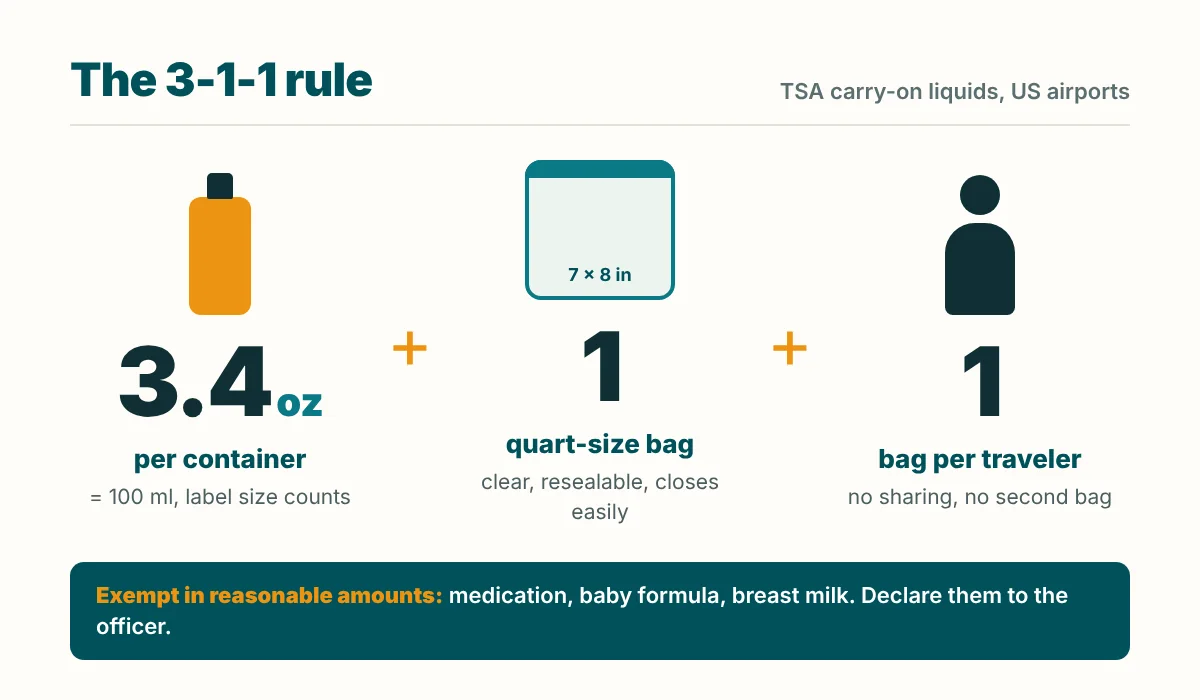
- Each liquid, gel, cream, paste or aerosol in your carry-on must be in a container of 3.4 ounces (100 ml) or less.
- All of those containers go in one quart-size clear, resealable bag, and each traveler gets one bag.
- Medications, baby formula and breast milk are allowed in larger amounts, but you must tell the officer.
- In checked bags, liquids are fine in normal sizes. Strong alcohol and aerosols have their own limits.
- As of late October 2026, TSA has not confirmed any end to the 3.4 oz limit, including the rumored water bottle exception for PreCheck.
The 3-1-1 rule in plain English
The name is a memory trick. The first 3 stands for 3.4 ounces, the maximum size of each container. The 1 in the middle is one quart-size bag that holds all those containers. The last 1 means one bag per passenger. Families do not get to pool a single bag, and you cannot spread bottles across two bags to fit more.
A quart-size bag measures about 7 by 8 inches (roughly 18 by 20 cm). TSA does not ask for a specific brand, only that the bag is clear, closes properly and is not bursting at the seams. If the zipper will not shut, an officer can ask you to remove items, and that is where most delays start.
The container size counts, not what is inside
This catches people every day. A 6 oz bottle of sunscreen with an inch left at the bottom is still a 6 oz bottle, and it will be refused. The label on the container decides, not your estimate of what remains. If a travel bottle has no size printed on it, buy one that does. Clear 3 oz or 100 ml bottles cost very little and save an argument.
Where the bag goes at the checkpoint
In a standard lane, take the bag out of your carry-on and put it in a bin by itself. In TSA PreCheck lanes you can usually leave it inside your bag. At checkpoints that use the newer CT (computed tomography) scanners, officers may tell you to keep liquids packed even in a standard lane. Follow what the officer at your lane says, because the equipment varies from one checkpoint to the next, sometimes inside the same airport.
What counts as a liquid at TSA security
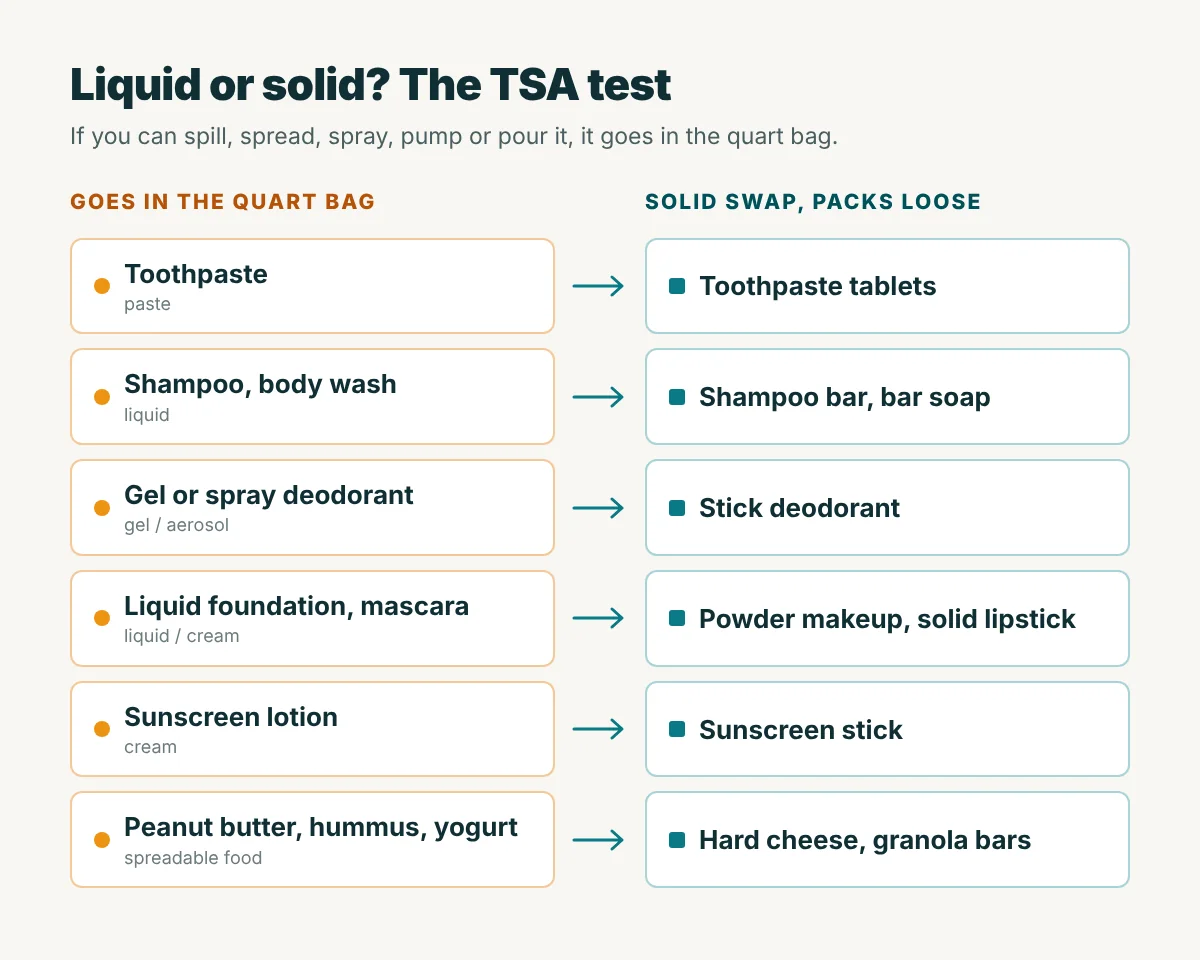
TSA’s working definition is simple: if you can spill it, spread it, spray it, pump it or pour it, treat it as a liquid. That is wider than most people expect, and food is where travelers get caught out.
- Food that counts: peanut butter, jam, honey, yogurt, hummus, salsa, creamy cheese, soup, sauces and dips.
- Toiletries that count: toothpaste, shampoo, conditioner, lotion, liquid foundation, mascara, lip gloss, gel deodorant, hair gel and perfume.
- Odd ones: snow globes, sprays of any kind, contact lens solution and liquid hand sanitizer.
Solid versions skip the bag entirely. A stick deodorant, a bar of soap, solid shampoo, powder makeup, a solid lipstick or a block of hard cheese can travel loose in your carry-on. Switching three or four of your usual products to solid ones is the easiest way to free up space in that single quart bag.
Bring an empty reusable water bottle. Empty bottles are allowed through screening, and almost every US airport has refill stations after security. It is the single most useful item for a long travel day.
Exceptions: medication, baby formula and breast milk
Some liquids are allowed above 3.4 oz because you genuinely need them. They do not have to fit in the quart bag, but they do get extra screening.
Medically necessary liquids
Liquid medications, both prescription and over the counter, are allowed in reasonable quantities for your trip. The same goes for liquids you need for a medical condition, such as saline or gel packs for a device. Take them out of your bag, tell the officer before screening starts, and expect them to be tested. A prescription label or a doctor’s note is not required by TSA, but it makes the conversation much shorter.
Formula, breast milk and baby food
Formula, breast milk, toddler drinks and baby food in pouches are allowed in reasonable quantities, with or without the child traveling with you. Ice packs and freezer packs used to keep them cold are allowed too. Separate them from the rest of your bag and declare them. Officers may ask to test the liquid, and you can ask them not to open a container if you prefer an alternative screening.
Frozen liquids
Frozen items are allowed in a carry-on only if they are frozen solid when you go through screening. If an ice pack or a frozen bottle has turned partly to slush, it is treated as a liquid and has to meet the 3-1-1 limit.
Duty-free liquids and connecting flights
Bought a bottle of perfume or spirits in a duty-free shop abroad and connecting in the US? You can keep it in your carry-on if three conditions are met: the shop packed it in a sealed, transparent, tamper-evident bag, the receipt is visible inside that bag, and the purchase was made within the previous 48 hours. If the seal is broken or the bag was opened, the item has to go in your checked luggage before you reach the next checkpoint.
The practical move on a connection is to collect your checked bag (you usually must after a first US entry), put the duty-free bottle inside it, and re-check the bag. That way nothing depends on the officer’s reading of a crumpled receipt.
Liquids in checked luggage: what the limits really are
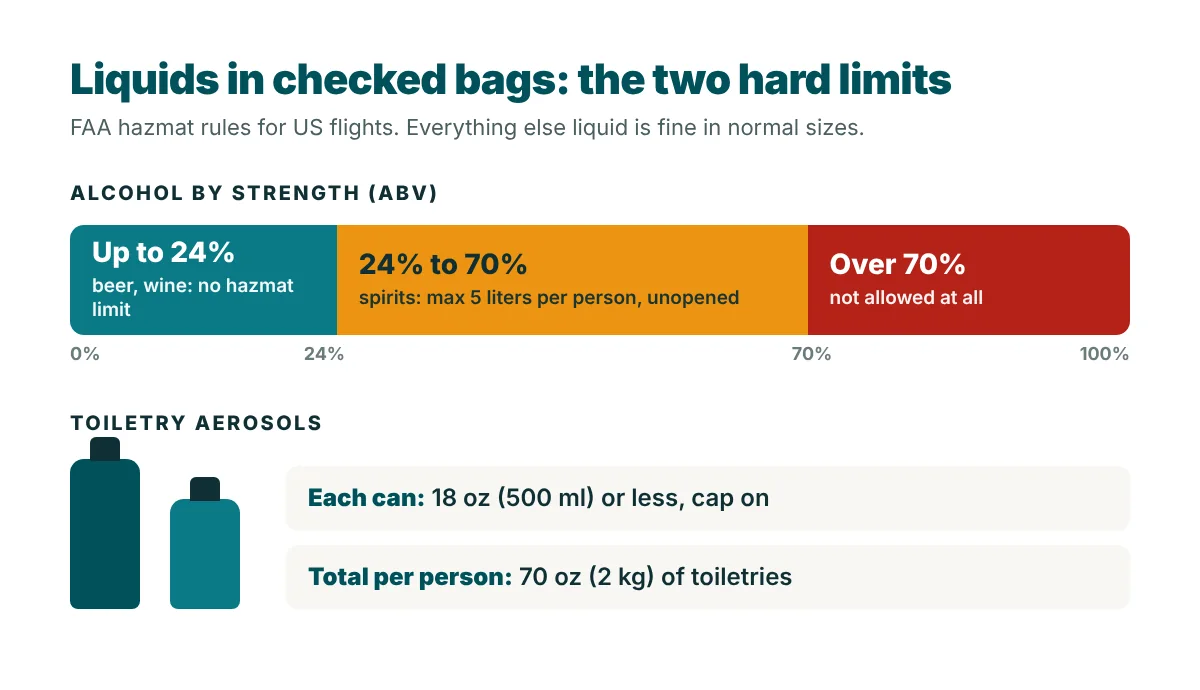
The 3-1-1 rule does not apply to checked bags. Full-size shampoo, wine and sunscreen can all go in your suitcase. Two categories have hard limits set by the FAA’s hazardous materials rules, and they are worth knowing before you shop.
| Item | Checked bag rule | Carry-on |
|---|---|---|
| Alcohol up to 24% ABV (beer, wine) | No hazmat limit, airline weight limits apply | Only in 3.4 oz containers in your quart bag |
| Alcohol 24% to 70% ABV (most spirits) | Up to 5 liters per person, in unopened retail packaging | Only in 3.4 oz containers in your quart bag |
| Alcohol over 70% ABV (over 140 proof) | Not allowed | Not allowed |
| Toiletry aerosols (hairspray, deodorant spray) | Each can 18 oz (500 ml) or less, total 70 oz (2 kg) per person, caps on | 3.4 oz cans in your quart bag |
| Non-toiletry aerosols (spray paint, cooking spray) | Generally not allowed | Not allowed |
To keep bottles intact, wrap each one in a plastic bag, then in clothing, and pack it in the middle of the suitcase rather than against the shell. Wine sleeves that inflate or seal are cheap and work well. A small leak in a checked bag is an inconvenience. A broken bottle of red wine is a ruined wardrobe.
One more detail: you may carry mini bottles of alcohol through security in your quart bag, but you cannot drink them on board. Federal rules only allow alcohol served by the airline crew.
What has actually changed in 2025 and 2026
A lot of articles claim the liquid limit is gone. It is not. Here is what has really moved:
- Shoes stay on. Since July 2025, TSA no longer asks most travelers to remove their shoes at screening.
- CT scanners are spreading. More checkpoints use 3D scanners, so you may be told to leave liquids and laptops in your bag. The quantity limit is the same.
- Water bottles for PreCheck are only a proposal. In September 2026 several outlets reported that TSA was considering letting PreCheck members bring a full water bottle at airports with the newest equipment. TSA has not confirmed this as a rule.
- New PreCheck lanes are being tested. On October 6, 2026, TSA announced redesigned PreCheck lanes with electronic ID gates at a first group of airports. It did not announce a new liquid allowance.
If you see a post saying a specific airport now accepts full-size bottles, check the airport’s own website or TSA on the day of travel. Until TSA publishes it, pack to the 3.4 oz rule.
Flying from another country into the US
Outside the United States, most airports use the same 100 ml limit, under different names. Some airports in Europe and the UK with new scanners have tested larger limits, then rolled them back or kept them only at specific terminals. Rules follow the airport you are departing from, not your passport or your airline. On a round trip, that means you can face two different policies in one week.
The safe habit is to pack your liquids to 100 ml and one clear bag for the whole trip. It works almost everywhere and you never have to repack at a gate. If you are preparing a bigger trip abroad, our international travel checklist covers documents, money and phone setup in the right order.
A 10-minute packing plan for your liquids
- Lay everything out. Put every product you plan to bring on a table, including food from the kitchen.
- Cut what the hotel provides. Shampoo, conditioner and body wash are in almost every hotel. Leave them at home.
- Swap for solids. Stick deodorant, bar soap, solid shampoo and powder sunscreen remove four bottles at once.
- Decant the rest. Fill labeled 3 oz bottles about three quarters full so they do not leak with cabin pressure.
- Close the bag test. If your quart bag closes without force, you are done. If not, move the extras to a checked bag or buy them on arrival.
- Pack it last. Put the bag at the top of your carry-on so you can lift it out in one move at the checkpoint.
For everything else in your suitcase, use our complete packing list for travel, and check the carry-on size limits by airline before you choose which bag to bring.
TSA liquid rules: frequently asked questions
Can I bring a full water bottle through TSA?
No. A full bottle larger than 3.4 oz will be refused at standard checkpoints. Bring it empty and fill it after security. A water bottle exception for some PreCheck travelers has been discussed in 2026 but was not in force as of late October 2026.
Is the TSA liquid limit 3.4 oz or 100 ml?
Both. TSA uses 3.4 ounces, which is the same as 100 milliliters. Many bottles show only one unit, and either is accepted.
Does toothpaste count as a liquid?
Yes. Toothpaste is a paste, so it must be 3.4 oz or less and go in your quart bag. Toothpaste tablets are a solid alternative.
Can I carry two quart bags if I bring no checked luggage?
No. The limit is one bag per passenger whatever luggage you check. Extra liquids need a checked bag or have to be bought at your destination.
What happens if my liquids are over the limit?
The officer will ask you to throw the item away, return it to your car, or check it if you still have time. Some airports offer mail-back kiosks. You will not be fined for an honest mistake with toiletries.
Last updated: October 2026