
Using a credit card abroad is usually the cheapest and safest way to pay on a trip, but only if you avoid three small traps: your bank’s foreign transaction fee, ATM charges, and the friendly question at the terminal, “Would you like to pay in your own currency?” Answer that one wrong and you can lose several percent on every payment without noticing. This guide explains what a card payment abroad really costs, how to choose and prepare your cards, and what to press at the terminal and the ATM.
Take a card with no foreign transaction fee if you can, plus a second card on another network. At the terminal or the ATM, always choose the local currency and refuse the conversion into your own currency: that offer adds a markup that consumer groups have measured at 2.6% to 12%. Turn on payment alerts, know your PIN, and expect deposits at hotels and car rental desks.
What does it cost to use a card abroad?
When you pay in a foreign currency, up to three costs can stack on the same payment. Only the first is unavoidable, and it is small.
| Cost | Who charges it | Typical level | How to avoid it |
|---|---|---|---|
| Network exchange rate | Visa or Mastercard | Close to the market rate | Unavoidable, and usually the best rate you will get |
| Foreign transaction fee | Your bank | 0% to 3% per payment | Use a card with no foreign fee |
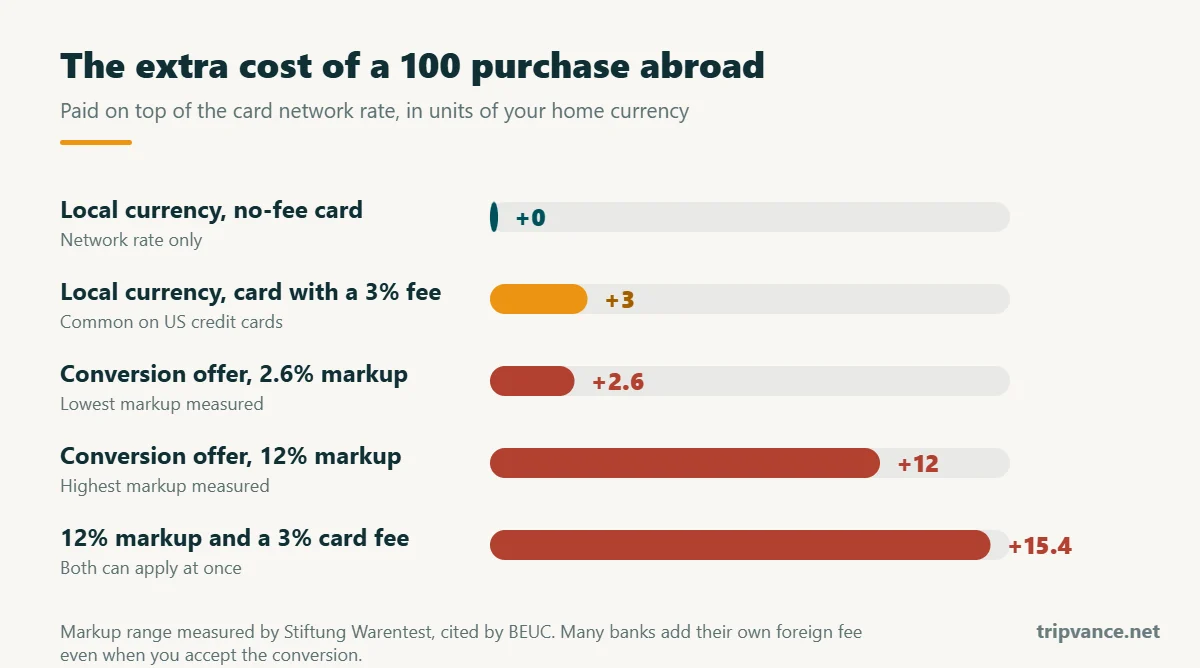
| Currency conversion at the terminal | The shop, hotel or ATM operator | 2.6% to 12% markup | Always choose the local currency |
The foreign transaction fee is written in your card’s terms, usually as a percentage. Many standard cards charge around 3%, while travel cards and many app-based banks charge nothing. The conversion offered at the terminal, called dynamic currency conversion, is a separate service run by the merchant’s payment provider, and it is where most travelers lose money.
Local currency or your own currency?
Abroad, a card terminal or ATM often shows the amount in your home currency and asks you to choose. It looks helpful: you see exactly what you will pay. But the exchange rate used is set by the merchant’s provider, not by your card network, and it includes a markup that goes partly to the merchant.
Pay in the local currency
- Your card network converts at its own rate
- Only your bank’s fee, if any, is added
- Usually the cheaper option by a wide margin
Pay in your own currency
- The merchant’s provider sets the rate
- A markup is built into that rate
- Your bank may still add its foreign fee on top
Watch for the usual nudges: the home-currency option highlighted in green, words like “guaranteed rate” or “no commission”, or a staff member choosing for you. You have the right to pay in the local currency. If the receipt shows your home currency and you did not agree, ask for the payment to be cancelled and redone before you sign or leave.
Under EU rules, a merchant or ATM that offers this conversion for payments in EU currencies must show its markup as a percentage over the latest European Central Bank reference rate before you confirm, and your bank must send you the same information electronically. It makes the comparison easier, but refusing the offer is still the simplest choice.
Credit card or debit card abroad?
Most travelers do best with both, each used for what it does well.
- Credit card for payments. It usually gives stronger protection against fraud and disputes, and a hotel or car rental deposit blocks the bank’s money, not yours. Many cards also include travel insurance or purchase protection when you pay the trip with them.
- Debit card for cash. Withdrawing cash with a credit card is usually treated as a cash advance, with an extra fee and interest from the first day. A debit card avoids that, though your bank may still charge a fee per withdrawal.
- Phone wallets work too. Apple Pay and Google Pay use your card in the background and do not expose the card number to the terminal. The currency question still appears, and the same answer applies.
Before you leave: prepare your cards
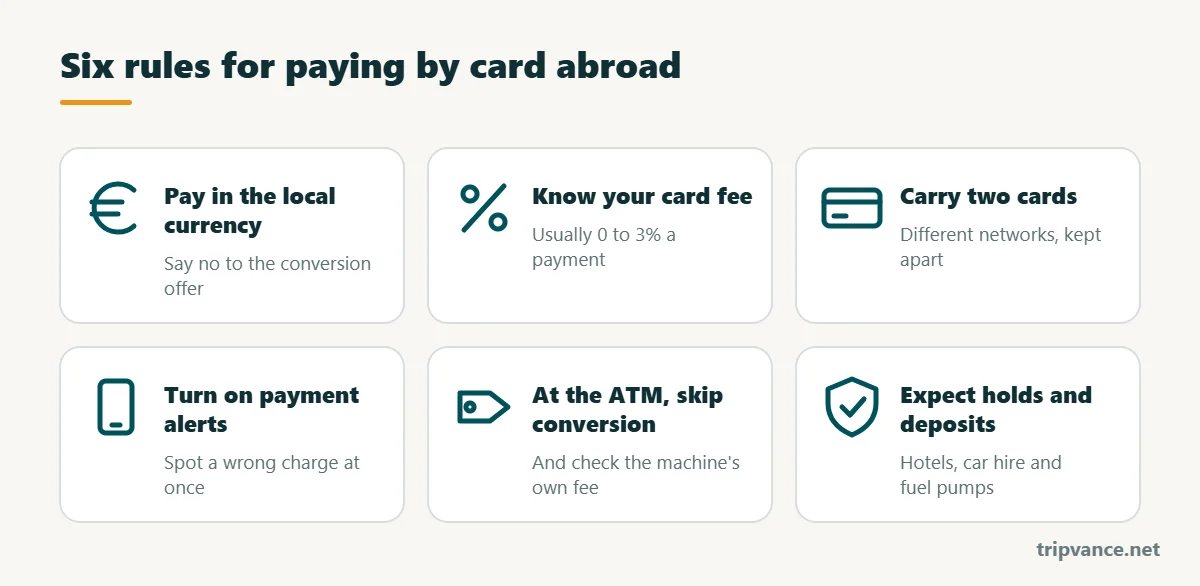
- Read the fee line in your card’s terms: foreign transaction fee, ATM fee abroad and cash advance fee.
- Check that international payments are on and that your limits are high enough for hotels and car rental deposits. Many banking apps let you change both in a minute.
- Turn on instant payment alerts so you see every charge, in which currency, as it happens.
- Carry two cards on different networks, for example one Visa and one Mastercard, and keep them in different places.
- Know your PIN. Ticket machines, tolls and fuel pumps often refuse a signature or a contactless payment without one.
- Save your bank’s number for calls from abroad, and keep your home line active for security codes sent by SMS. Our guide to eSIMs for travel explains how to keep that line while using local data.
Withdrawing cash at ATMs abroad
Even in countries where cards work everywhere, some cash is useful for small shops, markets, tips and taxis. A few habits keep withdrawals cheap.
- Use bank ATMs, inside or next to a branch. Standalone machines in tourist areas often charge more and push the conversion option harder.
- Refuse the conversion again: choose “without conversion” or the local currency.
- Read the operator’s fee on the screen before confirming. If it is high, cancel and try another bank.
- Withdraw fewer, larger amounts if your bank charges a fixed fee per withdrawal, and keep the cash split between two places.
- Cover the keypad and check the card slot for anything loose or added.
Deposits and holds: hotels, car rental and fuel
Some businesses block an amount on your card before the final bill. A hotel may hold the cost of your stay plus a deposit, a car rental desk can block several hundred units of currency, and some fuel pumps pre-authorize a fixed amount. The hold usually disappears a few days after you leave, but it reduces your available limit in the meantime.
Most rental companies require a credit card in the main driver’s name for the deposit, and many refuse debit or prepaid cards. Check the conditions before you book, especially for a long trip with a large deposit.
If your card is lost, blocked or used without permission
Freeze the card in your banking app first: it takes seconds and can be reversed if the card turns up in a jacket pocket. Then call your bank, report any charge you do not recognize, and switch to your second card. Keep a note of the bank’s number away from your wallet, and photograph the front of your cards without the security code.
Some cards include travel insurance when you use them to pay for the trip, but the cover is often limited. Compare it with a dedicated policy in our guide to travel insurance, and add your cards and bank numbers to your international travel checklist.
Frequently asked questions
Should I pay in local currency or my own currency abroad?
In the local currency, almost always. Paying in your own currency lets the merchant’s provider choose the exchange rate, with a markup that consumer studies have measured between 2.6% and 12%.
What is a foreign transaction fee?
A percentage your bank adds to payments made in a foreign currency or processed abroad. It is often around 3% on standard cards and zero on many travel cards.
Is it better to use a credit card or a debit card abroad?
Use a credit card for payments and deposits, and a debit card for cash withdrawals. Credit card cash withdrawals usually count as cash advances, with fees and immediate interest.
Do I need to tell my bank before traveling?
Many banks no longer ask for travel notices, but you should check that international payments are enabled, review your limits and turn on alerts in the app.
Why was I charged more than the price on the receipt?
Usually a foreign transaction fee added by your bank, or a conversion you accepted at the terminal. A temporary hold from a hotel or fuel pump can also make your balance look lower for a few days.
Can I use Apple Pay or Google Pay abroad?
Yes, wherever contactless payments are accepted. The fees are those of the card behind it, and you should still choose the local currency.
Last updated: November 2026. Card fees and limits vary by bank and change over time: check your own card’s terms before you travel.