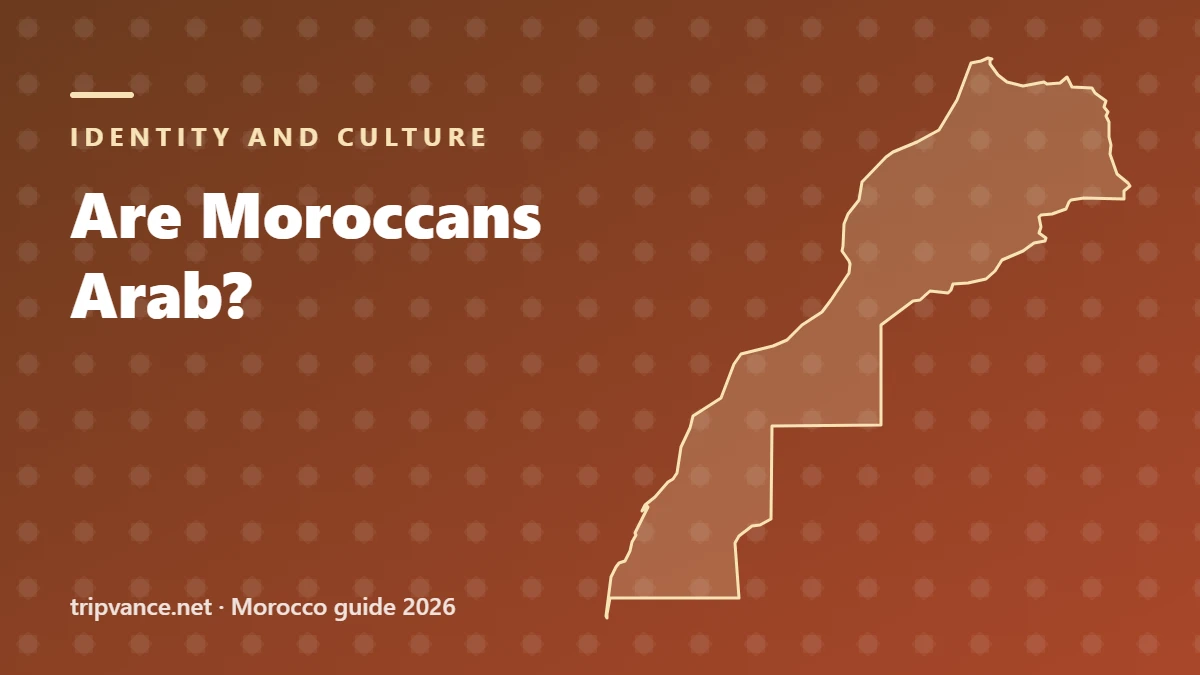
Are Moroccans Arab? Many are, and most Moroccans speak Arabic, but the most accurate answer is the one Morocco gives itself: Moroccan identity is plural. The Constitution describes a single national identity forged by the meeting of Arab-Islamic, Amazigh and Saharan-Hassani components, and enriched by African, Andalusian, Hebrew and Mediterranean influences. So a Moroccan may feel Arab, Amazigh, both, or simply Moroccan, and all of these are normal answers in Morocco.
Morocco is part of the Arab world: Arabic is an official language, nine Moroccans in ten speak Moroccan Arabic, and the country has been a member of the Arab League since 1958. But Moroccans are not only Arab. The Amazigh (Berber) people were in North Africa long before Arabic arrived, Amazigh has been an official language since 2011, and centuries of mixing mean that most Moroccan families carry several of these roots at once.
What Morocco’s Constitution says
The preamble of the 2011 Constitution is the clearest official statement on the question. It describes Morocco as a sovereign Muslim state attached to its national unity and territorial integrity, and determined to preserve its national identity in all its fullness and diversity. That identity is described as one and indivisible, built from the convergence of its Arab-Islamic, Amazigh and Saharan-Hassani components, and nourished by African, Andalusian, Hebrew and Mediterranean tributaries.
Article 5 then gives Arabic and Amazigh equal standing as official languages and commits the State to preserving Hassaniya. In other words, the Moroccan State does not define its citizens by a single ethnic label. It defines them as Moroccans, with a shared identity made of several layers.
Arab, Amazigh or both?
The Amazigh (plural Imazighen, “free people”) are the original inhabitants of North Africa. Their languages, villages, music and customs were here for thousands of years before the arrival of Islam and the Arabic language at the end of the 7th century. From the 8th century onward, Arab scholars, soldiers, traders and later tribes from the east settled in Morocco, and the Idrisid dynasty founded in 788 tied the country’s state tradition to Islam and the Arabic language.
What followed was not a replacement of one people by another, but a long mixing. Great Moroccan dynasties such as the Almoravids and the Almohads were of Amazigh origin and spread Arabic learning; Arab-origin families settled in Amazigh valleys and learned Tachelhit or Tamazight. Today, many families who speak only Darija have Amazigh grandparents, and many Amazigh speakers have Arab ancestors. That is why most Moroccans see “Arab” and “Amazigh” as cultural and linguistic belongings rather than separate races.

The Saharan-Hassani component
In the southern provinces, the Saharan-Hassani culture has its own language (Hassaniya), poetry, music, dress such as the women’s melhfa and the men’s daraa, and nomadic traditions such as tea ceremonies under the khaima tent. The Constitution names it explicitly as one of the three pillars of national identity, and the Moussem of Tan-Tan, a great gathering of Saharan tribes, has been on UNESCO’s list of intangible heritage since 2008.
African, Andalusian, Hebrew and Mediterranean influences
- African: centuries of trans-Saharan trade linked Morocco to West Africa. Gnawa music, born from those ties and inscribed by UNESCO in 2019, is one of its most famous expressions.
- Andalusian: Muslims and Jews who left Al-Andalus, especially after 1492 and 1609, settled in Fes, Tetouan, Rabat-Salé and Chefchaouen. Andalusian classical music (al-Ala), cuisine and architecture still shape those cities.
- Hebrew: Jews have lived in Morocco for more than two thousand years. Jewish Moroccan heritage is protected by the State, synagogues and cemeteries have been restored across the country, and Morocco has the largest Jewish community remaining in the Arab world.
- Mediterranean: Phoenician, Roman (Volubilis), Iberian and wider Mediterranean exchanges left their mark on the northern coast, its ports and its food.

So, is Morocco an Arab country?
Yes, in the sense used by international organisations: Morocco is a member of the Arab League (since 1958), Arabic is an official language, and Moroccans share a deep cultural and religious bond with the rest of the Arab world. The Constitution even asks the country to strengthen its belonging to the Arab-Islamic Umma.
But the same Constitution commits Morocco to its African belonging, to the Amazigh language and to Mediterranean openness. Morocco is therefore Arab, African, Amazigh and Mediterranean at once. Calling it simply “Middle Eastern” is the one label that does not fit: it is a North African country. See is Morocco a country? for the basics.
How Moroccans describe themselves
Ask Moroccans and you will hear many answers. Some say “I am Arab”, others “I am Amazigh”, “I am Soussi”, “I am Rifi”, “I am Sahraoui”, or simply “I am Moroccan” (Maghribi), which is the most common answer of all. These labels are not in conflict. National symbols reflect that balance: Tifinagh appears next to Arabic on public buildings, Yennayer (14 January) has been an official holiday since 2024, and Amazigh is taught in public schools.
If you talk with Moroccans about identity, ask rather than assume. “Are you Amazigh or Arab?” can be an awkward question for someone whose family is both. “Where is your family from?” opens a much more interesting conversation.
Frequently asked questions
Are Moroccans African?
Yes. Morocco is an African country, a member of the African Union, and its Constitution names its African roots as part of national identity.
Is “Moroccan” an ethnicity?
“Moroccan” is a nationality. Morocco’s census records the languages people use, not their ethnic origin, and many Moroccan families have both Arab and Amazigh roots.
Are Amazigh and Berber the same people?
Yes. Amazigh is the name the people use for themselves and the term used by Moroccan institutions; “Berber” comes from outside and many find it outdated.
Do Moroccans consider themselves Arab?
Many do, many others identify first as Amazigh or Saharan, and almost everyone identifies as Moroccan. Feeling Arab and Amazigh at the same time is common.
Is Morocco in the Middle East?
No. Morocco is in North Africa. It is part of the Arab world, but geographically it lies in Africa, next to Europe.
Sources
- Constitution of the Kingdom of Morocco, 2011, Preamble and Article 5 (sgg.gov.ma).
- High Commission for Planning (HCP), General Population and Housing Census 2024, results on languages (hcp.ma).
- UNESCO Intangible Cultural Heritage lists: Moussem of Tan-Tan (2008), Gnawa (2019).
- League of Arab States, member states.
- Royal decision making the Amazigh New Year an official public holiday, Royal Cabinet communiqué, 3 May 2023.