
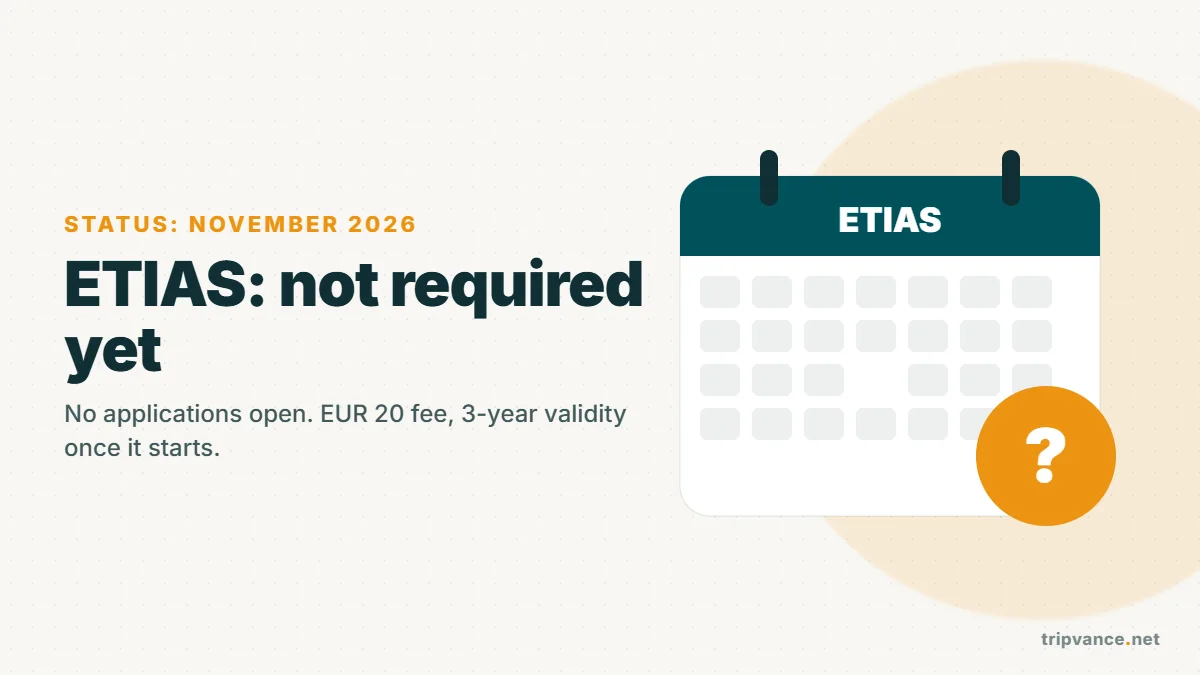
ETIAS in 2026 is still a plan, not a requirement. As of November 2026 the official EU website says plainly that ETIAS is not in operation and that no applications are being collected. If you are a US, Canadian, British or Australian traveler heading to Europe this winter or next spring, you do not need to apply for anything called ETIAS, and any site asking you to pay for one today is not the EU.
What has changed is the border itself. Since 10 April 2026, the Entry/Exit System (EES) records your fingerprints and photo at the first Schengen border you cross. This guide sorts out the two, using only what the European Union publishes on its official ETIAS and EES pages.
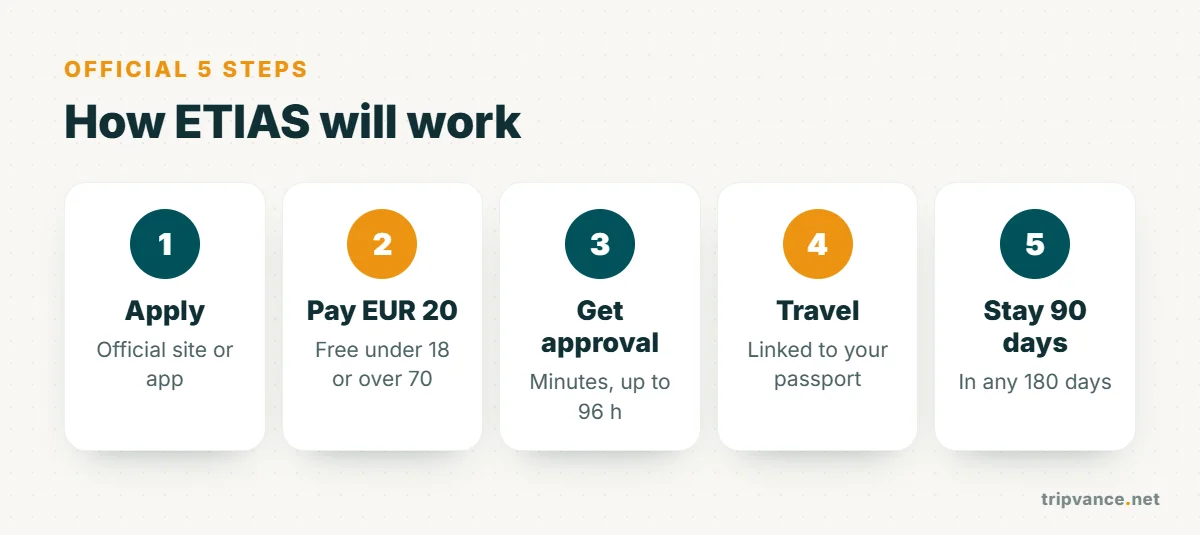
ETIAS has no launch date yet. The EU says it will announce the start date several months in advance. When it opens, it will cost EUR 20 (free under 18 and over 70), stay valid for 3 years or until your passport expires, and allow stays of up to 90 days in any 180 in 30 European countries.
Tripvance is an independent travel site. It is not affiliated with the European Union, its agencies or any government, and it does not process ETIAS applications. When ETIAS opens, apply only on the official EU website or the official ETIAS app.
Is ETIAS required in 2026?
No. The wording on the official ETIAS site, repeated on every page, is that ETIAS is currently not in operation and no applications for travel authorisations are collected at this point. The same page says the EU will inform travelers about the specific start date several months before launch. Until that announcement, airlines will not ask for it and border guards cannot refuse you for not having one.
Private sites already sell “ETIAS applications” or “ETIAS pre-registration”. There is nothing to submit yet. Once ETIAS opens, you will apply only on the official website or the official ETIAS mobile app, and the fee will be EUR 20.
Why the launch date keeps moving
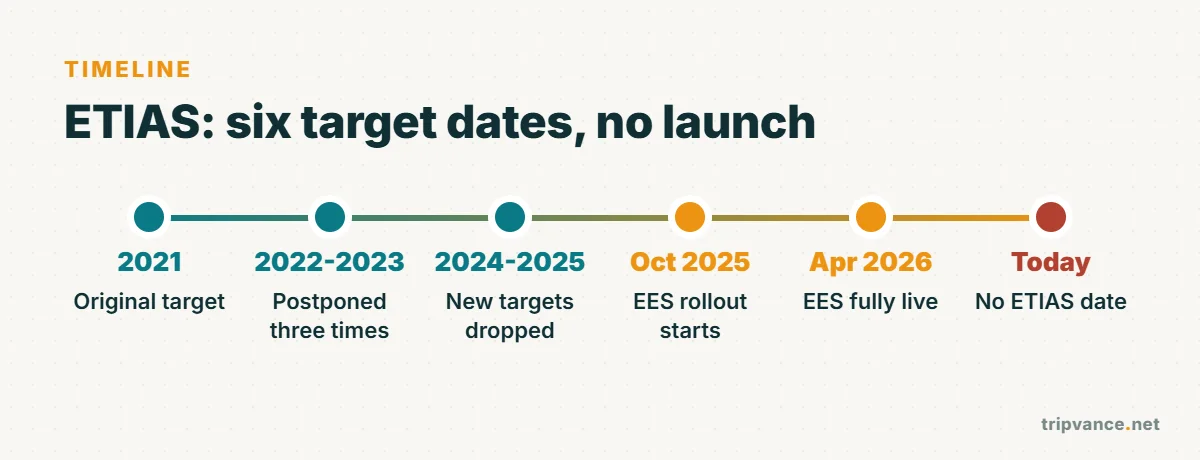
ETIAS has slipped many times. It was first meant to start in 2021, then moved to 2022, May 2023, November 2023, 2024 and 2025. The EU later aimed for the last quarter of 2026, and in mid-2026 that target disappeared from its website too. The main reason is order: ETIAS was always designed to start after the Entry/Exit System, because it relies on EES data. EES only became fully operational at all external borders on 10 April 2026.
The first target date when the system was adopted.
Several postponements in a row.
New targets announced, then dropped.
The biometric entry and exit record arrives first, in phases over six months.
The official site now gives no date at all.
Most reporting points to 2027, but only the EU’s notice counts.
Who will need ETIAS once it starts
The official rule has three parts. You will need an ETIAS travel authorisation if you are not an EU national, if your country’s citizens can visit the participating countries without a visa for short stays, and if you do not hold certain EU residence cards or residence permits. That covers travelers from the United States, Canada, Australia, the United Kingdom and many other visa-free countries.
- You will not need it if you already need and hold a valid Schengen visa. The official FAQ states that travelers with a valid visa do not need ETIAS.
- It is not a visa. It does not let you work or study long term. A work trip for a meeting or conference is fine; a job is not.
- It does not guarantee entry. Border guards still check the usual entry conditions.
- One person, one authorisation. No family or group applications. Each traveler, children included, needs their own.
ETIAS and EES are not the same thing
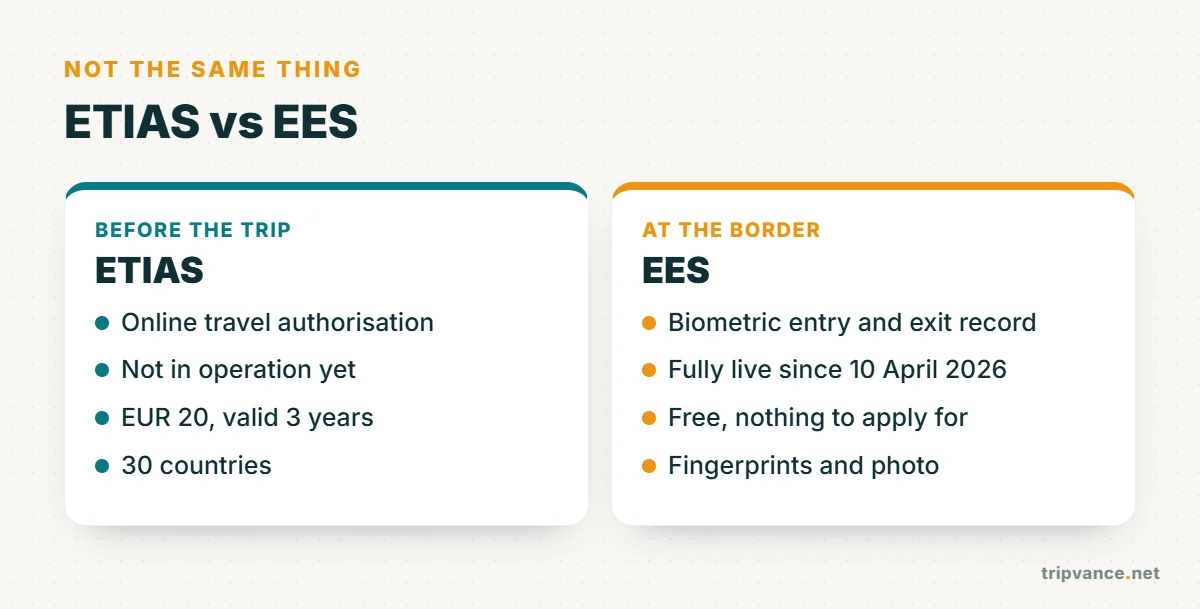
People mix them up because both arrived in the same years and both concern non-EU visitors. The difference is simple: ETIAS will be a permission you get online before the trip, while EES is a record made at the border when you arrive and leave.
ETIAS
- Online travel authorisation for visa-exempt travelers
- Status: not in operation, no date yet
- EUR 20, valid 3 years
- 30 countries
EES
- Electronic record of each entry and exit
- Status: fully operational since 10 April 2026
- Free, no application
- Fingerprints and photo for visa-free travelers; under 12s give no fingerprints
For you this means EES applies now. On your first crossing since April 2026, expect to give four fingerprints and a facial image if you travel without a visa. If you already hold a Schengen visa, only your photo is taken, because your fingerprints are already in the visa system. EES also counts your 90 days automatically, so overstays are spotted at the exit.
Fee, validity and processing time
| Point | Official answer |
|---|---|
| Fee | EUR 20, non-refundable |
| Who pays nothing | Under 18, over 70, and eligible family members of EU nationals |
| Validity | 3 years, or until your passport expires if sooner |
| Length of stay | Up to 90 days in any 180-day period; Cyprus counted separately |
| Processing | Most within minutes, at the latest 96 hours |
| Longest case | Up to 30 more days if extra documents or an interview are requested |
| Where to apply | Official ETIAS website or official mobile app only |
| Printing | Not needed: airlines and border guards see it in the system |
The longer path works like this. If your file is not cleared automatically, you get a reply within 96 hours asking for more information. You then have 10 days to send it. If that is still not enough, the consulate of the relevant country invites you to an interview, in person or online, and decides within 48 hours after it. That is why the EU advises getting ETIAS before booking flights and hotels.
What you will need to apply
The form will ask for personal details (name, date and place of birth, nationality, address, email and phone), your parents’ first names, your passport details, your level of education and current job, the first country you plan to visit, and answers about criminal convictions, travel to conflict zones and past return decisions. You can still change your route after approval: the first country is only used to process the file.
- A passport valid for more than 3 months after you plan to leave Europe
- A passport issued less than 10 years ago
- An email address you personally can access, since all messages go there
- A payment card for the EUR 20 fee, unless you are exempt
Your ETIAS will be tied to your passport number. Type it exactly, and watch the classic trap: the number 0 versus the letter O. A mismatch means you will be refused boarding. If you renew your passport, you will need a new ETIAS.
What to do now if you are traveling to Europe
- Check your passport. Valid at least 3 months beyond your return date and less than 10 years old is the safe standard for both today and the future ETIAS. Our international travel checklist covers the rest.
- Allow extra time at the first border. EES registration takes longer the first time, especially at land and sea borders.
- Count your days. The 90-in-180 rule is now enforced electronically. The EU’s official EES page offers a tool to check how long you can stay.
- Sign up for official updates rather than reading forecasts. The start date will be published on the official ETIAS site months ahead.
Tour operators and agencies can apply on behalf of clients once ETIAS opens, as long as the client signs a declaration of representation. Keeping trip details and traveler data in one place makes that easier.
See how Tripvance organizes bookingsFrequently asked questions
Do Americans need ETIAS in 2026?
No. ETIAS is not in operation and no applications are open. US citizens travel to Schengen countries visa-free as before, and now go through EES registration at the border.
When does ETIAS start?
There is no confirmed date. The EU says it will announce the start several months before launch. Most reporting points to 2027, but no official date exists.
How much will ETIAS cost?
EUR 20 on the official website or app. Applicants under 18 or over 70 do not pay, and the fee is not refunded if the application is refused.
Is ETIAS the same as a visa?
No. It is a travel authorisation for people who do not need a visa. It does not allow you to work or to study long term, and people who hold a valid Schengen visa do not need it.
Will UK citizens need ETIAS?
Yes, once it starts, because UK nationals can visit the Schengen area without a visa. The official site published a dedicated article on UK nationals and ETIAS in April 2026.
Does EES replace passport stamps?
Yes, at the borders of the countries using EES. Cyprus and Ireland still stamp passports manually.
- European Union: Official ETIAS website
- European Union: ETIAS frequently asked questions
- European Union: EES frequently asked questions
- European Union: What is the EES?
- EY: European Union postpones ETIAS launch to 2024 (March 2023)
- Erickson Immigration Group: EU postpones ETIAS launch to mid-2025
- Groups Today: ETIAS delayed, no official launch date
Last checked against the official EU pages: November 2026.