
How to get over jet lag comes down to one thing most travelers never plan for: light. Pills, hydration tricks and in-flight rituals all have their place, but your body clock takes its orders from the timing of daylight, and you can use that on purpose. Get the timing right and a week of 3 a.m. wake-ups shrinks to a few rough mornings. Get it wrong and you can actually push your clock the wrong way.
Shift your sleep by about 1 hour a day for 2 to 3 days before you fly, switch to destination time the moment you board, then use light: after flying east, get bright light in the late morning and avoid it in the evening; after flying west, get light in the late afternoon and evening. Expect your clock to catch up by roughly 1 hour a day going east and 1.5 hours a day going west.
What jet lag is, and why it is not just tiredness
Inside your brain sits a master clock that runs on a cycle of roughly 24 hours. It decides when you feel sleepy, when your body temperature drops, when you get hungry and when your gut expects food. Fly across several time zones in a few hours and that clock is still running on home time while the sun, your meals and your hotel alarm run on local time. The mismatch is jet lag.
The CDC’s travel health guidance treats it as a real sleep disorder, with formal criteria: insomnia or heavy daytime sleepiness after crossing at least two time zones, with symptoms that start within a day or two of travel. A long flight with no time change, say London to Cape Town, leaves you tired. That is travel fatigue, and one good night fixes it. Jet lag does not go away after one night, because the problem is the clock, not the lack of sleep.
Typical symptoms include:
- Trouble falling asleep at night, or waking at 3 or 4 a.m. and staying awake
- Heavy sleepiness in the afternoon, often right when you need to be sharp
- Poor concentration and memory, slower reactions
- Indigestion, constipation, low appetite at mealtimes and hunger at odd hours
- A general feeling of being unwell, irritable or slightly anxious
How long does jet lag last?
The CDC gives a useful rule of thumb: the body clock adapts by about 1 hour per day after flying east and about 1.5 hours per day after flying west. Divide the number of time zones by that rate and you get a rough number of days before your clock is fully in step with local time.
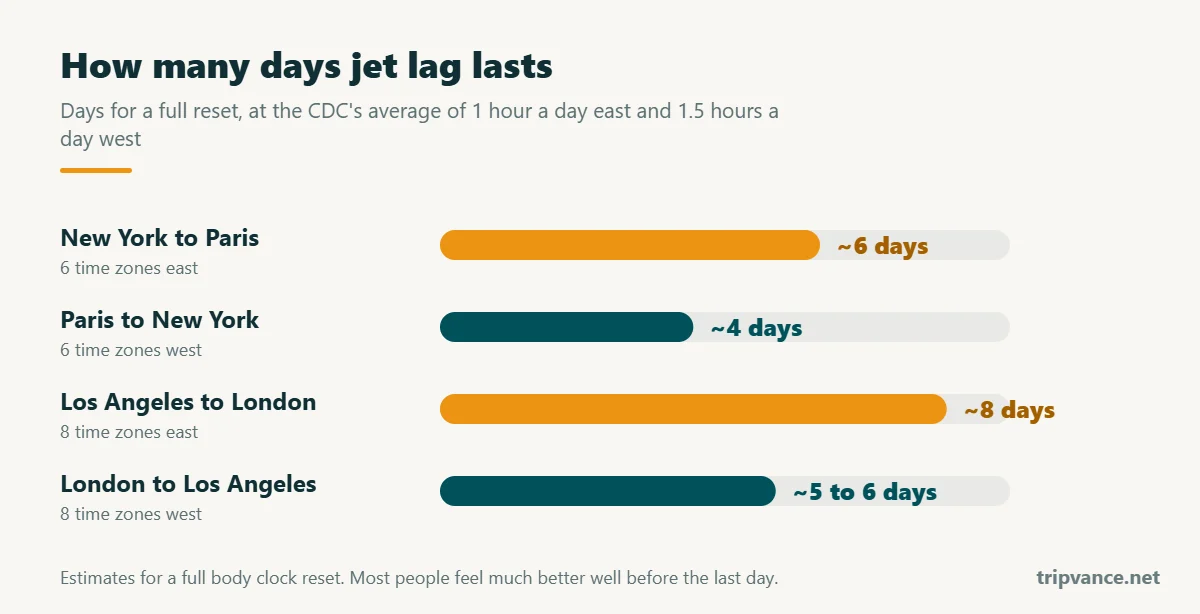
Why is east harder? Flying east means you have to fall asleep earlier than your body wants, which is like trying to go to bed at 7 p.m. at home. Your internal day is naturally a little longer than 24 hours, so staying up later comes easily and going to bed earlier does not. That is why New York to Paris tends to hurt more than Paris to New York, even though the time difference is the same.
These figures are for a full reset. Most people feel noticeably better well before the last day, especially if they manage their light exposure. Age, how much sleep you lost on the trip and how busy your first days are all make a difference.
Jet lag planner: your light schedule
Pick your route details below. The planner uses the CDC’s average adaptation rates and a simple body clock model to tell you, in local time, when bright light helps and when it works against you during your first days.
Before you fly: start the shift at home
The cheapest jet lag fix happens before you pack. The CDC suggests moving your sleep toward the destination over the 2 to 3 days before departure, by about 1 hour a day: earlier for an eastward trip, later for a westward one. Three days of that turns a 6 hour jump into a 3 hour one before you have even reached the airport.
- Going east: go to bed and get up an hour earlier each day, and get bright light soon after waking.
- Going west: go to bed and get up an hour later each day, and keep the evening bright.
- Choose your arrival time: on long eastbound trips, an arrival around midday is easier to manage than a dawn landing straight into bright morning sun.
- Bank sleep: arriving already short of sleep makes every symptom worse. Skip the late-night packing session.
- Short trip? If you will only be away 2 or 3 days, the NHS suggests staying on home time where you can. Adapting fully would take longer than the trip.
Build the shift into your travel itinerary so the first day after landing is light, not your most important meeting or a 6 a.m. tour pickup. Our international travel checklist has a slot for exactly this.
On the plane: switch to destination time
Set your watch and phone to destination time as soon as you board, then behave accordingly. If it is night where you are going, try to sleep: eye mask, earplugs or noise cancelling headphones, and skip the second movie. If it is daytime there, stay awake, keep the window shade up when allowed and walk the aisle now and then.
- Water: drink regularly. Dry cabin air and dehydration make headaches and fatigue worse. Bring an empty bottle through security and fill it airside; our guide to the TSA liquid rules explains why it has to be empty.
- Alcohol: keep it light. It helps you fall asleep but breaks up sleep later, so you land more tired.
- Caffeine: keep it low during the flight if you need to sleep on board.
- Connections: a stopover splits the time change, which some people find gentler. Leave enough time between flights; see how long of a layover you need.
After landing: light is the main lever
Your clock is most sensitive to light around its low point, which falls roughly 2 to 4 hours before your usual wake-up time at home. Light received after that low point moves the clock earlier; light received before it moves the clock later. That is the whole trick, and it explains why “get outside in the morning” is not always right.
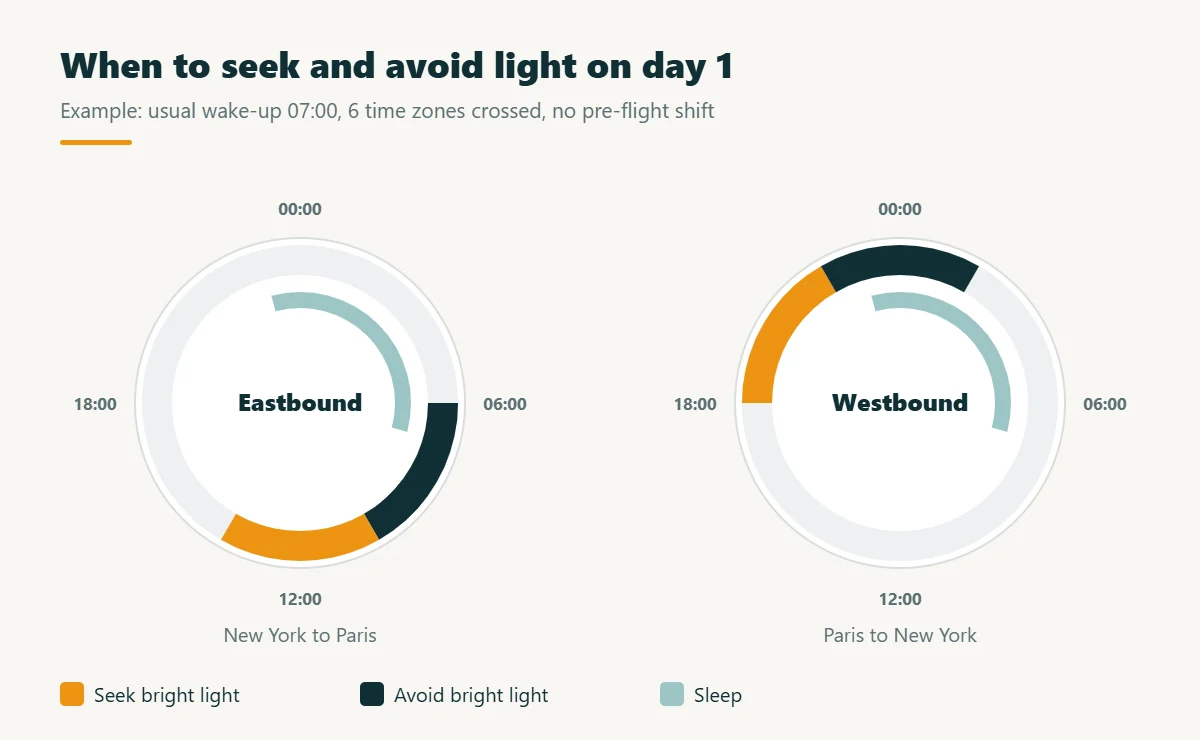
Take a New Yorker who usually wakes at 7:00 and flies to Paris, 6 hours ahead. On day one, their body still thinks 4:00 New York time is the low point, which is 10:00 in Paris. Bright sun at 8:00 Paris time lands before that low point and pushes the clock later, the wrong way. So for the first morning: sunglasses until about 10:00, then as much daylight as possible until about 14:00. Each following day, move both windows an hour earlier.
Flying west is kinder. The Parisian landing in New York wants to stay up later, so the late afternoon and early evening sun does most of the work. Very early morning light is the thing to dodge for the first days, which is easy if you sleep through it.
Caffeine, naps and meals
- Caffeine: the CDC’s guidance allows up to about 200 mg (roughly a large filter coffee) every 4 hours during daylight if you need it, stopping 6 hours before bedtime.
- Naps: keep them to 20 to 30 minutes. A three hour afternoon nap feels wonderful and wrecks the night.
- Meals: eat at local mealtimes from the first day, even if you are not hungry. Food timing helps the clocks in your gut follow along.
- Movement: a walk outdoors combines daylight and activity, the two things that help most.
Melatonin and sleeping pills: what the evidence says
Melatonin is the hormone your brain releases in the evening, and taken as a supplement it can nudge the clock. The CDC notes that small doses of 0.5 to 1 mg are often enough, that doses above 5 mg should be avoided, and that timing matters more than quantity: after an eastward flight it is taken around local bedtime. Timing it badly, while your own melatonin is already high, does little.
Not every health body is convinced. The NHS states that melatonin is not recommended for jet lag because there is not enough evidence that it works. Rules also differ by country: it is sold as a supplement in the US, where the FDA does not regulate the content of supplements, while in the UK it is a prescription medicine. If you are pregnant or breastfeeding, buying for a child, or taking other medication, talk to a doctor or pharmacist first.
Short-acting sleeping tablets can help a few bad nights, but the NHS warns they can be addictive and should only be used briefly for severe symptoms. The CDC advises avoiding long-acting sedatives and drowsy antihistamines, which add grogginess and raise the risk of falls. Never mix them with alcohol on a plane.
A step by step plan: New York to Paris
Here is how the advice fits together for a typical eastbound trip of 6 time zones. Adjust the clock times to your own wake-up time with the planner above.
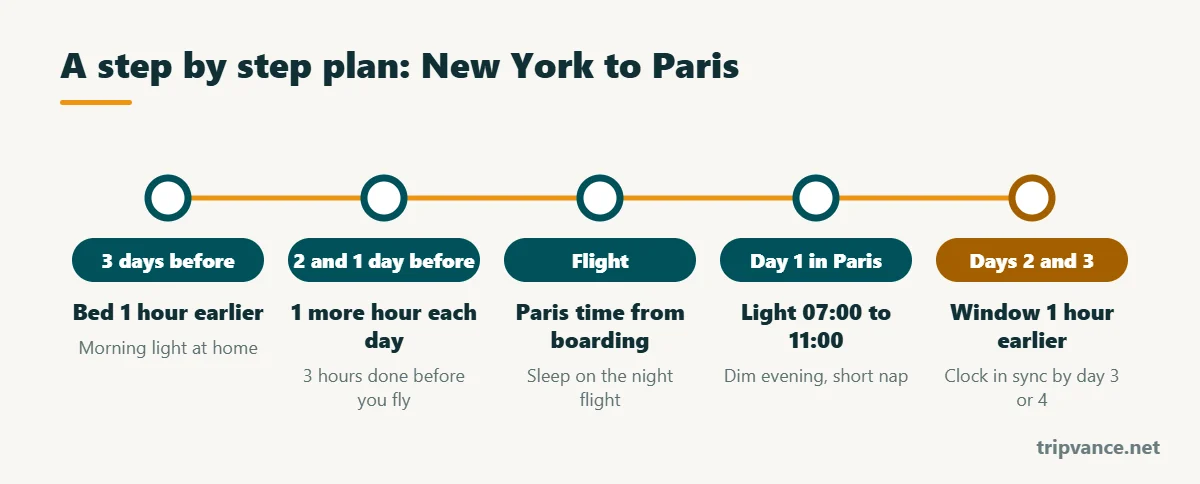
Get daylight soon after waking. Dim the lights and screens in the evening.
By departure your clock is already about 3 hours closer to Paris.
An overnight flight is the moment to sleep. Light meal, little alcohol.
Thanks to the head start, your low point now sits around 07:00 Paris time. Get outside after it, keep the evening dim, nap 20 minutes at most.
With 3 hours already done at home, the remaining gap closes in about 3 days instead of 6.
Why jet lag can feel worse on the way home
Plenty of travelers swear the return trip is harder. Often it is the direction: for Americans coming back from Asia, or Europeans coming back from the US, home is to the east. It is also the context. On holiday you can sleep in and wander around in the sun; at home you are back at a desk under office lights with an alarm set for 6:30.
Two things help. Book your return a day or two before you go back to work, and use the same light rules for the trip home. If a long delay or missed connection eats into that buffer day, check whether you are owed flight delay compensation; under EU rules a 3 hour late arrival can be worth up to €600 per person.
An eye mask, earplugs and a pair of sunglasses do more for jet lag than any gadget. They are on our printable packing list for that reason.
Jet lag: quick answers
How long does jet lag last?
Roughly one day per time zone after flying east and two thirds of a day per time zone after flying west, based on the CDC’s average adaptation rates. Six time zones east means about six days for a full reset, with the worst of it usually over in two or three.
Is jet lag worse flying east or west?
East, for most people. You have to fall asleep earlier than your body wants, and the natural tendency of the human clock is to drift later, not earlier.
Should I sleep when I arrive?
If you land in the morning, stay up until a normal local bedtime and allow yourself one nap of 20 to 30 minutes at most. If you land in the evening, go to bed at a sensible local hour even if you are not sleepy.
Can you avoid jet lag completely?
Not on a long trip across many time zones, but you can shorten it a lot. Pre-flight shifting plus well timed light can cut several days off the adjustment.
Does melatonin help with jet lag?
It can help some travelers when taken in a small dose at the right time, according to the CDC. The NHS does not recommend it for jet lag because the evidence is limited. Ask a pharmacist or doctor before using it, especially for children or during pregnancy.
Does a 2 or 3 hour time difference cause jet lag?
It can cause mild symptoms, and two time zones is the formal threshold. Most people adapt within one to three days and feel little more than an early or late morning.
Last updated: November 2026. This guide is general information, not medical advice. If you have a sleep disorder, a chronic condition or take regular medication, ask your doctor before changing your sleep or using melatonin.