
Ask ten frequent flyers how early to get to the airport and you will hear everything from “two hours, always” to “forty minutes if I have PreCheck”. Both camps are partly right. The old 2 hour and 3 hour rules are a safe default, but the number that really matters is printed in your airline’s rules: the minute check-in closes, the minute your bag must be on the belt, and the minute the boarding door shuts. Work back from those and you will rarely sprint or wait for nothing.
Plan on 2 hours before a domestic flight and 3 hours before an international one. You can trim that to about 75 to 90 minutes for a carry-on only domestic trip with TSA PreCheck at a mid-size airport. Add 30 to 60 minutes for holiday peaks, kids, a checked bag at a big hub, or leaving Europe on a non-EU passport.
How early to get to the airport: the 2 hour and 3 hour rule
The two numbers everyone quotes come straight from the airlines. Delta tells domestic passengers to arrive at least 2 hours before departure and suggests at least 3 hours when you are leaving the United States. United gives the same 2 and 3 hour advice, and Air France says 3 hours for international flights and 2 hours within France and Europe. The TSA repeats the same advice during busy periods.
These are buffers, not legal requirements. They absorb what you cannot control: a long security line, a slow shuttle bus, a bag drop queue out the door. The trap most people fall into is treating the rule as fixed in both directions. At a small regional airport on a Tuesday morning, 2 hours is generous. At Atlanta or JFK on the Sunday after Thanksgiving, it can be tight.
The deadlines that really decide it: check-in, bag drop and boarding
Every airline publishes three deadlines, and missing any one can cost you the flight even if the plane is still at the gate: the check-in cutoff, the bag cutoff, and the gate or boarding cutoff, when unclaimed seats are released and the door closes.
Here is what the main carriers say on their own pages as of October 2026. Some airports carry longer limits, so the time on your boarding pass always wins over this table.
| Airline | Domestic check-in | Checked bag | International check-in | Gate or door |
|---|---|---|---|---|
| American Airlines | 45 min | 45 min (60 international) | 60 min | Doors close 15 min before |
| Delta Air Lines | 30 min without bags | 45 min (60 at JFK) | 60 min (75 to 120 at some airports) | At the gate 15 min before; 45 min international |
| United Airlines | 45 min, bags or not | 45 min | 60 min (75 to 90 at some airports) | Boarded about 15 min before; check your pass |
| Southwest Airlines | 30 min | 45 min | 60 min (75 for Aruba) | In the gate area 10 min before, or the booking can be canceled |
| British Airways (Heathrow T5) | 45 min short haul | Same as check-in | 60 min long haul | Through security by 35 min, at the gate by 20 min |
| Air France | 40 min within Europe | Same as check-in | 60 min | Gate closes 20 min before (15 min Orly to mainland France) |
| Emirates (Dubai) | Not applicable | At check-in | Counters open 3 h before (4 h at some airports) | Through passport control 90 min before, at the gate 60 min before in Economy |
Two details are worth underlining. United moved its domestic check-in cutoff from 30 to 45 minutes for travelers without bags in June 2025, so the habit of strolling in 35 minutes before a United flight no longer works. And Emirates is the outlier: at Dubai it wants Economy passengers at the gate a full hour before departure, which changes the math completely for anyone flying long haul out of DXB.
Southwest’s gate rule has teeth. If you are not in the gate area with a boarding pass at least 10 minutes before the scheduled departure, Southwest says your reservation may be canceled, not just your seat given away.
Work backwards from your departure time
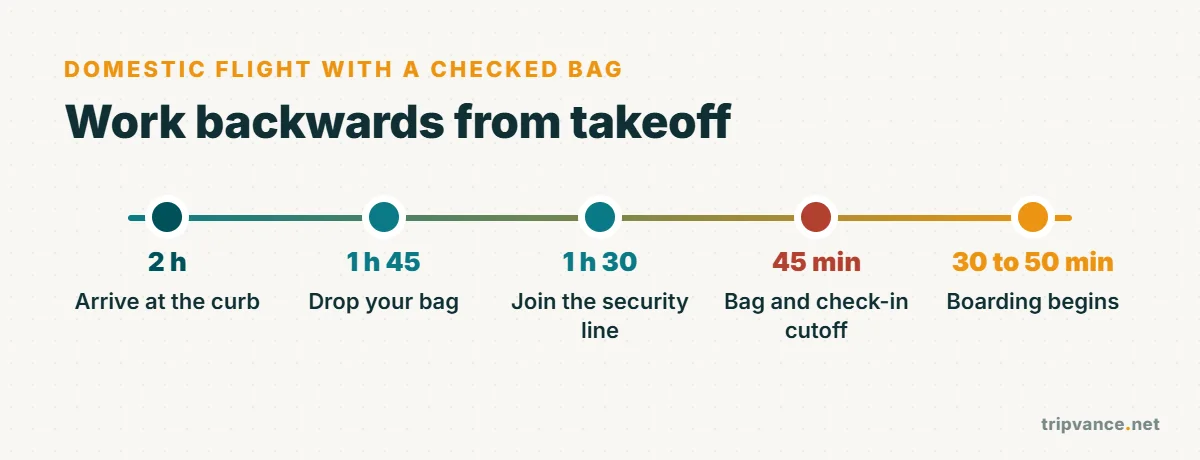
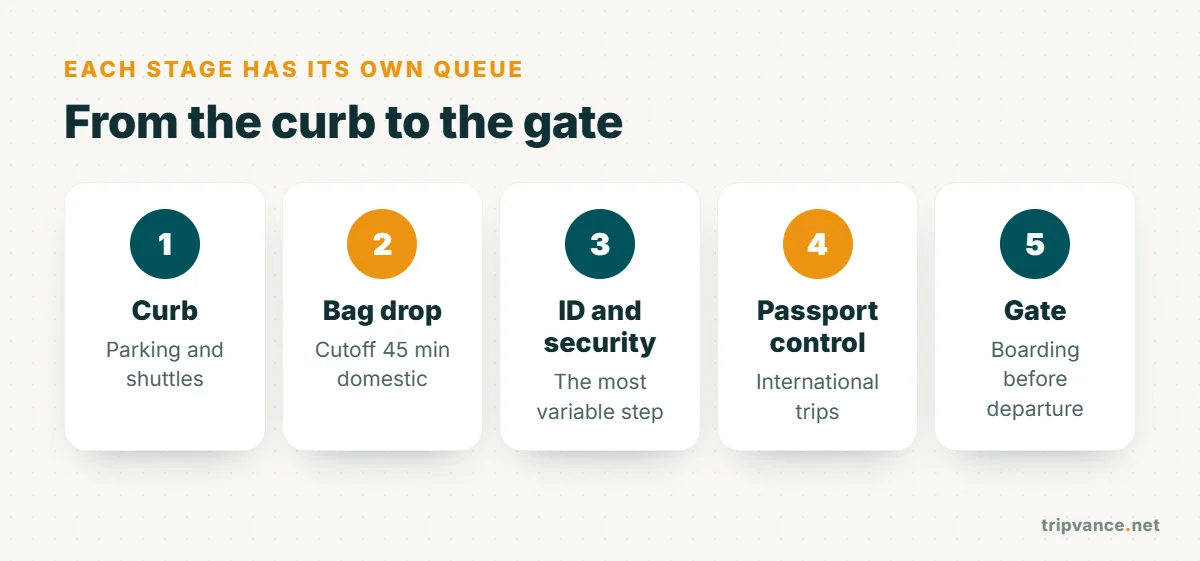
The most reliable way to decide when to leave home is to start at the departure time on your ticket and walk the clock backwards. Here is how that looks for a typical domestic flight with a checked bag at a large US airport.
Parking shuttles and rental car returns can easily eat 20 minutes.
You should already be checked in on the app. The bag drop queue is the one line you cannot skip with PreCheck, so do it first.
Have your ID or passport in hand and your liquids bag on top. This is the step with the most variance, so it gets the biggest buffer.
American, Delta and United stop accepting checked bags for domestic flights at this point. If you are still in the bag line, speak to an agent now.
American starts most flights 30 to 50 minutes before departure.
On American the door closes 15 minutes before departure and you will not be allowed on after that. Delta wants you at the gate and ready by the same time.
International flights follow the same logic with bigger numbers: a 60 minute check-in cutoff, a 45 minute gate time at Delta, and document checks before all of it. That is the third hour.
Security lines: what the TSA numbers say
Security is the part of the trip with the most variance, so it deserves real numbers. US checkpoints are busier than ever. The TSA screened a record of about 3.13 million people on Sunday 30 November 2025, the Sunday after Thanksgiving, beating the previous high of 3.09 million set on 22 June 2025.
During the partial government shutdown in spring 2026, TSA officers went unpaid from mid-February, call-out rates passed 40 percent at some airports, and the agency’s acting administrator told Congress that travelers were facing its highest wait times ever, with some lines lasting more than four hours. Funding was restored on 30 April 2026 and lines returned to normal, but it is a reminder that “2 hours” assumes a functioning checkpoint. If the news mentions a shutdown, add an hour.
TSA PreCheck, CLEAR and the MyTSA app
TSA PreCheck is the single biggest time saver for US travelers. The TSA says about 99 percent of PreCheck passengers wait less than 10 minutes, you keep your shoes, belt and light jacket on, and laptops stay in the bag. Enrollment costs $78 with IDEMIA, $85 with Telos or $77.95 through CLEAR, and children 17 and under can come through with an enrolled parent when the PreCheck indicator shows on their own boarding pass.
CLEAR is a separate, private paid service that checks your identity with biometrics and walks you to the front of the screening line. It does not replace screening, so pair it with PreCheck.
The free MyTSA app shows how busy your airport is likely to be at your day and time of travel, based on historical data. Many large airports also post live checkpoint waits online.
What adds time, and how much
The 2 hour rule assumes an average trip. Yours probably is not. Each of these factors pushes your arrival time earlier, and they stack.
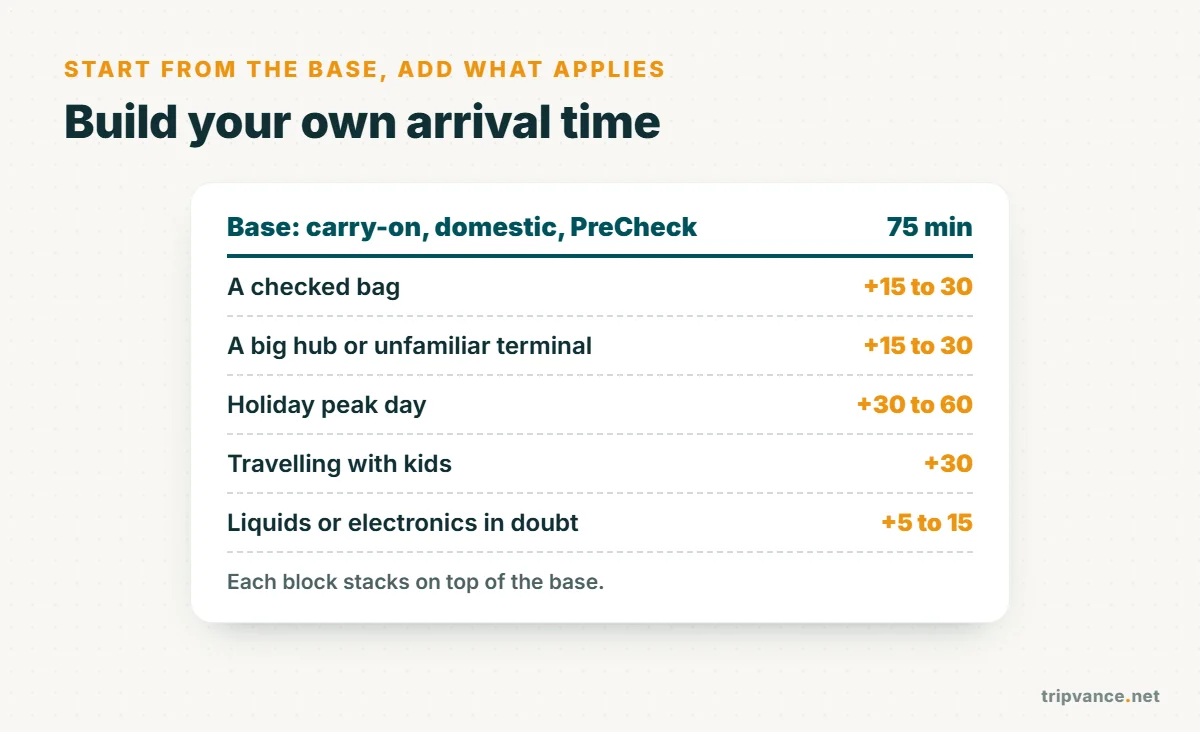
- A checked bag: adds the bag drop queue and moves your hard deadline to 45 minutes before departure on most US carriers. Count 15 to 30 extra minutes.
- A big hub or a terminal you do not know: long walks, trains between concourses and confusing layouts. Count 15 to 30 minutes.
- Peak days: the Sunday after Thanksgiving, the days around Christmas and New Year, the Friday before a holiday weekend and spring break. Count 30 to 60 minutes.
- Kids: strollers, car seats, extra bags and bathroom stops. Count 30 minutes, more with infants.
- Liquids or electronics you are not sure about: a bag pulled for a second look costs 5 to 15 minutes. Our guide to TSA liquid rules and the rules for a power bank on a plane help you pack so it does not happen.
The opposite also works. A bag that fits the overhead bin means no bag drop at all, and our carry-on size chart by airline shows exactly how big that bag can be.
International flights: documents, REAL ID and Europe’s EES
International trips add a document check before you ever see security. The agent has to see your passport, and often a visa, an electronic travel authorization or proof of onward travel. If anything is missing, you need time to fix it. The international travel checklist covers what to have ready.
REAL ID at US checkpoints
Since 7 May 2025, every traveler aged 18 or older needs a REAL ID compliant license or another acceptable ID, such as a passport, to pass a TSA checkpoint on a domestic flight. Since 1 February 2026, travelers who show up without one can use TSA ConfirmID, an identity check that costs $45 and covers a 10 day travel period. TSA warns that it takes longer, so if you are in that situation, add at least 30 minutes.
Leaving Europe on a non-EU passport
Europe’s Entry/Exit System (EES) replaced passport stamps for non-EU short-stay visitors in 29 European countries. It started on 12 October 2025 and became fully operational on 10 April 2026. The first time you cross, border officers record your fingerprints and a facial image, and the system logs every entry and exit. The temporary rule that let border guards pause the checks during queues ended on 6 September 2026, and early reports put a full EES check at around 90 seconds per traveler, compared with about 20 seconds for a stamp.
For US, UK, Canadian and other non-EU travelers flying home from Paris, Lisbon, Madrid or Rome, passport control is now a real queue. Give yourself the full 3 hours at minimum, and 3.5 hours in summer or at the end of school holidays.
Changing planes on the way? Connections have their own rules for passport control and bag recheck. Read how long of a layover you need before you book a tight one.
Rule of thumb by trip type
Our recommendations for arriving at the terminal, built on the cutoffs and wait data above:
| Your trip | Arrive | Why |
|---|---|---|
| Domestic, carry-on only, PreCheck, small or mid-size airport | 75 to 90 min | 45 min cutoff plus a short security line |
| Domestic, carry-on only, standard security, big hub | 1 h 45 to 2 h | Security and long walks to the gate |
| Domestic with a checked bag | 2 h | Bag drop queue and 45 min bag cutoff |
| Domestic on a holiday peak day, or with kids | 2 h 30 | Record crowds and slower security |
| Domestic without REAL ID (ConfirmID) | 2 h 30 | Extra identity check at the checkpoint |
| International from the US | 3 h | Document check, 60 min cutoff, earlier gate time |
| Leaving Europe on a non-EU passport | 3 h to 3 h 30 | EES exit checks at passport control |
| Emirates from Dubai | 3 h | Gate time 60 min before departure in Economy |
Save time on the day by doing the work at home: check in online 24 hours ahead and pack the night before with a packing list.
Running late? What to do in the last hour
What you do in the next ten minutes decides whether you fly.
- Check in on the app right now, from the car or the train, if you have not already. If the window has closed, the app will usually tell you, and that is your cue to call.
- Drop the checked bag if you can. If you are near the 45 minute bag cutoff, decide whether everything can fit in a carry-on. A late bag is the most common reason people miss flights they could have made.
- Call or message the airline before departure. Most carriers are far more flexible about rebooking a passenger who contacts them before the flight leaves than one who simply does not show up.
- Ask for help at security. At many airports, staff will let travelers whose flight is boarding go to the front of the line. Ask politely and show your boarding pass; it is not guaranteed.
- Go to the gate even if you think it is too late. Departures are often delayed, and the door may still be open.
- If you miss it, ask about the next flight. Same-day standby or a change to a later flight is often possible, sometimes for a fee depending on your fare.
Arrived on time and the flight is the one running late? If it lands 3 hours or more behind schedule, or is cancelled, check whether you are owed money: our flight delay compensation guide covers EU261, UK261 and the US refund rules.
Airport arrival times: quick answers
Is 1 hour enough time at the airport for a domestic flight?
Only in the best case: carry-on only, already checked in, TSA PreCheck and a small airport. With American or United you must still be checked in 45 minutes before departure, so arriving at 60 minutes leaves only 15 minutes of slack.
How early should I get to the airport for an international flight?
Three hours. Check-in usually closes 60 minutes before departure, some airports require 75 to 120 minutes, and Delta wants international passengers at the gate 45 minutes before takeoff.
Is 2 hours early enough for a domestic flight?
Yes, on most days, even with a checked bag. Add 30 minutes on holiday peaks, with young children or at a very large hub.
How early can I check a bag?
It depends on the airline and airport. British Airways at Heathrow Terminal 5, for example, opens Economy bag drop 3 hours before long haul and 2 hours before short haul flights. Check your airline’s page if you want to drop a bag very early.
Do I need to arrive earlier with TSA PreCheck?
No, PreCheck lets you arrive later because 99 percent of members wait under 10 minutes. The check-in and bag cutoffs still apply, so do not cut it below about 75 minutes.
Can I use my passport instead of a REAL ID?
Yes. A valid passport is an acceptable ID at TSA checkpoints, including for domestic flights.
Last updated: October 2026. Cutoffs change and vary by airport, so check the time on your boarding pass before you leave.