If you want to know how to become a travel agent in 2026, the honest answer is that nobody hands you a license. There is no exam and no degree between you and your first booking. What stands in the way is a set of business decisions: who you sell under, which state rules apply to you, and where your first ten clients come from.
Learn the basics with an entry course, then pick a path: join an agency as an employee, or sell as an independent contractor under a host agency that gives you its accreditation numbers and supplier commissions. Register your business, check your state’s Seller of Travel rules, choose a niche, and build a simple website where clients can see your trips.
What a travel agent actually does in 2026
Clients can book a flight and a hotel on their phone in four minutes. They come to an agent for what is hard: a honeymoon across three countries, a cruise with a grandparent in a wheelchair, 22 guests for a destination wedding, a safari whose lodges sell out a year ahead. That is why most agents now call themselves travel advisors.
Day to day, that means researching, quoting, booking with suppliers, handling changes and being the person clients call when a flight is cancelled at 11 pm. Selling matters as much as planning: an agent who knows Japan inside out but cannot find clients earns nothing. The Bureau of Labor Statistics counted 61,500 travel agent jobs in 2025.
How to become a travel agent: the three paths
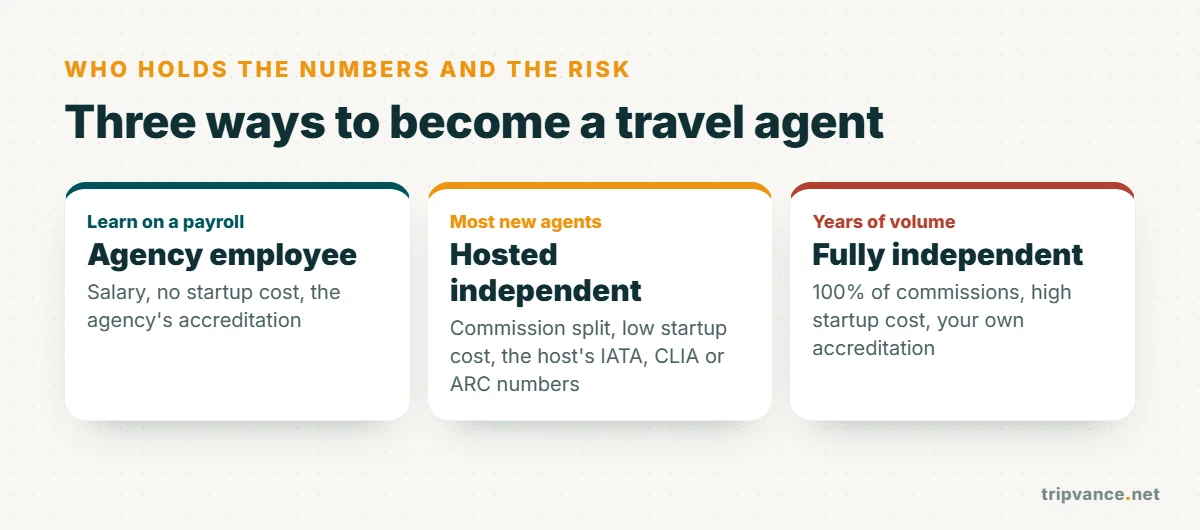
Every route into travel sales is a version of one of these three. They differ in who holds the accreditation numbers, who takes the legal risk and who keeps the commission.
| What matters | Agency employee | Independent with a host | Fully independent |
|---|---|---|---|
| How you are paid | Salary, sometimes plus commission | Your share of the commission split, plus your own fees | 100% of commissions and fees |
| Startup cost | None | Low: host fees, business setup, website | High: accreditation fees, bonds, insurance |
| Accreditation numbers | The agency’s | The host’s (IATA, CLIA, ARC) | Your own |
| Who finds the clients | Partly the agency | You | You |
| Freedom over niche and brand | Limited | High | Full |
| Best for | Learning on a payroll | Most new agents | Advisors with years of volume |
Employee. You learn on someone else’s systems with a paycheck while you make your early mistakes, but you build your own client list slowly. Hosted independent. You run a small business under a host’s accreditation and supplier agreements; Host Agency Reviews reports a median of 4 years’ experience for hosted advisors, so this is where most careers now start. Fully independent. You hold your own numbers and contracts. The median independently accredited advisor has 13 years of experience, because going solo only pays once your volume earns better rates on its own.
What a host agency does, and how commission splits work
A host agency provides the accreditation numbers suppliers ask for, negotiated commission levels, booking tools, training, often errors and omissions insurance, and the back office that tracks and pays commissions. You bring the clients.
The money follows a fixed route: you book under the host’s number, the supplier pays the commission to the host, usually after the client travels, and the host keeps its percentage and pays you the rest. Cash arrives weeks or months after the sale.
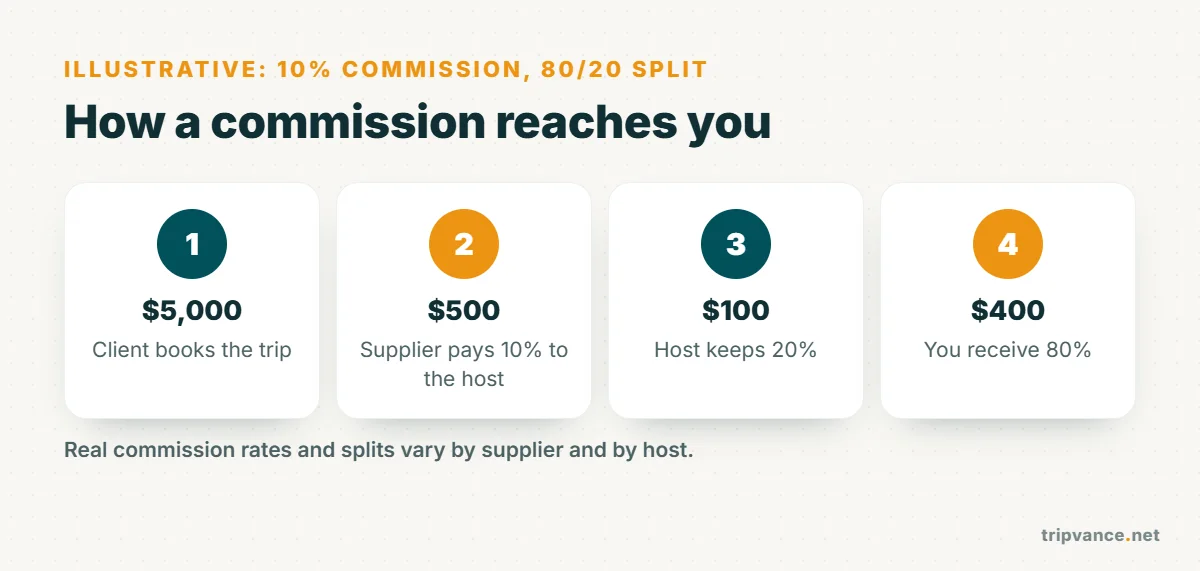
Splits vary widely. Host Agency Reviews publishes examples ranging from 60/40 to 90/10 (the first number is the agent’s share), with 70/30 and 80/20 among the most common in reader discussions. Treat those as typical ranges, not a standard. A 90/10 host often charges higher fees; a 70/30 host may include leads or mentoring.
The trap most new agents fall into is choosing a host on the split alone. Ask what you pay per month or per year, whether there are minimum sales, how quickly commissions are paid out, whether E&O insurance is included, who owns the client list if you leave, and whether the host holds Seller of Travel registrations in the states you sell into.
Travel agent certification: useful, but not required
The BLS is clear: certification is not required. Some credentials still help, because they teach you the product faster and reassure a nervous first client.
- The Travel Institute: TRIPKIT. The entry program for new advisors. The 6th edition launched on 19 January 2026 and ends with the TAP (Travel Agent Proficiency) test on industry basics.
- The Travel Institute: CTA (Certified Travel Associate). Needs at least 12 months of industry experience, then coursework and a proctored exam.
- The Travel Institute: CTC (Certified Travel Counselor). Needs at least 5 years of experience selling travel and focuses on management skills.
- CLIA cruise certifications. CCC, ACC, MCC and ECC, in that order. Enrolment is open only to CLIA Individual Agent Members, which usually means your agency or host is a CLIA member.
- Destination specialist courses. Tourism boards and suppliers run free or low-cost training on a country, cruise line or resort brand: the quickest route to product knowledge in your niche.
Entry course or host training first, destination courses next, and the CTA after your first year, when it has something real to build on.
Licenses, Seller of Travel laws and accreditation numbers
There is no federal travel agent license. A few states regulate people who sell travel to their residents, so the rules can apply based on where your clients live, not only where you live. Confirm on the state sites in the sources, because fees and forms change.
States with Seller of Travel rules
- California. Sellers of travel must register with the Attorney General’s office and show the registration number in their advertising. Host Agency Reviews describes an exemption for some hosted independent agents who sell only through a registered host, with client payments going to the host or supplier.
- Florida. Registration with the Department of Agriculture and Consumer Services costs 300 dollars a year, usually with a 25,000 dollar bond. Independent agents selling for a registered Florida seller must also file their own annual application.
- Washington. A Sellers of Travel license is needed to sell or advertise travel. If you hold client money for more than five business days, you also need a trust account, a bond of 10,000 to 50,000 dollars depending on sales, or an approved association membership.
- Hawaii. Travel agencies need a license from the Professional and Vocational Licensing Division and must follow the client trust account rules in Chapter 468L, with a waiver possible for out-of-state agencies that never take cash or checks.
Iowa (2020) and Nevada (2015) repealed their laws. Host Agency Reviews also flags agency rules in Delaware, Illinois, Louisiana, Massachusetts and New York. That is the picture as of October 2026; check before you sell.
Exemptions depend on whose name is on the invoice and where the money goes. If you sell to clients in California, Florida, Washington or Hawaii, ask your host in writing which registrations cover you, and confirm with the state.
IATA, IATAN, CLIA and ARC numbers
Suppliers pay commission only to sellers they can identify, and these numbers are how. Hosted agents use the host’s; fully independent agents apply for their own.
- CLIA number: lets you book cruises directly with member cruise lines. CLIA listed agency dues of 429 dollars a year for 2025.
- IATA / IATAN number: recognised by hotels, tour operators and many other suppliers. IATAN charges 110 dollars for a new Independent Contractor Business application in 2026, and its key person needs two years of documented experience.
- ARC number: needed only if you want to issue airline tickets yourself. Host Agency Reviews lists a 2,300 dollar application fee and a bond of at least 20,000 dollars, which is why leisure agents rarely bother.
- IATAN ID card: the card that proves you work in travel and gets you agent rates. In the US you need to work at least 20 hours a week in travel sales and have earned at least 5,000 dollars in salary or commission in the past 12 months.
How much do travel agents make?
The BLS figures cover employed travel agents only, and its pay data do not include self-employed workers:
The BLS still expects about 5,900 openings a year, mostly to replace leavers. The median employed agent earned 50,160 dollars in May 2025, slightly under the 50,980 dollar median for all occupations. The lowest-paid 10% earned under 34,610 dollars and the top 10% over 76,660 dollars.
Host Agency Reviews’ 2024 research puts experienced full-time agents higher: about 67,256 dollars on average for hosted advisors with 3 or more years in the job, and 78,940 dollars for fully independent ones. Survey averages, not promises: first-years earn far less.
Income comes from commissions paid by suppliers as a percentage of the booking, and service or planning fees charged to the client. In Host Agency Reviews’ 2023 report, 49% of hosted advisors charged a fee. It protects your time on clients who ask for three quotes and then book online.
Choose a niche and find your first clients
“I plan trips” is not a niche. “I plan multi-generational Alaska cruises” is, and so is “Morocco and Egypt for first-time visitors” or “sports team travel for Ohio high schools”. A clear niche makes everything cheaper: fewer suppliers to study, a website that writes itself, referrals who know whom to send. The best niches pair trips worth a real commission with something you already know well, like the former teacher running school trips.
Your first bookings will almost always come from people who already know you: friends, family, former colleagues, your club, parents at school. That is how trust works in this trade. Tell them exactly what you sell. Group trips speed things up: one destination wedding can bring 20 travellers into your database at once. For the plans you send, our travel itinerary template gives you a clean structure.
Your first 90 days as a travel agent
A realistic plan for a hosted independent starting from zero, with paperwork front-loaded so nothing blocks the first sale.
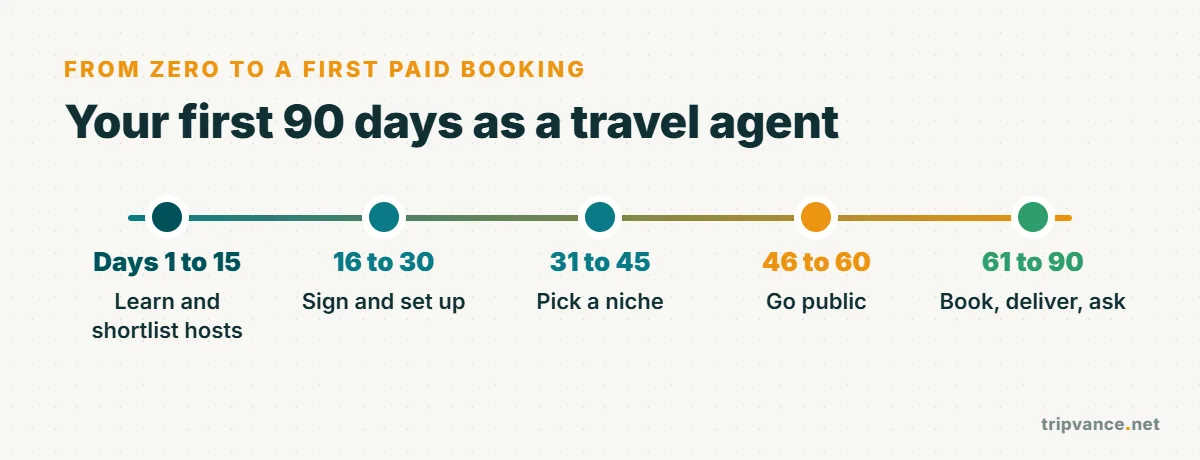
Start an entry course and interview three hosts with the questions above.
Join a host, get an EIN and bank account, confirm E&O and state registrations.
Take two or three destination courses and build three sample trips.
Publish your website with those trips, set up a CRM and a fee policy, tell everyone you know.
Quote every lead within 24 hours and ask each happy client for a review and a referral.
Business setup and the tools you need
As an independent you are a business owner from day one: a business name, an EIN from the IRS, a separate bank account and a bookkeeping habit. Many agents form an LLC to keep business and personal assets apart; whether it is worth it in your state is a question for an accountant or attorney. Errors and omissions (E&O) insurance covers a mistake that costs a client money, such as a wrong entry rule. Many hosts include or require it; if yours does not, price a policy before your first booking. And let clients pay suppliers or the host directly whenever possible: it lowers your exposure in Seller of Travel states.
- A CRM to log leads, quotes, birthdays and trip dates. A spreadsheet works at first.
- Your host’s booking tools and a secure way to collect passport details.
- A website where clients can browse your trips, read who you are and send a request at 10 pm without phoning you.
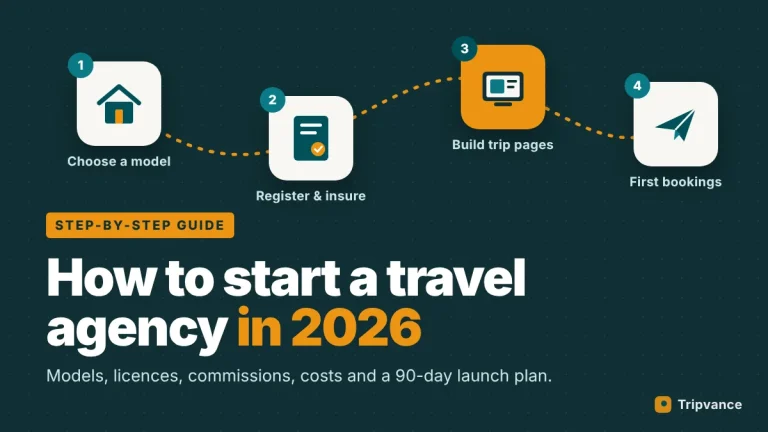
The website is where many new agents stall: a contact form is not enough if you sell packaged trips. Our tour operator software guide covers the bigger options. On WordPress, Tripvance is a free plugin that turns your trips into tour pages with itineraries and a booking request form, including a “Book via WhatsApp” button, then sends invoices and a guest pass once you confirm. It does not take online payments, which suits hosted agents whose clients pay suppliers or the host. If you would rather have the site built, we also do travel agency website design. And when you outgrow solo work, read how to start a travel agency.
Tripvance is free on WordPress.org. Publish tours, activities and transfers, receive booking requests and send invoices from your own site.
See the featuresBecoming a travel agent: quick answers
Do you need a license to become a travel agent?
No personal license exists at federal level, and certification is not required. Your business may need a Seller of Travel registration if you sell to residents of California, Florida, Washington or Hawaii, unless a host’s registration covers you.
How long does it take to become a travel agent?
You can join a host and make a first booking within a few weeks. Expect 6 to 12 months to build steady income, and several years to reach the averages experienced advisors report.
Can I become a travel agent from home with no experience?
Yes. Most hosts accept new agents and provide training. What you need is time to learn the product and a network to sell to, not prior experience.
Is a travel agent certification worth the cost?
An entry course is worth it in your first months. The CTA makes more sense after a year of selling, when it can sharpen skills you already use.
How much do new travel agents make?
Usually little in year one, because commissions arrive after clients travel. The BLS median for employed agents was 50,160 dollars in May 2025; independent income depends on your niche and how fast you build a client base.
- U.S. Bureau of Labor Statistics: Occupational Outlook Handbook, Travel Agents
- Host Agency Reviews: Travel agent license and Seller of Travel registration
- Host Agency Reviews: How much do travel agents make
- California Attorney General: Seller of Travel
- Florida FDACS: Seller of Travel registration package guide (PDF)
- Washington State Department of Licensing: Sellers of travel
- IATA / IATAN: ID card eligibility
- CLIA: Travel advisor certification
Last updated: October 2026. State rules and fees change, so confirm with the state agency before you sell.