
Driving in Morocco gives you a freedom that buses and trains cannot: a stop in a kasbah village, a detour to a viewpoint in the Atlas, a coastal road at your own pace. The motorways are modern, signs are in Arabic and French, and renting a car is easy. The adjustments are elsewhere: frequent police checks, speed radars, near-zero alcohol tolerance, animals on rural roads and busy city traffic. Here are the rules, documents and habits that make a Moroccan road trip go smoothly.
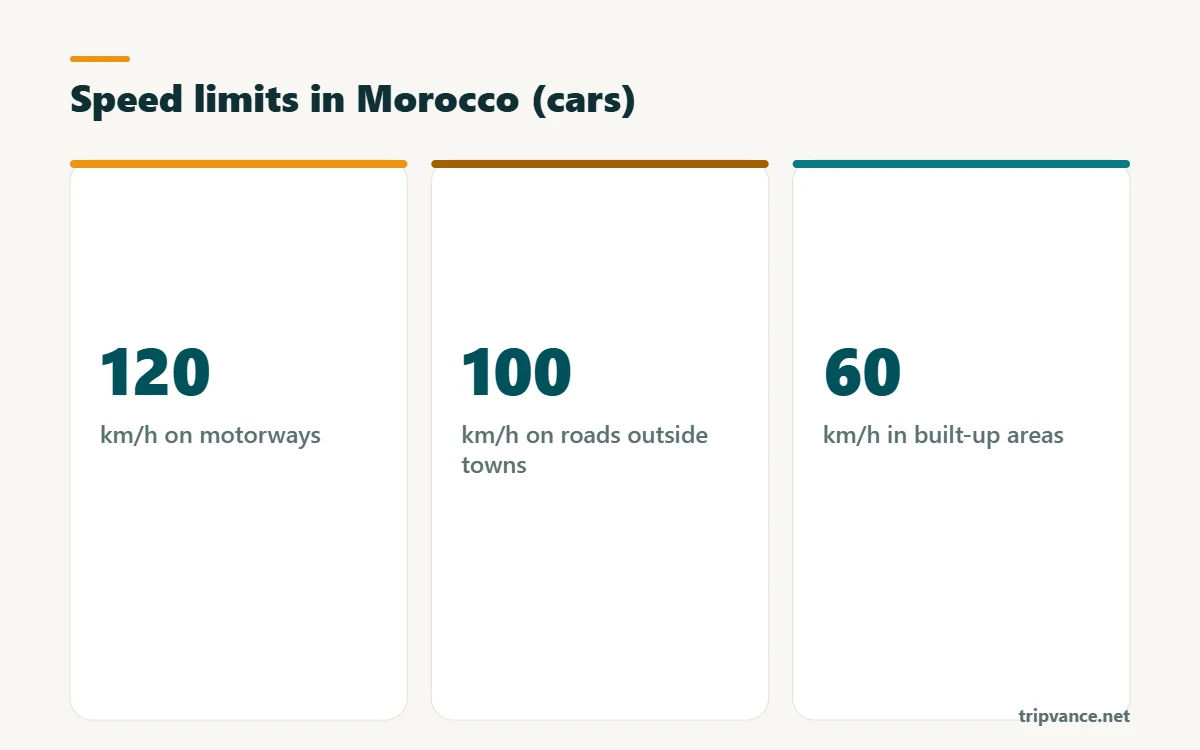
Morocco drives on the right. Visitors can drive with their national licence for up to one year; UK drivers must also carry the 1968 international driving permit. Limits for cars are 120 km/h on motorways, 100 km/h on other roads and 60 km/h in towns. The alcohol limit is so low that the only safe rule is no alcohol at all. Seat belts are compulsory in all seats.
Do you need an international driving permit?
A valid national licence is accepted for tourists for up to one year from entry. Whether you also need an international driving permit (IDP) depends on your country. The UK government states that British drivers need both their licence and the 1968 version of the IDP, and that Morocco no longer accepts the 1949 version. Rental companies may also ask for an IDP when your licence is not in Latin script. When in doubt, get one before you leave: it is cheap and only issued in your home country.
Key road rules
- Seat belts are compulsory for the driver and all passengers, front and rear. Children must travel in a suitable seat at the back.
- Phones: holding a phone while driving is an offence. Use a mount or let a passenger navigate.
- Alcohol: the legal limit, set by the Highway Code, is 0.2 g per litre of blood. That is less than one drink, so do not drink at all if you drive.
- Priority: follow the signs carefully at roundabouts and junctions; behaviour can differ from what you know at home.
- Documents: keep your passport, licence, rental contract and insurance certificate in the car at all times.
Police and Royal Gendarmerie checkpoints are frequent at town entrances and on main roads. Slow down, stop when signalled, greet the officer and show your documents. Mobile and fixed speed radars are common. Fines for minor offences are often paid on the spot: always ask for the official receipt.
Check your speed and documents
Before you drive:
Independent tool. It does not replace the Moroccan Highway Code (Law 52-05).
Renting a car in Morocco
Car rental in Morocco is available at every international airport and in all big cities, from international brands and many local agencies. Prices drop sharply outside school holidays. A few checks before signing save most of the problems people report.
- Minimum age and licence seniority: most companies ask for at least 21 years and 2 years of licence, sometimes more for bigger cars.
- Deposit: usually blocked on a credit card in the driver’s name. Debit cards are often refused.
- Insurance: read the excess (franchise) and what is excluded, such as tyres, windscreen and underbody on unpaved tracks.
- Photos and video of the car, inside and out, before you leave the car park, including the fuel level.
- Ask whether driving on tracks or in the desert is allowed, and whether a second driver is included.
Insurance, temporary admission and border tips are covered in our guide to the ferry from Spain to Morocco.
Motorways, tolls and mountain roads
The motorway network run by Autoroutes du Maroc (ADM) links Tangier, Rabat, Casablanca, Marrakech and Agadir, as well as Fès, Meknès and Oujda. Motorways are tolled: pay at the booth in cash or by card, or use the Jawaz electronic tag. Service areas with fuel and cafés are regular.
Off the motorways, the drive becomes the trip. The N9 between Marrakech and Ouarzazate crosses the Tizi n’Tichka pass at about 2,260 metres: it is well paved but winding, slow behind trucks and can close briefly after snow in winter. In the south and the Atlas, expect livestock, cyclists and pedestrians on the road, unlit verges at night and long distances between towns.
Unlit carts, animals and pedestrians are hard to see after dark. Plan your stages to arrive before sunset, and fill the tank before crossing the mountains or heading into desert areas.
Driving and parking in cities
City traffic is dense, with scooters, taxis and pedestrians everywhere. Medinas are closed to cars or simply too narrow: park outside and walk. In most streets you will meet a parking guardian, often in a reflective vest, who watches the cars; a few dirhams when you leave is the custom, and official parkings show their rates. Leave nothing visible inside the car.
Planning several stops? Our road trip planning guide helps you set realistic daily distances, and our Morocco customs guide explains the 2,000 MAD cash limit if you are budgeting for tolls and fuel.
Frequently asked questions
Can I drive in Morocco with my US licence?
Yes, foreign licences are valid for visitors for up to one year. An international driving permit is recommended and some rental companies ask for it.
Is it safe to drive in Morocco?
Main roads and motorways are in good condition. The risks come from speed, night driving in rural areas and busy cities. Drive defensively and plan daytime stages.
What is the speed limit in Morocco?
For cars: 120 km/h on motorways, 100 km/h on roads outside built-up areas and 60 km/h in towns, unless signs show a lower limit.
Are there toll roads in Morocco?
Yes, the motorways operated by ADM are tolled. You can pay in cash, by card or with the Jawaz electronic tag.
What number do I call after an accident?
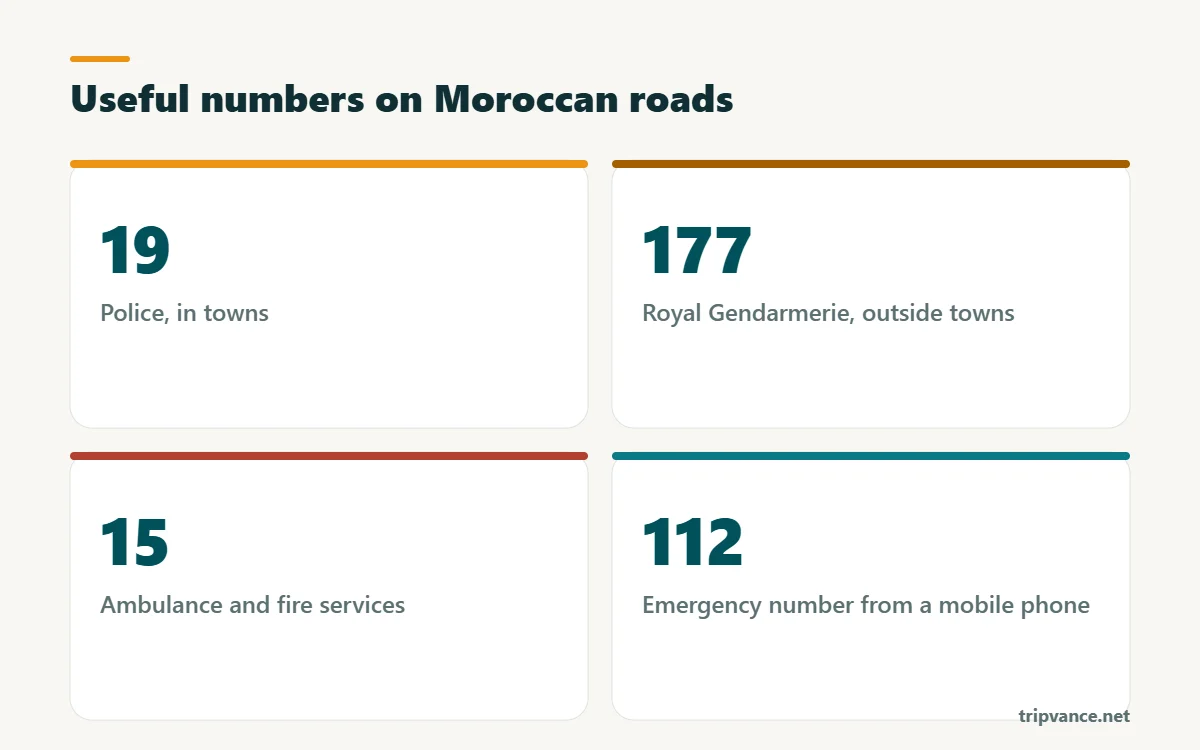
19 for the police in towns, 177 for the Royal Gendarmerie outside towns, 15 for ambulance and fire services. 112 also works from a mobile phone.
Can I rent a car in Morocco without a credit card?
Rarely. Most companies block the deposit on a credit card in the main driver’s name.
Passport validity, plug adapters, mobile data: check everything in a few clicks.
Open the travel toolsUpdated November 2026. Road rules and fines are set by Law 52-05 on the Highway Code and its implementing texts.